Bredt Sarah G T, Torres Juliana O, Diniz Laura B F, Praça Gibson M, Andrade André G P, Morales Juan C P, Rosso Tomaz L N, Chagas Mauro H
Escola de Educação Física, Fisioterapia e Terapia Ocupacional, Universidade Federal de Minas Gerais, Belo Horizonte, Brazil.
Instituto de Ciências Biológicas e da Saúde, Universidade Federal de Viçosa, Florestal, Brazil.
Biol Sport. 2020 Jun;37(2):131-138. doi: 10.5114/biolsport.2020.93038. Epub 2020 Feb 11.
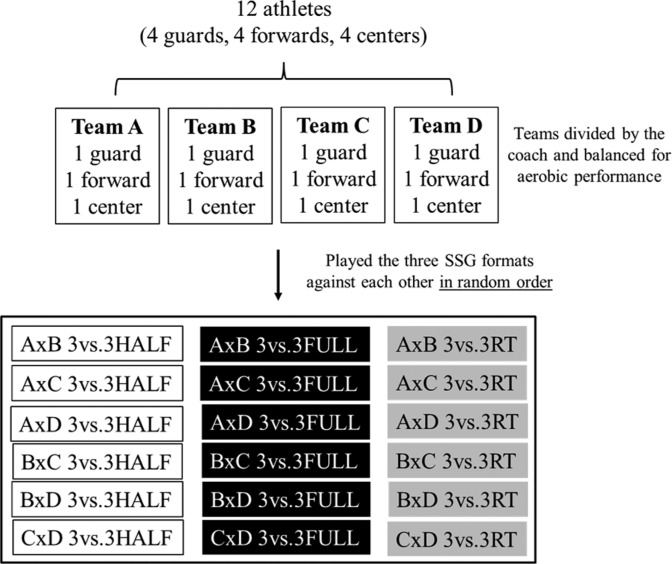
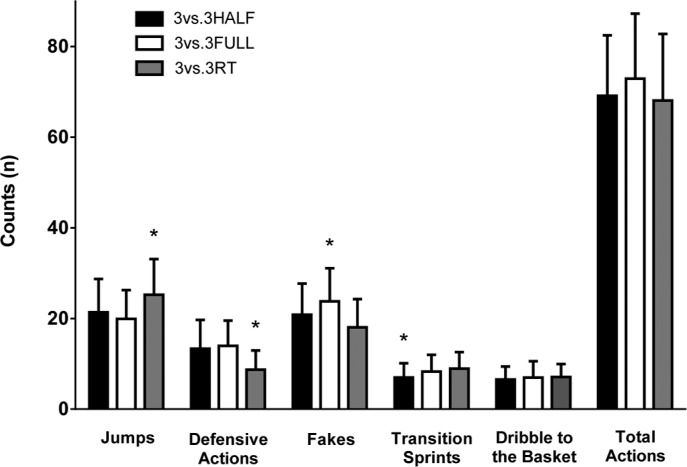
Different small-sided games (SSG) can be used by coaches to induce specific demands on athletes during team sports training. In basketball, defensive and time pressures are common stressors experienced by players during official matches. However, no studies have investigated the effect of changing these variables in SSG during training. We compared the physical and physiological demands of three basketball SSG performed in a half court with two hoops: 3vs3 with man-to-man defence in the half playing area, 3vs3 with man-to-man defence in the full playing area, and 3vs3 with a reduced shot-clock (3vs3HALF, 3vs3FULL, 3vs3RT, respectively). Twelve male U-17 basketball athletes formed four balanced teams. Each team played the three SSG against each other in a random order, totalling 18 SSG. During the SSG, the players wore triaxial accelerometers and heart rate monitors. SSG were filmed to record the players' motor actions. The results showed that 3vs3FULL (p=0.004, d=0.42, small-to-moderate effect) and 3vs3RT (p=0.026, d=0.33, small-to-moderate effect) increased the time spent in higher acceleration zones compared to 3vs3HALF. Both 3vs3FULL and 3vs3RT presented more transition sprints compared to 3vs3HALF. The 3vs3FULL also presented more fakes and the 3vs3RT presented more jumps compared to the 3vs3HALF. Physiological responses presented no differences between the SSG formats. In conclusion, defensive and time pressures increase the physical demand in 3vs3 SSG performed in the half court. The three SSG investigated in this study presented mean heart rate values close to 90% of the maximum heart rate, which suggests that these SSG may be used to increase athletes' aerobic performance.
在团队运动训练中,教练可以采用不同的小场地比赛(SSG)来对运动员施加特定要求。在篮球运动中,防守压力和时间压力是球员在正式比赛中常见的应激源。然而,尚无研究调查在训练期间改变小场地比赛中的这些变量所产生的影响。我们比较了在半场有两个篮筐的情况下进行的三种篮球小场地比赛的身体和生理需求:在半场比赛区域进行人盯人防守的3对3比赛、在全场比赛区域进行人盯人防守的3对3比赛以及缩短进攻时间的3对3比赛(分别为3vs3HALF、3vs3FULL、3vs3RT)。12名17岁以下的男性篮球运动员组成了四支实力均衡的队伍。每支队伍以随机顺序与其他队伍进行这三种小场地比赛,总共进行18场小场地比赛。在小场地比赛期间,球员佩戴三轴加速度计和心率监测器。对小场地比赛进行拍摄以记录球员的运动动作。结果表明,与3vs3HALF相比,3vs3FULL(p = 0.004,d = 0.42,小到中等效应)和3vs3RT(p = 0.026,d = 0.33,小到中等效应)增加了在更高加速度区域所花费的时间。与3vs3HALF相比,3vs3FULL和3vs3RT都出现了更多的过渡冲刺。与3vs3HALF相比,3vs3FULL还出现了更多的假动作,3vs3RT出现了更多的跳跃动作。生理反应在不同的小场地比赛形式之间没有差异。总之,防守压力和时间压力增加了在半场进行的3对3小场地比赛中的身体需求。本研究中调查的这三种小场地比赛的平均心率值接近最大心率的90%,这表明这些小场地比赛可用于提高运动员的有氧能力。