Department of Civil and Environmental Engineering and the Institute for Critical Technology and Applied Science, Center for Sustainable Nanotechnology (VTSuN), Virginia Tech, Blacksburg, USA.
J Nanobiotechnology. 2018 Nov 22;16(1):95. doi: 10.1186/s12951-018-0419-1.
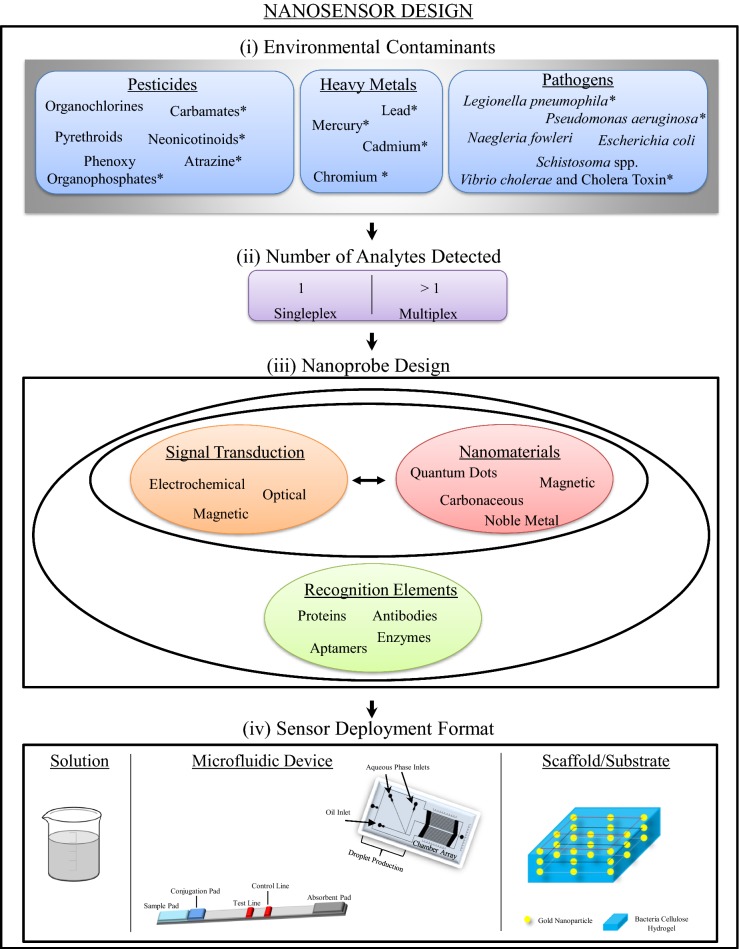
The need and desire to understand the environment, especially the quality of one's local water and air, has continued to expand with the emergence of the digital age. The bottleneck in understanding the environment has switched from being able to store all of the data collected to collecting enough data on a broad range of contaminants of environmental concern. Nanomaterial enabled sensors represent a suite of technologies developed over the last 15 years for the highly specific and sensitive detection of environmental contaminants. With the promise of facile, low cost, field-deployable technology, the ability to quantitatively understand nature in a systematic way will soon be a reality. In this review, we first introduce nanosensor design before exploring the application of nanosensors for the detection of three classes of environmental contaminants: pesticides, heavy metals, and pathogens.
随着数字时代的出现,人们对环境,尤其是当地水和空气质量的理解的需求和愿望不断扩大。对环境的理解的瓶颈已经从能够存储收集到的所有数据转变为收集足够多的关于广泛关注的环境污染物的数据。纳米材料传感器代表了过去 15 年来开发的一系列技术,用于高度特异性和敏感地检测环境污染物。由于具有易于使用、低成本、现场部署技术的承诺,定量地以系统的方式理解自然的能力将很快成为现实。在这篇综述中,我们首先介绍了纳米传感器的设计,然后探讨了纳米传感器在检测三类环境污染物中的应用:农药、重金属和病原体。