Sakai Yusuke, Islam Md Sirajul, Adamiak Martyna, Shiu Simon Chi-Chin, Tanner Julian Alexander, Heddle Jonathan Gardiner
Malopolska Centre of Biotechnology, Jagiellonian University, 30-387 Krakow, Poland.
School of Biomedical Sciences, Li Ka Shing Faculty of Medicine, The University of Hong Kong, Hong Kong, China.
Genes (Basel). 2018 Nov 23;9(12):571. doi: 10.3390/genes9120571.
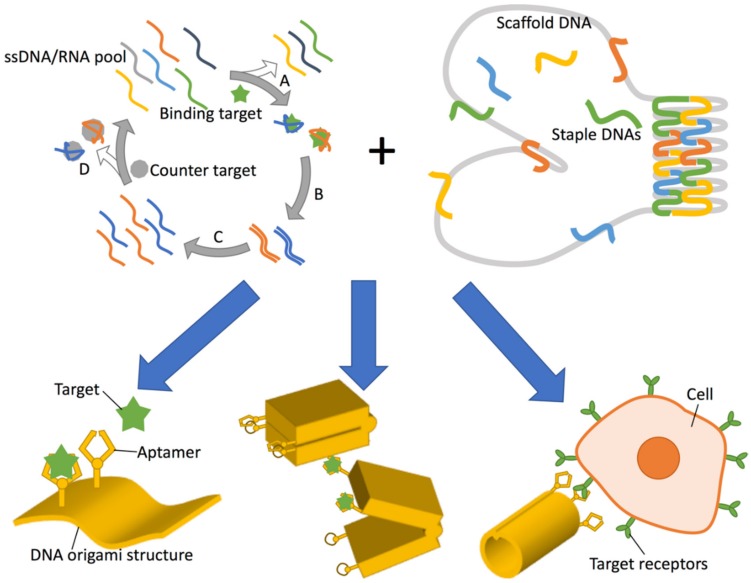
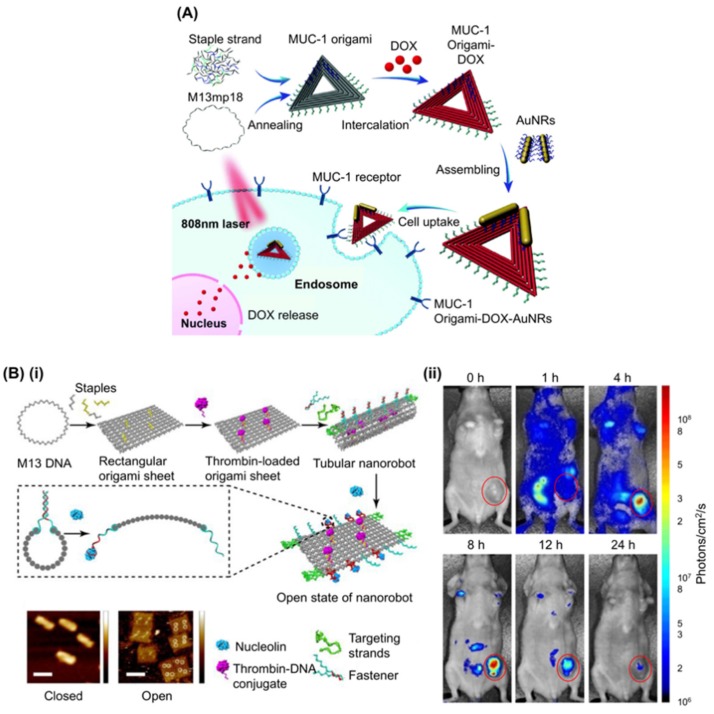
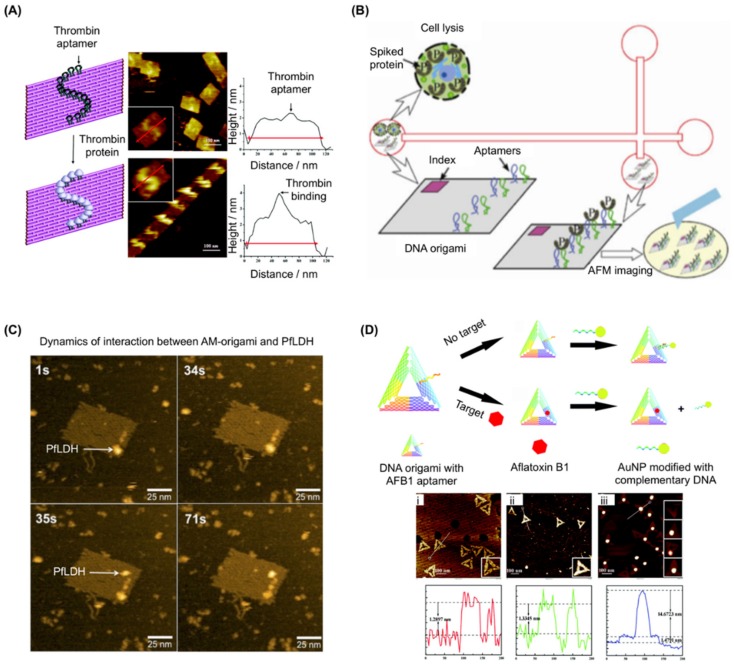
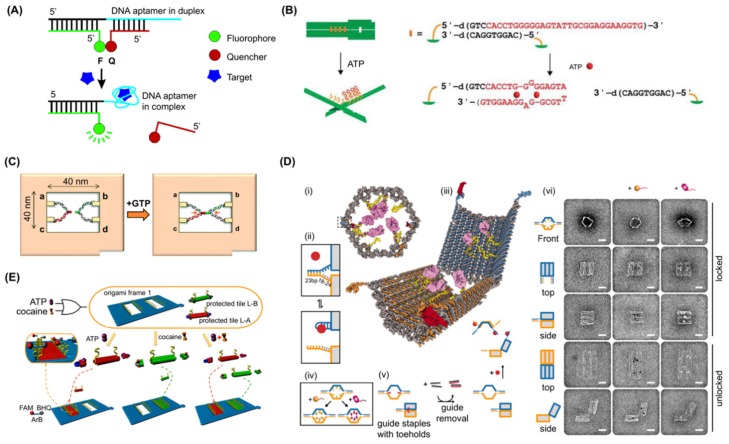
DNA origami has emerged in recent years as a powerful technique for designing and building 2D and 3D nanostructures. While the breadth of structures that have been produced is impressive, one of the remaining challenges, especially for DNA origami structures that are intended to carry out useful biomedical tasks in vivo, is to endow them with the ability to detect and respond to molecules of interest. Target molecules may be disease indicators or cell surface receptors, and the responses may include conformational changes leading to the release of therapeutically relevant cargo. Nucleic acid aptamers are ideally suited to this task and are beginning to be used in DNA origami designs. In this review, we consider examples of uses of DNA aptamers in DNA origami structures and summarise what is currently understood regarding aptamer-origami integration. We review three major roles for aptamers in such applications: protein immobilisation, triggering of structural transformation, and cell targeting. Finally, we consider future perspectives for DNA aptamer integration with DNA origami.
近年来,DNA折纸术已成为一种用于设计和构建二维及三维纳米结构的强大技术。尽管已产生的结构种类繁多令人印象深刻,但仍存在的挑战之一,尤其是对于旨在在体内执行有用生物医学任务的DNA折纸结构而言,是赋予它们检测和响应感兴趣分子的能力。目标分子可能是疾病指标或细胞表面受体,而响应可能包括导致释放治疗相关货物的构象变化。核酸适体非常适合这项任务,并开始用于DNA折纸设计中。在这篇综述中,我们考虑了DNA适体在DNA折纸结构中的使用示例,并总结了目前关于适体与折纸整合的理解。我们回顾了适体在这类应用中的三个主要作用:蛋白质固定、触发结构转变和细胞靶向。最后,我们考虑了DNA适体与DNA折纸整合的未来前景。