Geminiani Alice, Casellato Claudia, Locatelli Francesca, Prestori Francesca, Pedrocchi Alessandra, D'Angelo Egidio
NEARLab, Department of Electronics, Information and Bioengineering, Politecnico di Milano, Milan, Italy.
Department of Brain and Behavioral Sciences, University of Pavia, Pavia, Italy.
Front Neuroinform. 2018 Dec 3;12:88. doi: 10.3389/fninf.2018.00088. eCollection 2018.
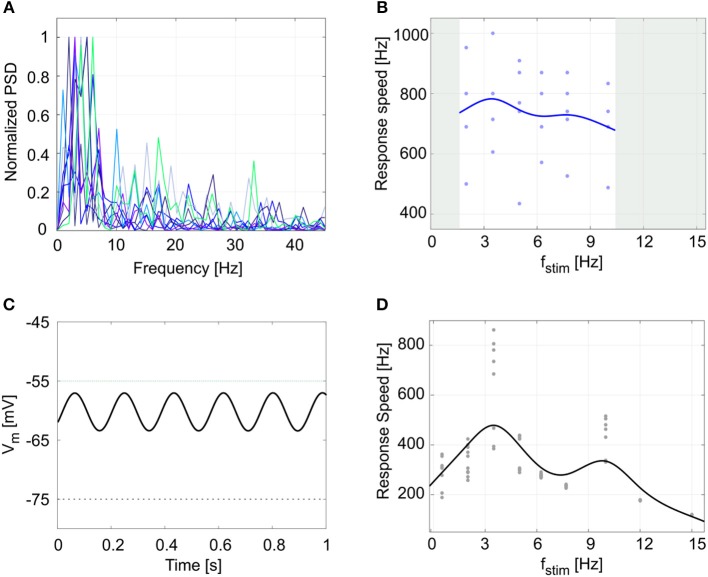
Brain neurons exhibit complex electroresponsive properties - including intrinsic subthreshold oscillations and pacemaking, resonance and phase-reset - which are thought to play a critical role in controlling neural network dynamics. Although these properties emerge from detailed representations of molecular-level mechanisms in "realistic" models, they cannot usually be generated by simplified neuronal models (although these may show spike-frequency adaptation and bursting). We report here that this whole set of properties can be generated by the (E-GLIF) neuron model. E-GLIF derives from the GLIF model family and is therefore mono-compartmental, keeps the limited computational load typical of a linear low-dimensional system, admits analytical solutions and can be tuned through gradient-descent algorithms. Importantly, E-GLIF is designed to maintain a correspondence between model parameters and neuronal membrane mechanisms through a minimum set of equations. In order to test its potential, E-GLIF was used to model a specific neuron showing rich and complex electroresponsiveness, the cerebellar Golgi cell, and was validated against experimental electrophysiological data recorded from Golgi cells in acute cerebellar slices. During simulations, E-GLIF was activated by stimulus patterns, including current steps and synaptic inputs, identical to those used for the experiments. The results demonstrate that E-GLIF can reproduce the whole set of complex neuronal dynamics typical of these neurons - including intensity-frequency curves, spike-frequency adaptation, post-inhibitory rebound bursting, spontaneous subthreshold oscillations, resonance, and phase-reset - providing a new effective tool to investigate brain dynamics in large-scale simulations.
脑神经元表现出复杂的电反应特性——包括内在阈下振荡、起搏、共振和相位重置——这些特性被认为在控制神经网络动态中起着关键作用。尽管这些特性源于“真实”模型中分子水平机制的详细表示,但它们通常不能由简化的神经元模型产生(尽管这些模型可能显示出脉冲频率适应和爆发)。我们在此报告,这整套特性可以由(E-GLIF)神经元模型产生。E-GLIF源自GLIF模型家族,因此是单室的,保持了线性低维系统典型的有限计算负荷,允许解析解,并且可以通过梯度下降算法进行调整。重要的是,E-GLIF旨在通过最少的一组方程来维持模型参数与神经元膜机制之间的对应关系。为了测试其潜力,E-GLIF被用于模拟一个表现出丰富和复杂电反应性的特定神经元,即小脑高尔基细胞,并根据从急性小脑切片中的高尔基细胞记录的实验电生理数据进行了验证。在模拟过程中,E-GLIF由与实验中使用的相同的刺激模式激活,包括电流阶跃和突触输入。结果表明,E-GLIF可以重现这些神经元典型的一整套复杂神经元动态——包括强度-频率曲线、脉冲频率适应、抑制后反弹爆发、自发阈下振荡、共振和相位重置——为在大规模模拟中研究脑动态提供了一种新的有效工具。