Department of Kinesiology and Nutrition, University of Illinois, Chicago, IL, United States of America.
Department of Kinesiology, Iowa State University, Ames, IA, United States of America.
PLoS One. 2019 Jan 7;14(1):e0210292. doi: 10.1371/journal.pone.0210292. eCollection 2019.
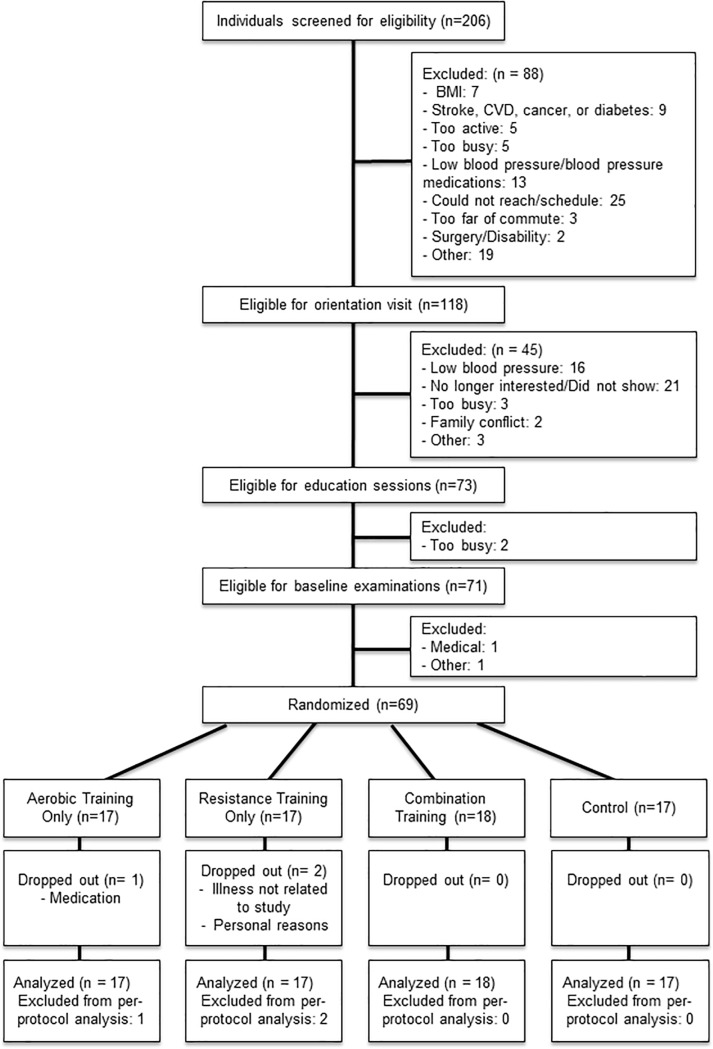
Although exercise has well-documented health benefits on cardiovascular disease (CVD), the benefit of combination exercise on CVD risk factors in individuals with elevated risk has not been fully elucidated. We compared the effects of aerobic, resistance, and a combination of both aerobic and resistance training on CVD risk factors including peripheral and central BP, cardiorespiratory fitness (CRF), muscular strength, body composition, blood glucose and lipids. Sixty-nine adults (58±7 years) with an elevated blood pressure or hypertension, overweight/obesity, and sedentary lifestyle were randomized to one of the three 8-week exercise programs or a non-exercise control group. Participants in all three exercise groups had an equal total exercise time, 3 days/week (aerobic: 60 minutes/session vs. resistance: 60 minutes/session vs. combination: aerobic 30 minutes/session plus resistance 30 minutes/session). Combined training provided significant reductions in peripheral (-4 mmHg) and central diastolic BP (-4 mmHg), increase in CRF (4.9 ml/kg/min), increase in upper (4 kg) and lower (11 kg) body strength, and increase in lean body mass (0.8 kg) (p <0.05). Aerobic training only increased CRF (7.7 ml/kg/min), and reduced body weight (-1.0 kg) and fat mass (-0.9 kg) (p <0.05). Resistance training only increased lower body strength (13 kg) and reduced waist circumference (-1.7 cm) (p <0.05). However, neither aerobic or resistance training alone showed significant reductions in BP (p>0.05). Furthermore, a composite score of CVD risk factors indicated a greater reduction with combination training compared to the control group. In conclusion, among individuals at an increased risk for CVD, as little as 8-weeks of combined training may provide more comprehensive CVD benefits compared to time-matched aerobic or resistance training alone.
尽管运动对心血管疾病(CVD)有明确的健康益处,但在有升高风险的个体中,组合运动对 CVD 风险因素的益处尚未完全阐明。我们比较了有氧运动、抗阻运动和有氧运动与抗阻运动相结合对 CVD 风险因素的影响,包括外周和中心血压、心肺适能(CRF)、肌肉力量、身体成分、血糖和血脂。69 名成年人(58±7 岁)血压升高或患有高血压、超重/肥胖和久坐不动的生活方式,随机分为三组 8 周的运动方案或非运动对照组。所有三组运动组的参与者总运动时间相等,每周 3 天(有氧运动:60 分钟/次;抗阻运动:60 分钟/次;组合运动:有氧运动 30 分钟/次加抗阻运动 30 分钟/次)。联合训练可显著降低外周(-4mmHg)和中心舒张期血压(-4mmHg),提高 CRF(4.9ml/kg/min),增加上半身(4kg)和下半身(11kg)力量,增加瘦体重(0.8kg)(p<0.05)。有氧运动仅增加 CRF(7.7ml/kg/min),降低体重(-1.0kg)和体脂(-0.9kg)(p<0.05)。抗阻运动仅增加下半身力量(13kg),降低腰围(-1.7cm)(p<0.05)。然而,单独的有氧运动或抗阻运动均未显著降低血压(p>0.05)。此外,与对照组相比,CVD 风险因素的综合评分表明联合训练的降低幅度更大。结论:在 CVD 风险增加的个体中,与单独的时间匹配的有氧运动或抗阻运动相比,仅 8 周的联合训练可能提供更全面的 CVD 益处。