Ministry of Education Key Laboratory for Earth System Modeling, Department of Earth System Science, Tsinghua University, Beijing 100084, China.
Joint Center for Global Change Studies, Beijing 100875, China.
Int J Environ Res Public Health. 2019 Jan 14;16(2):222. doi: 10.3390/ijerph16020222.
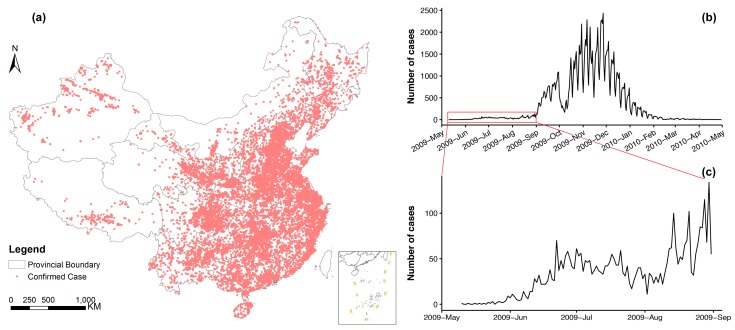
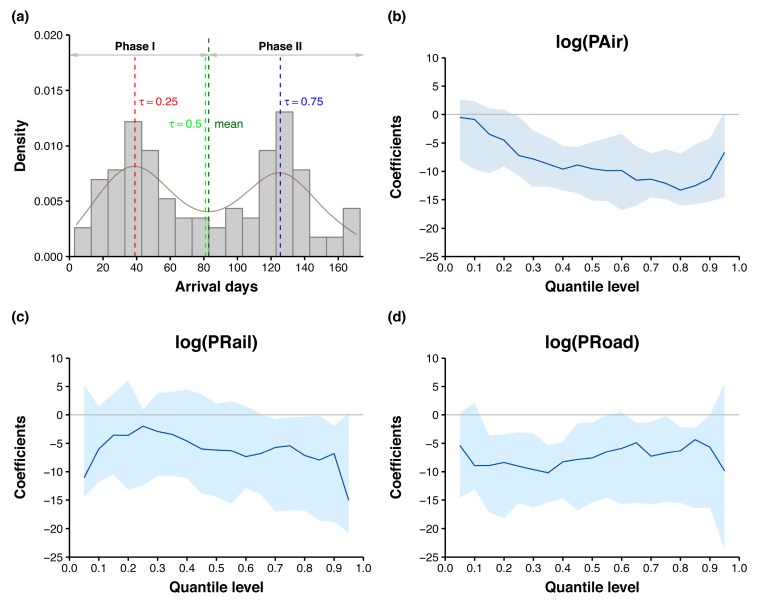
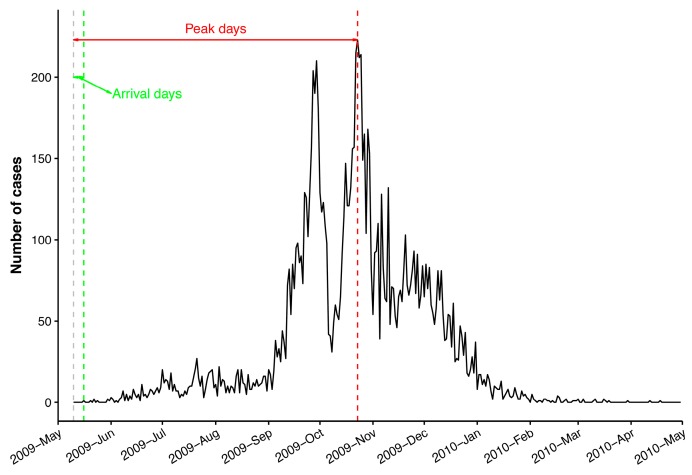
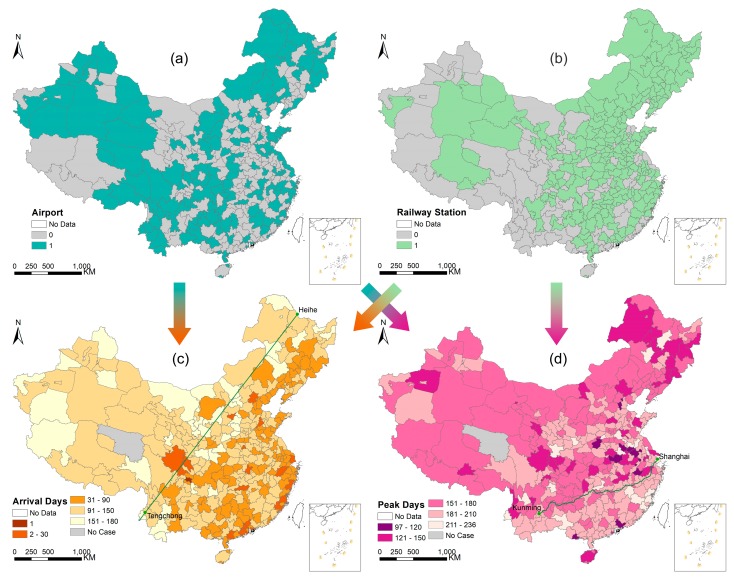
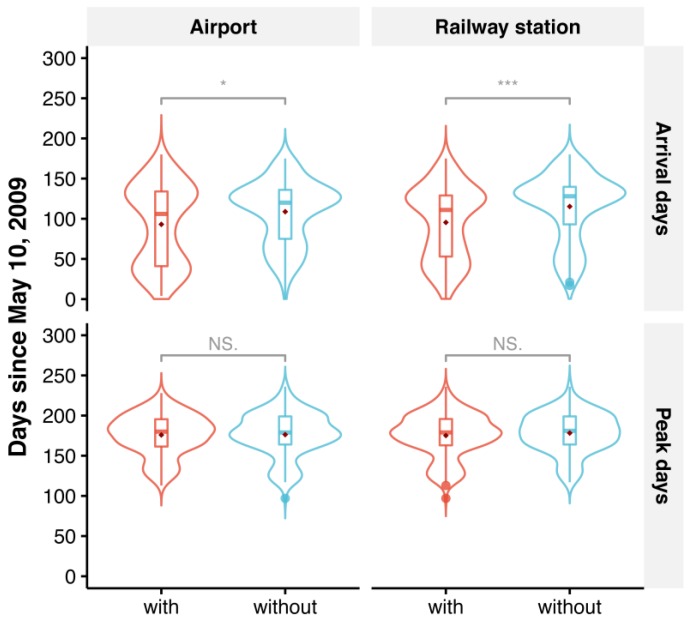
There is increasing concern about another influenza pandemic in China. However, the understanding of the roles of transport modes in the 2009 influenza A(H1N1) pandemic spread across mainland China is limited. Herein, we collected 127,797 laboratory-confirmed cases of influenza A(H1N1)pdm09 in mainland China from May 2009 to April 2010. Arrival days and peak days were calculated for all 340 prefectures to characterize the dissemination patterns of the pandemic. We first evaluated the effects of airports and railway stations on arrival days and peak days, and then we applied quantile regressions to quantify the relationships between arrival days and air, rail, and road travel. Our results showed that early arrival of the virus was not associated with an early incidence peak. Airports and railway stations in prefectures significantly advanced arrival days but had no significant impact on peak days. The pandemic spread across mainland China from the southeast to the northwest in two phases that were split at approximately 1 August 2009. Both air and road travel played a significant role in accelerating the spread during phases I and II, but rail travel was only significant during phase II. In conclusion, in addition to air and road travel, rail travel also played a significant role in accelerating influenza A(H1N1)pdm09 spread between prefectures. Establishing a multiscale mobility network that considers the competitive advantage of rail travel for mid to long distances is essential for understanding the influenza pandemic transmission in China.
人们越来越担心中国会再次爆发流感大流行。然而,对于 2009 年甲型 H1N1 流感在中国大陆的传播中,各种交通方式所扮演的角色,人们的了解十分有限。在此,我们收集了中国大陆 2009 年 5 月至 2010 年 4 月期间的 127797 例甲型 H1N1pdm09 实验室确诊病例。我们计算了所有 340 个地级市的到达日和高峰期,以描述疫情的传播模式。我们首先评估了机场和火车站对到达日和高峰期的影响,然后应用分位数回归来量化到达日与航空、铁路和公路旅行之间的关系。结果表明,病毒的早期到达与发病高峰的提前到来无关。机场和火车站所在地的地级市显著提前了到达日,但对高峰期没有显著影响。此次流感大流行从东南向西北分两个阶段在 2009 年 8 月 1 日左右传播到中国大陆各地。在第一阶段和第二阶段,航空和公路旅行都在加速疫情传播方面发挥了重要作用,但铁路旅行仅在第二阶段显著。总之,除了航空和公路旅行外,铁路旅行也在加速甲型 H1N1pdm09 在各省市之间的传播中发挥了重要作用。建立一个多尺度的流动网络,考虑到铁路旅行在中长途旅行方面的竞争优势,对于理解中国的流感大流行传播至关重要。