Department of Molecular and Internal Medicine, Institute of Biomedical and Health Sciences, Hiroshima University, Hiroshima, Japan.
J Diabetes Investig. 2019 Sep;10(5):1229-1236. doi: 10.1111/jdi.13010. Epub 2019 Feb 19.
AIMS/INTRODUCTION: Our previous survey of two Japanese populations, with different lifestyles but identical genetic dispositions, showed that Japanese Americans had different dietary intakes and higher prevalences of obesity and diabetes mellitus, compared with the native Japanese population. The present study examined whether Westernized dietary habits could affect the development of obesity or diabetes.
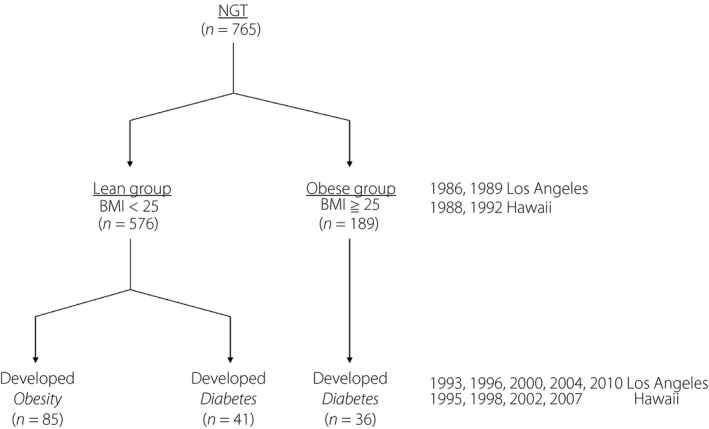
This study included 765 individuals with normal glucose tolerance at baseline medical examinations (1986 or 1989 in Los Angeles and in 1988 or 1992 in Hawaii) who subsequently completed follow-up medical examinations several years later. The participants were categorized at baseline as "lean" (576 individuals, body mass index of <25 kg/m ) or "obese" (189 individuals, body mass index of ≥25 kg/m ). Nutrient intakes were analyzed for associations with the development of obesity or diabetes using Cox's proportional hazard model.
A total of 41 lean participants developed diabetes, which was not associated with any nutrient intakes (mean follow up 10.8 ± 6.6 years). A total of 36 obese participants developed diabetes, which was positively associated with intakes of animal protein, animal fat and saturated fatty acid (mean follow up 10.7 ± 6.3 years). A total of 85 lean participants became obese, which was positively associated with intakes of simple carbohydrates, sugar and fructose, as well as inversely associated with intakes of vegetable protein and complex carbohydrates (mean follow up 10.4 ± 6.5 years).
In the Japanese Americans, different nutrient intakes affected the development of obesity and diabetes. Furthermore, the associations of nutrient intakes with diabetes development varied according to the presence or absence of obesity.
目的/引言:我们之前对两个具有不同生活方式但具有相同遗传特征的日本人群进行了调查,结果表明,与日本本土人群相比,美籍日本人的饮食摄入不同,肥胖症和糖尿病的患病率更高。本研究旨在探讨西方化的饮食习惯是否会影响肥胖或糖尿病的发生。
本研究共纳入了 765 名在基线体检时血糖正常的个体(1986 年或 1989 年在洛杉矶,1988 年或 1992 年在夏威夷),随后在几年后完成了随访体检。根据基线时的身体质量指数(BMI),参与者分为“瘦”组(576 人,BMI<25kg/m²)或“肥胖”组(189 人,BMI≥25kg/m²)。采用 Cox 比例风险模型分析了营养摄入与肥胖或糖尿病发展的关系。
共有 41 名瘦参与者发生了糖尿病,这与任何营养素摄入均无关(平均随访时间为 10.8±6.6 年)。共有 36 名肥胖参与者发生了糖尿病,这与动物蛋白、动物脂肪和饱和脂肪酸的摄入呈正相关(平均随访时间为 10.7±6.3 年)。共有 85 名瘦参与者发生了肥胖,这与简单碳水化合物、糖和果糖的摄入呈正相关,与蔬菜蛋白和复杂碳水化合物的摄入呈负相关(平均随访时间为 10.4±6.5 年)。
在美籍日本人中,不同的营养素摄入影响肥胖和糖尿病的发生。此外,营养素摄入与糖尿病发展的相关性取决于是否存在肥胖。