Nutrition Division, World Food Programme, Rome, Italy.
Friedman School of Nutrition Science and Policy, Tufts University, Boston, Massachusetts, USA.
Matern Child Nutr. 2019 Jul;15(3):e12793. doi: 10.1111/mcn.12793. Epub 2019 Feb 27.
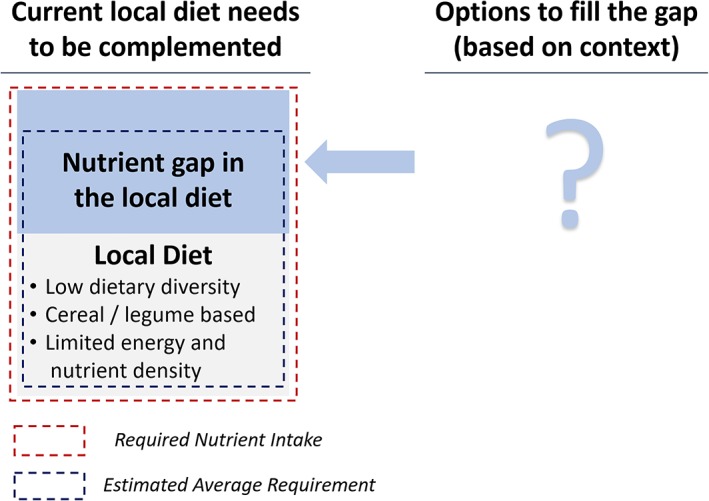
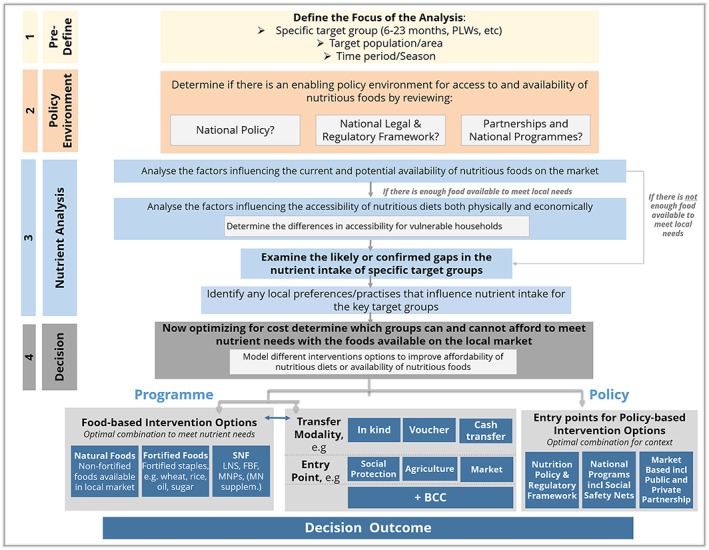
Improved nutrition situation analysis can increase the understanding of the likely magnitude and main causes of the nutrient gap among a particular target group, for example, children under 2 or pregnant and lactating women, in a particular context. The World Food Programme, with input from University of California Davis, International Food Policy Research Institute, Epicentre, Harvard University, Mahidol University, Save the Children, and UNICEF, has developed a framework for strengthened nutrition situation analysis and decision making called the "Fill the Nutrient Gap" (FNG), which aims to support identification of strategies to increase availability, access, and choice of nutritious foods, to ultimately improve nutrient intake. The FNG engages stakeholders from different sectors throughout the analytical process to provide input and discuss findings to collectively identify and prioritize context-specific strategies. The FNG analysis contributes to better understanding the nutrition situation because it (a) focuses on the dietary intake side of the malnutrition framework and analyses in-depth the nutrient intake of different target groups; (b) linear programming is used in combination with review of secondary data to characterize barriers to nutrient intake, in particular to understand the availability, cost and affordability of nutritious diets for households and target groups with higher nutritional needs, and model potential interventions to improve them; (c) it links the nutrition situation analysis to decision making by providing an evidence base for decision makers to inform their strategies; (d) it facilitates multisectoral discussion on barriers to nutrient intake and enables a prioritization of context-specific strategies (both nutrition specific and sensitive) to improve the nutrition situation across food, health, and social protection systems.
改善营养状况分析可以提高对特定目标群体(例如,2 岁以下儿童或孕妇和哺乳期妇女)在特定背景下营养素差距的可能程度和主要原因的理解。世界粮食计划署在加利福尼亚大学戴维斯分校、国际粮食政策研究所、生态中心、哈佛大学、玛希隆大学、拯救儿童组织和儿基会的协助下,制定了一个名为“填补营养缺口”(FNG)的强化营养状况分析和决策框架,旨在支持确定增加营养食品的供应、获取和选择的战略,最终改善营养素摄入。FNG 让不同部门的利益相关者参与整个分析过程,提供投入并讨论发现,以共同确定和优先考虑具体情况的战略。FNG 分析有助于更好地了解营养状况,因为它:(a) 侧重于营养不良框架的饮食摄入方面,并深入分析不同目标群体的营养素摄入情况;(b) 线性规划与二次数据审查相结合,以确定营养素摄入的障碍,特别是了解对营养需求较高的家庭和目标群体的营养饮食的供应、成本和可负担性,并模拟潜在的干预措施来改善它们;(c) 通过为决策者提供决策依据,将营养状况分析与决策联系起来;(d) 促进多部门讨论营养素摄入的障碍,并能够对改善整个食品、健康和社会保护系统的营养状况的具体情况的战略(营养特定和敏感)进行优先排序。