Research Center for Experimental Orthopaedics, Heidelberg University Hospital, Germany, Schlierbacher Landstr. 200a, 69118 Heidelberg, Germany.
Center of Orthopaedic and Trauma Surgery/Spinal Cord Injury Center, Heidelberg University Hospital, Germany, Schlierbacher Landstr. 200a, 69118 Heidelberg, Germany.
Int J Mol Sci. 2019 Feb 2;20(3):653. doi: 10.3390/ijms20030653.
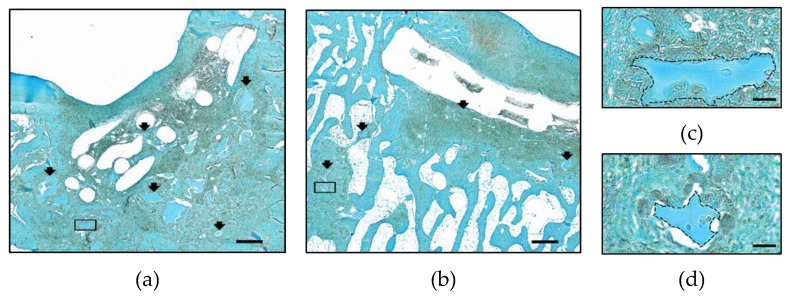
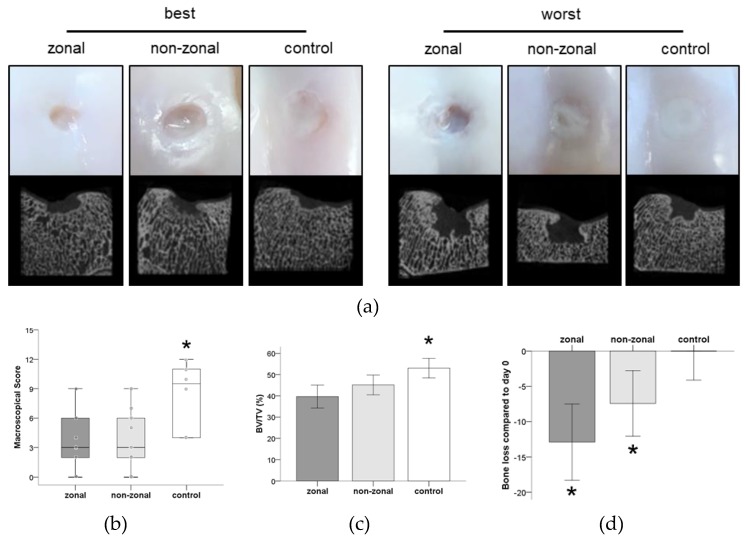
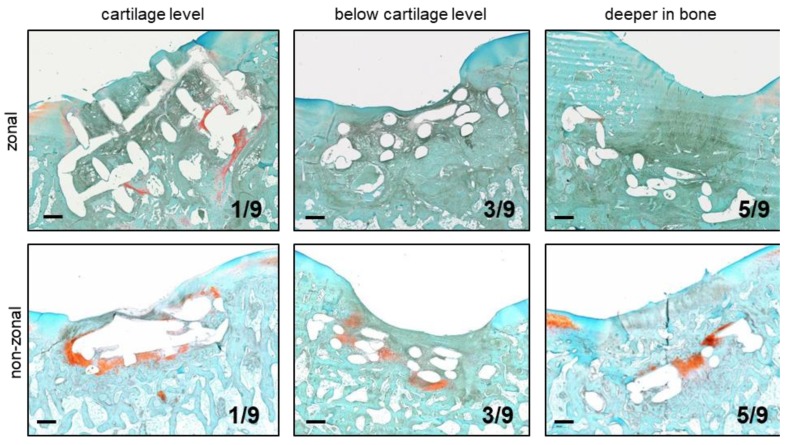
Despite advances in cartilage repair strategies, treatment of focal chondral lesions remains an important challenge to prevent osteoarthritis. Articular cartilage is organized into several layers and lack of zonal organization of current grafts is held responsible for insufficient biomechanical and biochemical quality of repair-tissue. The aim was to develop a zonal approach for cartilage regeneration to determine whether the outcome can be improved compared to a non-zonal strategy. Hydrogel-filled polycaprolactone (PCL)-constructs with a chondrocyte-seeded upper-layer deemed to induce hyaline cartilage and a mesenchymal stromal cell (MSC)-containing bottom-layer deemed to induce calcified cartilage were compared to chondrocyte-based non-zonal grafts in a minipig model. Grafts showed comparable hardness at implantation and did not cause visible signs of inflammation. After 6 months, X-ray microtomography (µCT)-analysis revealed significant bone-loss in both treatment groups compared to empty controls. PCL-enforcement and some hydrogel-remnants were retained in all defects, but most implants were pressed into the subchondral bone. Despite important heterogeneities, both treatments reached a significantly lower modified O'Driscoll-score compared to empty controls. Thus, PCL may have induced bone-erosion during joint loading and misplacement of grafts in vivo precluding adequate permanent orientation of zones compared to surrounding native cartilage.
尽管软骨修复策略取得了进展,但治疗局灶性软骨病变仍然是预防骨关节炎的一个重要挑战。关节软骨分为几个层次,目前移植物缺乏区带组织,这被认为是修复组织生物力学和生化质量不足的原因。本研究旨在开发一种用于软骨再生的区带方法,以确定与非区带策略相比,其结果是否可以得到改善。在小型猪模型中,将含有细胞种子的上层(被认为能诱导透明软骨)和含有间充质基质细胞(MSC)的下层(被认为能诱导钙化软骨)的水凝胶填充聚己内酯(PCL)构建物与基于细胞的非区带移植物进行了比较。植入时,移植物的硬度相当,且没有引起明显的炎症迹象。6 个月后,X 射线微断层扫描(µCT)分析显示,与空对照组相比,所有治疗组的骨丢失都显著。所有缺损中均保留了 PCL 增强和一些水凝胶残余物,但大多数植入物被压入软骨下骨。尽管存在重要的异质性,但与空对照组相比,两种治疗方法的改良 O'Driscoll 评分均显著降低。因此,PCL 可能在关节负载期间导致骨侵蚀,并导致体内移植物错位,与周围天然软骨相比,不能充分永久定向区带。