Department of Epidemiology, Erasmus MC, University Medical Centre, PO Box 2040, 3000 CA, Rotterdam, The Netherlands.
Leiden University College, The Hague, The Netherlands.
Eur J Nutr. 2020 Mar;59(2):493-504. doi: 10.1007/s00394-019-01918-5. Epub 2019 Feb 8.
Several studies have reported seasonal variation in intake of food groups and certain nutrients. However, whether this could lead to a seasonal pattern of diet quality has not been addressed. We aimed to describe the seasonality of diet quality, and to examine the contribution of the food groups included in the dietary guidelines to this seasonality.
Among 9701 middle-aged and elderly participants of the Rotterdam Study, a prospective population-based cohort, diet was assessed using food-frequency questionnaires (FFQ). Diet quality was measured as adherence to the Dutch dietary guidelines, and expressed in a diet quality score ranging from 0 to 14 points. The seasonality of diet quality and of the food group intake was examined using cosinor linear mixed models. Models were adjusted for sex, age, cohort, energy intake, physical activity, body mass index, comorbidities, and education.
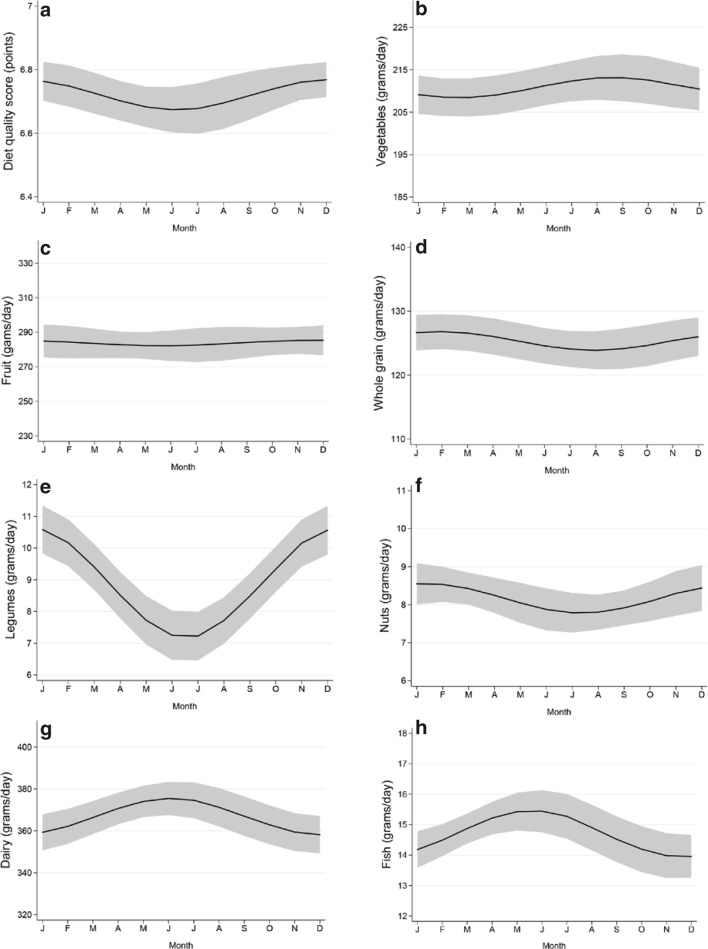
Diet quality had a seasonal pattern with a winter-peak (seasonal variation = 0.10 points, December-peak) especially among participants who were men, obese and of high socio-economic level. This pattern was mostly explained by the seasonal variation in the intake of legumes (seasonal variation = 3.52 g/day, December-peak), nuts (seasonal variation = 0.78 g/day, January-peak), sugar-containing beverages (seasonal variation = 12.96 milliliters/day, June-peak), and dairy (seasonal variation = 17.52 g/day, June-peak).
Diet quality varies seasonally with heterogeneous seasonality of food groups counteractively contributing to the seasonal pattern in diet quality. This seasonality should be considered in future research on dietary behavior. Also, season-specific recommendations and policies are required to improve diet quality throughout the year.
几项研究报告称,食物组和某些营养素的摄入量存在季节性变化。然而,这是否会导致饮食质量的季节性模式尚不清楚。我们旨在描述饮食质量的季节性,并研究膳食指南中包含的食物组对这种季节性的贡献。
在鹿特丹研究(一项前瞻性的基于人群的队列研究)的 9701 名中年和老年人参与者中,使用食物频率问卷(FFQ)评估饮食。饮食质量通过遵守荷兰饮食指南来衡量,并表示为 0 到 14 分的饮食质量评分。使用余弦线性混合模型检查饮食质量和食物组摄入量的季节性。模型调整了性别、年龄、队列、能量摄入、身体活动、体重指数、合并症和教育。
饮食质量具有季节性模式,冬季峰值(季节性变化= 0.10 分,12 月峰值),尤其是男性、肥胖和社会经济水平较高的参与者。这种模式主要由豆类(季节性变化= 3.52 克/天,12 月峰值)、坚果(季节性变化= 0.78 克/天,1 月峰值)、含糖饮料(季节性变化= 12.96 毫升/天,6 月峰值)和乳制品(季节性变化= 17.52 克/天,6 月峰值)摄入量的季节性变化解释。
饮食质量随季节变化而变化,食物组的季节性存在差异,对饮食质量的季节性模式产生相反的影响。在未来的饮食行为研究中应考虑这种季节性。还需要制定特定季节的建议和政策,以改善全年的饮食质量。