Center for Health Economics Research Hannover (CHERH), Leibniz University Hannover, Otto-Brenner-Straße 1, 30159, Hannover, Germany.
BMC Geriatr. 2019 Mar 13;19(1):82. doi: 10.1186/s12877-019-1068-4.
Informal caregivers are an essential pillar for ensuring and maintaining the outpatient care of the frail elderly. Due to demographic changes, including an increase in the number of people in need of care as well as changing social structures (full-time employment of women, increasing number of single households, etc.) these informal care structures are fraught by considerable challenges. To support and facilitate informal caregivers in their role of nursing, it is important to identify their preferences, needs, and thus create a preference-oriented system.
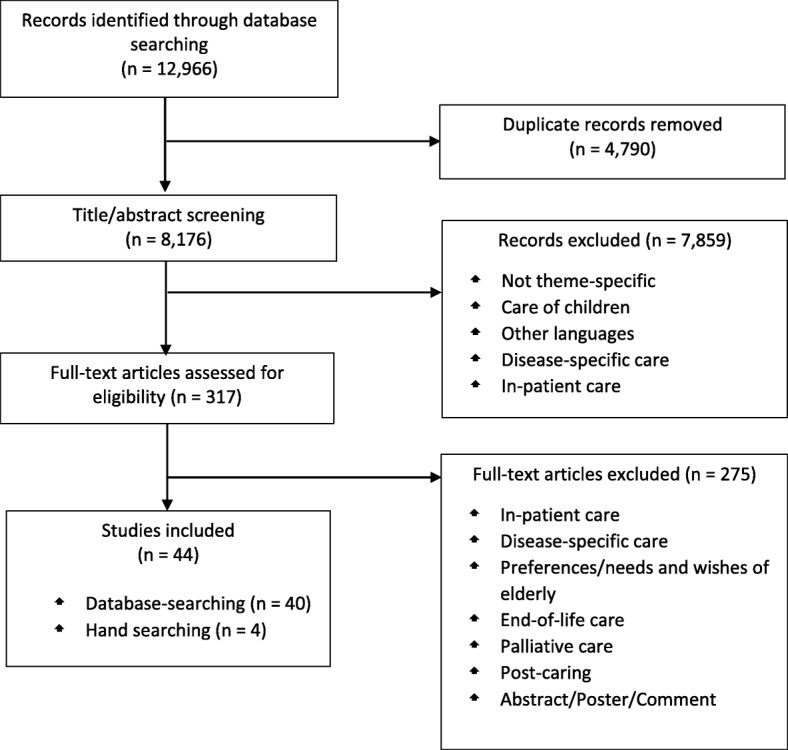
A systematic review was conducted to identify preferences and needs regarding the organization of informal care. The database searches were performed by using EMBASE, Scopus and Dimdi.
A total of 44 studies were included in the present review. Studies from 17 different countries provide broad international perspectives. Besides the preferences for long-term care structure, the following four principal topics were identified: (1) informational needs; (2) support needs; (3) organizational needs, and (4) needs for societal recognition.
To meet the current challenges in the outpatient or home-based care of elders, it is essential to strengthen the role of informal caregivers. Therefore, it is necessary to adopt and further develop informal care structures according to the needs of informal caregivers. However, demographic, financial and cultural aspects of each country need to be considered as these may influence the preferences and needs of informal caregivers.
非正式护理人员是确保和维持体弱老年人门诊护理的重要支柱。由于人口结构变化,包括需要护理的人数增加以及社会结构的变化(女性全职就业、单身家庭增多等),这些非正式护理结构面临着相当大的挑战。为了支持和促进非正式护理人员履行护理职责,了解他们的偏好、需求,并由此创建一个以偏好为导向的系统是很重要的。
本研究进行了系统综述,以确定关于非正式护理组织的偏好和需求。数据库检索通过 EMBASE、Scopus 和 Dimdi 进行。
本综述共纳入 44 项研究。来自 17 个不同国家的研究提供了广泛的国际视角。除了对长期护理结构的偏好外,还确定了以下四个主要主题:(1)信息需求;(2)支持需求;(3)组织需求;(4)社会认可需求。
为了应对目前老年人门诊或家庭护理的挑战,必须加强非正式护理人员的作用。因此,有必要根据非正式护理人员的需求来采用和进一步发展非正式护理结构。然而,每个国家的人口、财务和文化方面都需要考虑在内,因为这些因素可能会影响非正式护理人员的偏好和需求。