Centre for Infectious Disease Control, National Institute for Public Health and the Environment (RIVM), 3721 MA Bilthoven, The Netherlands.
Section Pediatric Infectious Diseases, Laboratory of Medical Immunology, Radboud Institute for Molecular Life Sciences, Radboudumc, 6525 GA Nijmegen, The Netherlands.
Viruses. 2019 Mar 12;11(3):243. doi: 10.3390/v11030243.
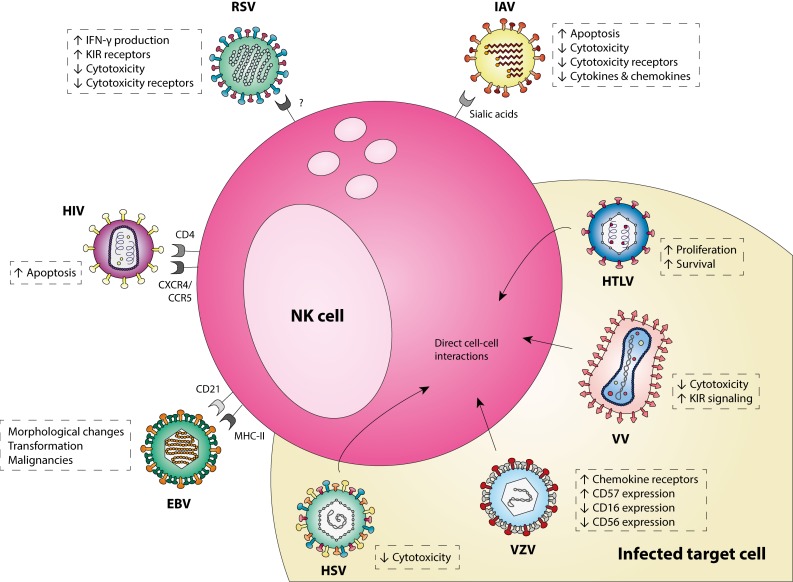
Natural killer (NK) cells are essential in the early immune response against viral infections, in particular through clearance of virus-infected cells. In return, viruses have evolved multiple mechanisms to evade NK cell-mediated viral clearance. Several unrelated viruses, including influenza virus, respiratory syncytial virus, and human immunodeficiency virus, can directly interfere with NK cell functioning through infection of these cells. Viral infection can lead to immune suppression, either by downregulation of the cytotoxic function or by triggering apoptosis, leading to depletion of NK cells. In contrast, some viruses induce proliferation or changes in the morphology of NK cells. In this review article, we provide a comprehensive overview of the viruses that have been reported to infect NK cells, we discuss their mechanisms of entry, and describe the interference with NK cell effector function and phenotype. Finally, we discuss the contribution of virus-infected NK cells to viral load. The development of specific therapeutics, such as viral entry inhibitors, could benefit from an enhanced understanding of viral infection of NK cells, opening up possibilities for the prevention of NK cell infection.
自然杀伤 (NK) 细胞在针对病毒感染的早期免疫反应中至关重要,特别是通过清除病毒感染的细胞。作为回报,病毒已经进化出多种机制来逃避 NK 细胞介导的病毒清除。几种不相关的病毒,包括流感病毒、呼吸道合胞病毒和人类免疫缺陷病毒,都可以通过感染这些细胞直接干扰 NK 细胞的功能。病毒感染会导致免疫抑制,要么通过细胞毒性功能的下调,要么通过触发细胞凋亡,导致 NK 细胞耗竭。相比之下,一些病毒会诱导 NK 细胞的增殖或形态变化。在这篇综述文章中,我们全面概述了已报道感染 NK 细胞的病毒,讨论了它们的进入机制,并描述了对 NK 细胞效应功能和表型的干扰。最后,我们讨论了感染病毒的 NK 细胞对病毒载量的贡献。开发特定的治疗方法,如病毒进入抑制剂,可能会受益于对 NK 细胞感染的深入了解,为预防 NK 细胞感染开辟了可能性。