Department of Molecular Biosciences, University of Texas at Austin, Austin, Texas, USA.
Department of Microbiology and Molecular Genetics, Michigan State University, East Lansing, Michigan, USA.
mBio. 2019 Mar 19;10(2):e00316-19. doi: 10.1128/mBio.00316-19.
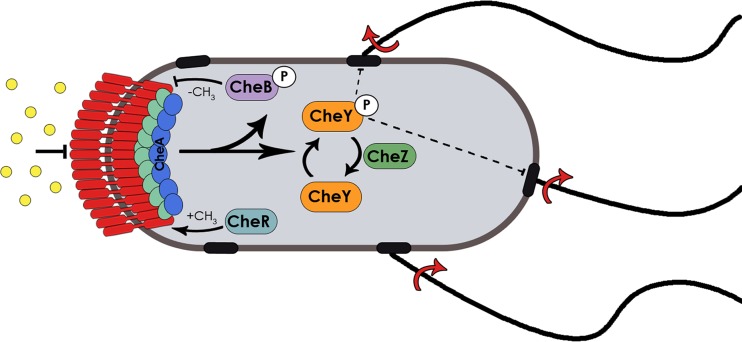
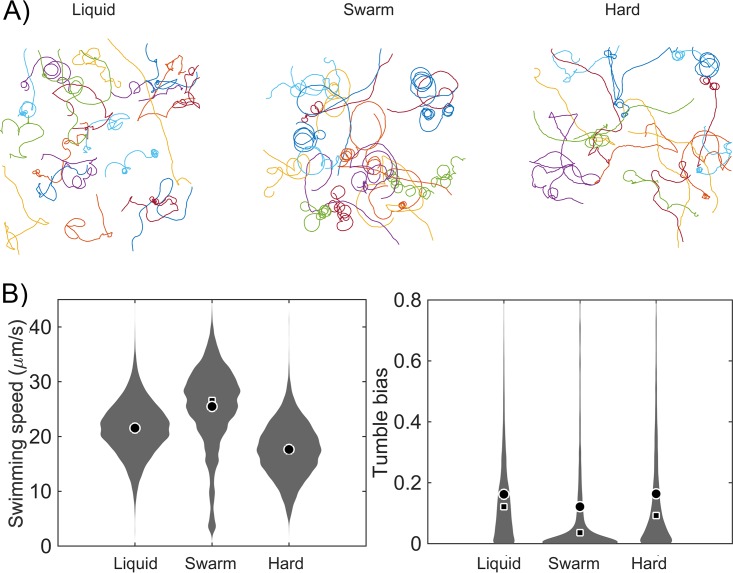
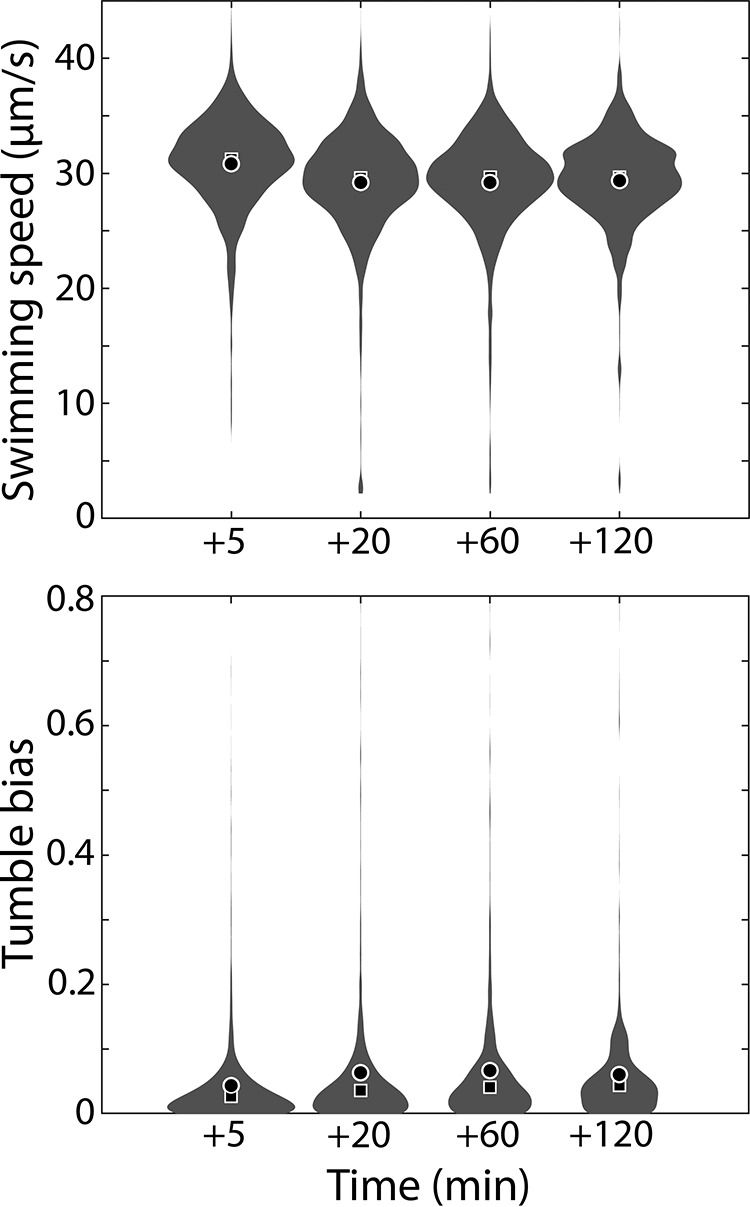
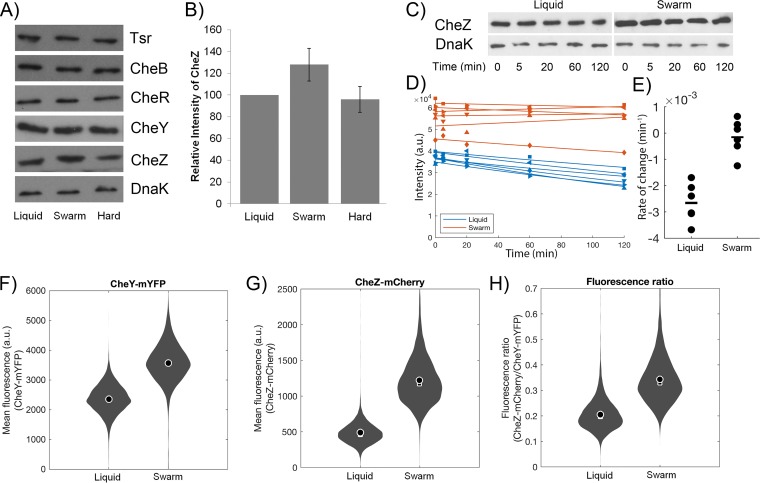
Many flagellated bacteria "swarm" over a solid surface as a dense consortium. In different bacteria, swarming is facilitated by several alterations such as those corresponding to increased flagellum numbers, special stator proteins, or secreted surfactants. We report here a change in the chemosensory physiology of swarming which alters its normal "run tumble" bias. bacteria taken from a swarm exhibit more highly extended runs (low tumble bias) and higher speeds than bacteria swimming individually in a liquid medium. The stability of the signaling protein CheZ is higher in swarmers, consistent with the observed elevation of CheZ levels and with the low tumble bias. We show that the tumble bias displayed by wild-type swarmers is the optimal bias for maximizing swarm expansion. In assays performed in liquid, swarm cells have reduced chemotactic performance. This behavior is specific to swarming, is not specific to growth on surfaces, and persists for a generation. Therefore, the chemotaxis signaling pathway is reprogrammed for swarming. The fundamental motile behavior of is a random walk, where straight "runs" are punctuated by "tumbles." This behavior, conferred by the chemotaxis signaling system, is used to track chemical gradients in liquid. Our study results show that when migrating collectively on surfaces, modifies its chemosensory physiology to decrease its tumble bias (and hence to increase run durations) by post-transcriptional changes that alter the levels of a key signaling protein. We speculate that the low tumble bias may contribute to the observed Lévy walk (LW) trajectories within the swarm, where run durations have a power law distribution. In animals, LW patterns are hypothesized to maximize searches in unpredictable environments. Swarming bacteria face several challenges while moving collectively over a surface-maintaining cohesion, overcoming constraints imposed by a physical substrate, searching for nutrients as a group, and surviving lethal levels of antimicrobials. The altered chemosensory behavior that we describe in this report may help with these challenges.
许多鞭毛细菌在固体表面上密集地聚集在一起,形成一个 consortium。在不同的细菌中,通过几种改变来促进群体运动,例如增加鞭毛数量、特殊的定子蛋白或分泌的表面活性剂。我们在这里报告了群体运动中化学感觉生理学的改变,这种改变改变了其正常的“跑-转”偏向。从群体中分离出来的细菌表现出更长的延伸跑(低转偏向)和比在液体培养基中单独游动的细菌更高的速度。信号蛋白 CheZ 的稳定性在群体运动者中更高,这与观察到的 CheZ 水平升高以及低转偏向一致。我们表明,野生型群体运动者表现出的转偏向是最大化群体扩展的最佳偏向。在液体中进行的测定中,群体细胞的趋化性表现降低。这种行为是群体运动特有的,不是在表面生长特有的,并且持续一代。因此,趋化信号通路被重新编程以适应群体运动。 的基本运动行为是随机漫步,其中直“跑”被“转”打断。这种行为是由趋化信号系统赋予的,用于在液体中追踪化学梯度。我们的研究结果表明,当在表面上集体迁移时,通过改变关键信号蛋白水平的转录后变化,改变其化学感觉生理学,降低转偏向(从而增加跑的持续时间)。我们推测,低转偏向可能有助于观察到的群体内 Lévy 游走(LW)轨迹,其中跑的持续时间具有幂律分布。在动物中,LW 模式被假设为在不可预测的环境中最大限度地搜索。当细菌集体在表面上移动时,会面临几个挑战——保持凝聚力、克服物理基质施加的限制、集体寻找营养物质以及生存于致命水平的抗菌剂。我们在本报告中描述的改变化学感觉行为可能有助于应对这些挑战。