Miranda Ana, Mira Alvaro, Berenguer Carmen, Rosello Belen, Baixauli Inmaculada
Departamento de Psicología evolutiva y de la educación, Universitad de Valencia, Valencia, Spain.
Departamento de Ciencias de la ocupación, logopedia, psicología evolutiva y de la educación, Universidad Católica de Valencia San Vicente Mártir, Valencia, Spain.
Front Psychol. 2019 Mar 8;10:464. doi: 10.3389/fpsyg.2019.00464. eCollection 2019.
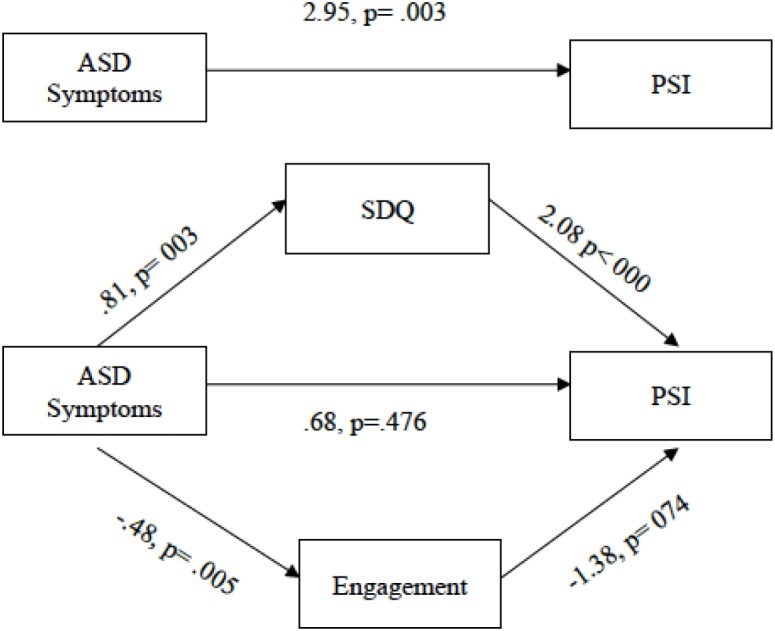
The present study investigated the mediating role of behavioral difficulties, coping strategies, and social functional support in the relationship between symptoms severity and parenting stress in mothers of children with ASD (autism spectrum disorder). The parenting stress questionnaire, coping orientation to problems experienced scale, strengths and difficulties questionnaire, and Duke-UNC social support questionnaire were administered to 52 mothers, who also estimated the ASD severity symptoms of their children. Correlation analyses revealed that parenting stress was positively correlated with the children's ASD symptoms and behavioral problems. On the other hand, parenting stress was negatively correlated with the engagement coping and social functional support reported by the mothers. Multiple mediation analysis indicated that engagement coping and behavioral difficulties were significant mediators in the relationship between ASD symptoms and parenting stress, with the engagement variable having a larger effect. The findings illustrate the need to promote the mothers' engagement coping orientation and the application of behavioral strategies with their children to help them to buffer the impact of stress.
本研究调查了行为困难、应对策略和社会功能支持在自闭症谱系障碍(ASD)儿童母亲的症状严重程度与育儿压力之间关系中的中介作用。对52位母亲进行了育儿压力问卷、应对问题经历取向量表、长处与困难问卷以及杜克大学-北卡罗来纳大学社会支持问卷的测试,这些母亲还对自己孩子的ASD严重症状进行了评估。相关分析表明,育儿压力与孩子的ASD症状和行为问题呈正相关。另一方面,育儿压力与母亲报告的参与应对和社会功能支持呈负相关。多重中介分析表明,参与应对和行为困难在ASD症状与育儿压力之间的关系中是显著的中介因素,其中参与变量的影响更大。研究结果表明,有必要促进母亲的参与应对取向,并对她们的孩子应用行为策略,以帮助她们缓冲压力的影响。