Aitila Phoebe, Mutyaba Michael, Okeny Simon, Ndawula Kasule Maurice, Kasule Rashid, Ssedyabane Frank, Okongo Benson, Onyuthi Apecu Richard, Muwanguzi Enoch, Oyet Caesar
Mbarara University of Science and Technology, Faculty of Medicine, Department of Medical Laboratory Sciences, P.O. Box 1410, Mbarara, Uganda.
Clarke International University, Institute of Allied Health, P.O. Box 7782, Kampala, Uganda.
J Trop Med. 2019 Mar 7;2019:9303072. doi: 10.1155/2019/9303072. eCollection 2019.
infection affects more than half of the world's population. The infection is generally acquired during childhood but can remain asymptomatic, with long-term clinical sequelae including gastritis, peptic ulcer disease, and stomach cancer.
The study was approved by Institutional Review Committee of Mbarara University of Science and Technology. After obtaining informed consent from parents/legal guardians, illegible children who presented with gastrointestinal complaints at Holy Innocents Children's Hospital were recruited; structured questionnaires were administered to the parents/guardians to collect information on sociodemographic data and risk factors of infection. Four (4) millilitres of blood was collected from each child and tested for . blood Antibody test and stool specimens were used for antigen test.
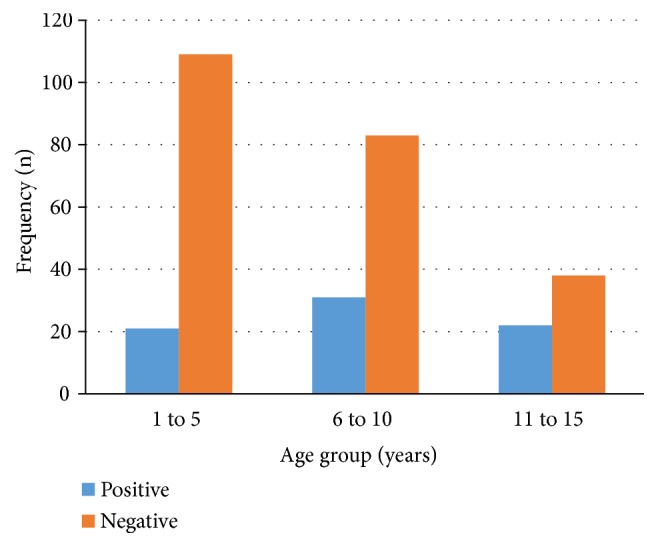
The prevalence of infection among the study participants was 24.3%. The infection rate increased with increase in age of the participants, from 16.2% among 1to 5 years old to 27.2% among 6 to 10 years. Infections were higher among school going children (68/74, p=0.003, OR 3.9; CI: 1.5 to 10.6) and children from crowded households (59/74, p<0.001, OR 2.6, and CI 1.3 to 5.0), unsafe source of drinking water at schools (46/74, p=0.003), and lack of sanitary facility at homes (57/74, p=0.001, and OR 1.6 CI 0.7 to 3.6).
The prevalence of infection among children aged 1 to 15 years at Holy Innocents Children's Hospital was high and increases with age. School attendance, lack of sanitary facility, lack of safe drinking water, and overcrowding were the risk factors associated with infection.
感染影响着世界上超过一半的人口。这种感染通常在儿童时期获得,但可能没有症状,长期临床后遗症包括胃炎、消化性溃疡疾病和胃癌。
该研究获得了姆巴拉拉科技大学机构审查委员会的批准。在获得父母/法定监护人的知情同意后,招募了在圣婴儿童医院出现胃肠道不适的儿童;向父母/监护人发放结构化问卷,以收集社会人口统计学数据和感染风险因素的信息。从每个孩子身上采集4毫升血液进行检测。血液抗体检测和粪便标本用于抗原检测。
研究参与者中感染的患病率为24.3%。感染率随着参与者年龄的增加而上升,从1至5岁儿童中的16.2%上升到6至10岁儿童中的27.2%。上学儿童(68/74, p = 0.003, 比值比3.9;可信区间:1.5至10.6)、来自拥挤家庭的儿童(59/74, p < 0.001, 比值比2.6, 可信区间1.3至5.0)、学校不安全的饮用水源(46/74, p = 0.003)以及家中缺乏卫生设施(57/74, p = 0.001, 比值比1.6,可信区间0.7至3.6)的感染率更高。
圣婴儿童医院1至15岁儿童中感染的患病率较高,且随年龄增长而增加。上学、缺乏卫生设施、缺乏安全饮用水和过度拥挤是与感染相关的风险因素。