The Maersk Mc-Kinney Moller Institute, Syddansk Universitet, Odense, Denmark.
Research Unit of Ophthalmology, Department of Opthalmology, Odense Universitetshospital, Odense, Denmark.
RMD Open. 2019 Mar 30;5(1):e000891. doi: 10.1136/rmdopen-2018-000891. eCollection 2019.
The development of standardised methods for ultrasound (US) scanning and evaluation of synovitis activity by the OMERACT-EULAR Synovitis Scoring (OESS) system is a major step forward in the use of US in the diagnosis and monitoring of patients with inflammatory arthritis. The variation in interpretation of disease activity on US images can affect diagnosis, treatment and outcomes in clinical trials. We, therefore, set out to investigate if we could utilise neural network architecture for the interpretation of disease activity on Doppler US images, using the OESS scoring system.
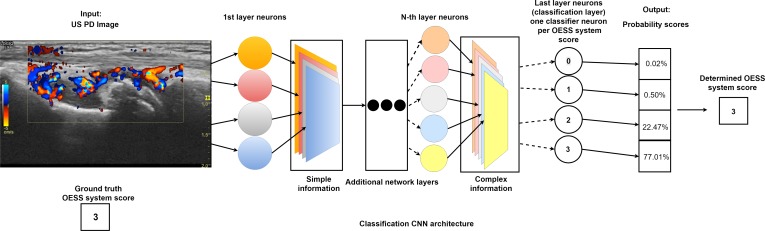
Two state-of-the-art neural networks were used to extract information from 1342 Doppler US images from patients with rheumatoid arthritis (RA). One neural network divided images as either healthy (Doppler OESS score 0 or 1) or diseased (Doppler OESS score 2 or 3). The other to score images across all four of the OESS systems Doppler US scores (0-3). The neural networks were hereafter tested on a new set of RA Doppler US images (n=176). Agreement between rheumatologist's scores and network scores was measured with the kappa statistic.
For the neural network assessing healthy/diseased score, the highest accuracies compared with an expert rheumatologist were 86.4% and 86.9% with a sensitivity of 0.864 and 0.875 and specificity of 0.864 and 0.864, respectively. The other neural network developed to four class Doppler OESS scoring achieved an average per class accuracy of 75.0% and a quadratically weighted kappa score of 0.84.
This study is the first to show that neural network technology can be used in the scoring of disease activity on Doppler US images according to the OESS system.
采用 OMERACT-EULAR 滑膜炎评分(OESS)系统对滑膜炎活动进行超声(US)扫描和评估的标准化方法的发展,是 US 在诊断和监测炎症性关节炎患者中的应用的重大进展。对 US 图像中疾病活动的解释差异可能会影响临床试验中的诊断、治疗和结局。因此,我们着手研究是否可以利用神经网络架构来根据 OESS 评分系统解释多普勒 US 图像中的疾病活动。
使用两种最先进的神经网络从类风湿关节炎(RA)患者的 1342 张多普勒 US 图像中提取信息。一个神经网络将图像分为健康(多普勒 OESS 评分为 0 或 1)或患病(多普勒 OESS 评分为 2 或 3)。另一个网络对所有四个 OESS 系统的多普勒 US 评分(0-3)对图像进行评分。随后在一组新的 RA 多普勒 US 图像(n=176)上测试神经网络。用 Kappa 统计量测量风湿病评分和网络评分之间的一致性。
对于评估健康/患病评分的神经网络,与专家风湿病学家相比,最高准确率分别为 86.4%和 86.9%,敏感性分别为 0.864 和 0.875,特异性分别为 0.864 和 0.864。另一个开发用于四级多普勒 OESS 评分的神经网络平均每级准确率为 75.0%,二次加权 Kappa 评分为 0.84。
这项研究首次表明,神经网络技术可用于根据 OESS 系统对多普勒 US 图像中的疾病活动进行评分。