Département d'Ecologie & Evolution, Université de Lausanne, Lausanne, Suisse.
Musée cantonal de zoologie, Lausanne, Suisse.
PLoS One. 2019 May 2;14(5):e0216360. doi: 10.1371/journal.pone.0216360. eCollection 2019.
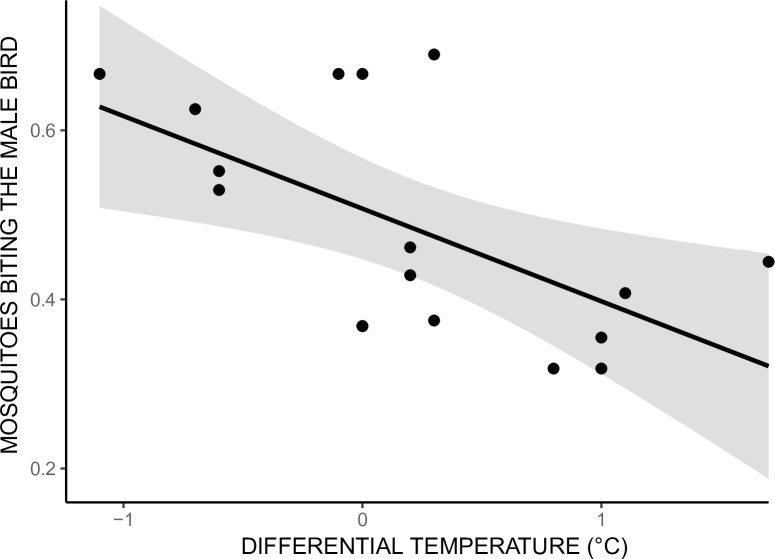
Sex-biased infections are a recurrent observation in vertebrates. In many species, males are more parasitized than females. Two potentially complementary mechanisms are often suggested to explain this pattern: sexual differences in susceptibility mainly caused by the effect of sex hormones on immunity and differential exposure to parasites. Exposure is mostly a consequence of host behavioural traits, but vector-borne parasitic infections involve another degree of complexity due to the active role of vectors in transmission. Blood-sucking insects may make choices based on cues produced by hosts. Regarding malaria, several studies highlighted a male-biased infection by Plasmodium sp in great tits (Parus major). We hypothesize that the mosquito vector, Culex pipiens, might at least partially cause this bias by being more attracted to male birds. Intrinsic variation associated to bird sex would explain a preference of mosquitoes for males. To test this hypothesis, we provide uninfected mosquitoes with a choice between uninfected male and female nestlings. Mosquito choice is assessed by sex typing of the ingested blood. We did not observe any preference for a given sex. This result does not support our prediction of a preference of mosquitoes for male great tits during the nestling period. In conclusion, mosquitoes do not seem to have an intrinsic preference for male nestlings. However, sexually divergent traits (e.g. behaviour, odour, metabolic rate) present in adults may play a role in the attraction of mosquitoes and should be investigated.
性偏感染在脊椎动物中是一种反复出现的现象。在许多物种中,雄性比雌性更容易受到寄生虫的感染。通常有两种潜在的互补机制来解释这种模式:主要由性激素对免疫的影响引起的易感性的性别差异,以及对寄生虫的不同暴露。暴露主要是宿主行为特征的结果,但由于媒介在传播中的积极作用,虫媒寄生虫感染涉及到另一个复杂程度。吸血昆虫可能会根据宿主产生的线索做出选择。关于疟疾,几项研究强调了一种雄性偏爱的疟原虫感染在大山雀(Parus major)中。我们假设,蚊子媒介库蚊(Culex pipiens)可能至少部分通过对雄性鸟类更具吸引力而导致这种偏向。与鸟类性别相关的内在变异可以解释蚊子对雄性的偏好。为了验证这一假设,我们为未感染的蚊子提供了一个选择,即未感染的雄性和雌性雏鸟。通过摄入血液的性别鉴定来评估蚊子的选择。我们没有观察到任何对特定性别的偏好。这一结果不支持我们关于蚊子在雏鸟期对雄性大山雀有偏好的预测。总之,蚊子似乎对雄性雏鸟没有内在的偏好。然而,在成年期存在的性别分化特征(例如行为、气味、代谢率)可能在蚊子的吸引力中起作用,应该进行研究。