Department of Functional Genomics, Chiba University Graduate School of Medicine, Japan.
Department of Urology, Chiba University Graduate School of Medicine, Japan.
Mol Oncol. 2019 Sep;13(9):1898-1912. doi: 10.1002/1878-0261.12532. Epub 2019 Jun 27.
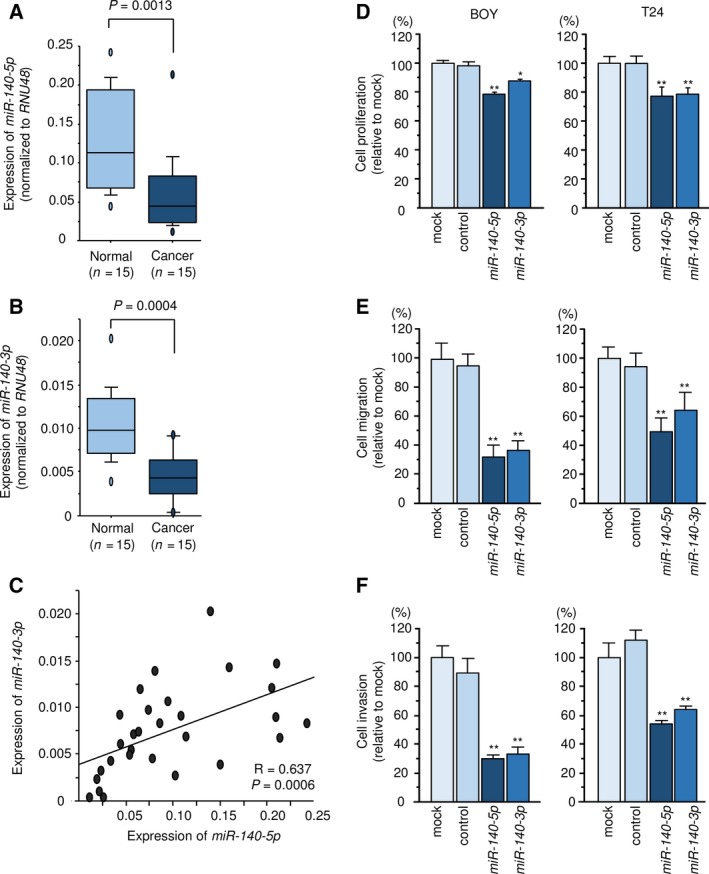
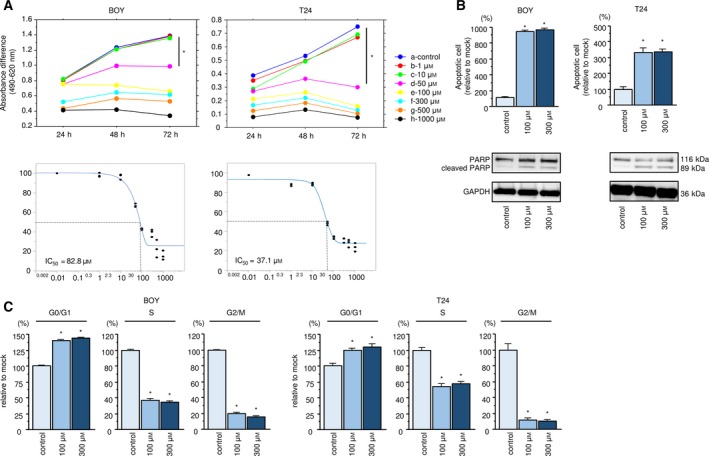
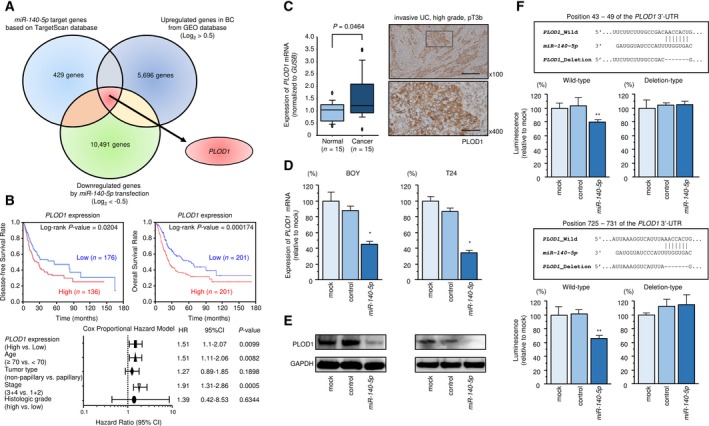
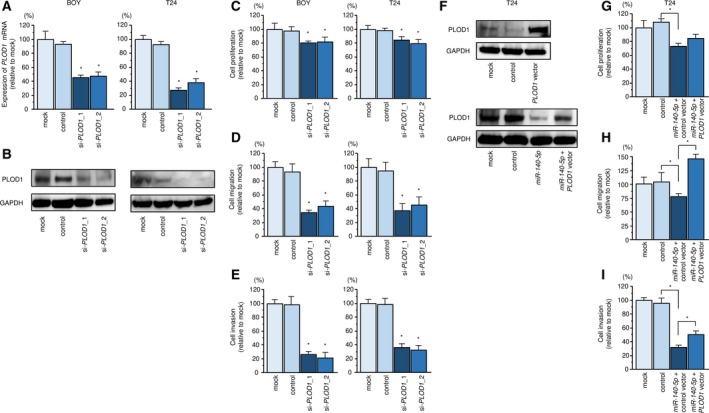
Bladder cancer (BC) is the ninth most malignant tumor worldwide. Some BC patients will develop muscle-invasive BC (MIBC), which has a 5-year survival rate of approximately 60% due to metastasis. As such, there is an urgent need for novel therapeutic and diagnostic targets for MIBC. Analysis of novel antitumor microRNA (miRNA)-mediated cancer networks is an effective strategy for exploring therapeutic targets and prognostic markers in cancers. Our previous miRNA analysis revealed that miR-140-5p acts as an antitumor miRNA in BC cells. Here, we investigated miR-140-5p regulation of BC molecular pathogenesis. Procollagen-lysine, 2-oxoglutarate 5-dioxygenase 1 (PLOD1) was found to be directly regulated by miR-140-5p, and aberrant expression of PLOD1 was observed in BC clinical specimens. High PLOD1 expression was significantly associated with a poor prognosis (disease-free survival: P = 0.0204; overall survival: P = 0.000174). Multivariate analysis showed PLOD1 expression to be an independent prognostic factor in BC patients (hazard ratio = 1.51, P = 0.0099). Furthermore, downregulation of PLOD1 by siRNAs and a specific inhibitor significantly decreased BC cell aggressiveness. Aberrant expression of PLOD1 was closely associated with BC pathogenesis. In summary, the present study showed that PLOD1 may be a potential prognostic marker and therapeutic target for BC.
膀胱癌(BC)是全球第九大恶性肿瘤。部分 BC 患者会发展为肌层浸润性膀胱癌(MIBC),由于转移,其 5 年生存率约为 60%。因此,迫切需要 MIBC 的新型治疗和诊断靶点。分析新型抗肿瘤 microRNA(miRNA)介导的癌症网络是探索癌症治疗靶点和预后标志物的有效策略。我们之前的 miRNA 分析表明,miR-140-5p 在 BC 细胞中作为一种抗肿瘤 miRNA 发挥作用。在这里,我们研究了 miR-140-5p 对 BC 分子发病机制的调节。发现前胶原赖氨酸,2-氧戊二酸 5-双加氧酶 1(PLOD1)可被 miR-140-5p 直接调控,并且在 BC 临床标本中观察到 PLOD1 的异常表达。高 PLOD1 表达与不良预后显著相关(无病生存期:P=0.0204;总生存期:P=0.000174)。多因素分析显示 PLOD1 表达是 BC 患者的独立预后因素(风险比=1.51,P=0.0099)。此外,siRNA 和特异性抑制剂下调 PLOD1 显著降低了 BC 细胞侵袭性。PLOD1 的异常表达与 BC 发病机制密切相关。综上所述,本研究表明 PLOD1 可能是 BC 的一个潜在预后标志物和治疗靶点。