Agnoli Sergio, Mancini Giacomo, Andrei Federica, Trombini Elena
Marconi Institute for Creativity, Alma Mater Studiorum University of Bologna, Bologna, Italy.
Department of Education, Alma Mater Studiorum University of Bologna, Bologna, Italy.
Front Psychol. 2019 Jul 30;10:1711. doi: 10.3389/fpsyg.2019.01711. eCollection 2019.
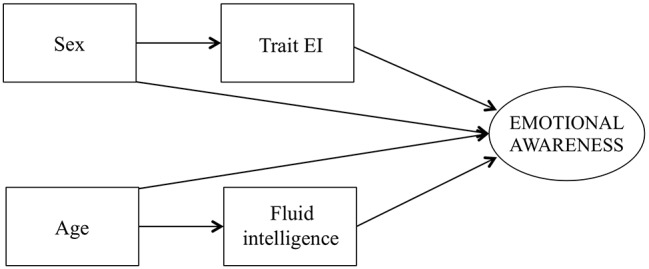
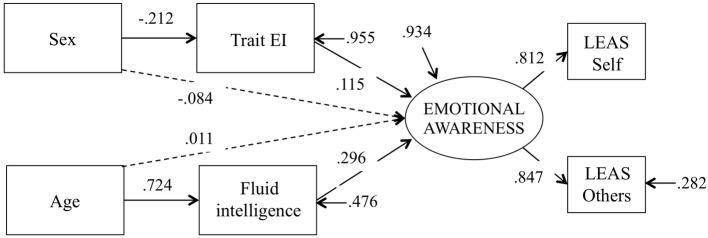
Emotional awareness (EA) has been defined as the cognitive skill devoted to the identification and description of one's own and others' emotional experiences, an ability that has usually been conceptualized along with the development of cognitive intelligence. Despite this, EA has also been deemed a central constituent of Emotional Intelligence (EI), a construct that captures individual differences in how we perceive, communicate, regulate, and understand our own emotions, as well as the emotions of others. The overlap between the cognitive and the emotional domain in the definition of the EA construct has created several difficulties in both its understanding and its usage, so much so that several questions regarding its nature and structure remain unanswered. The aim of the present work was to test in a unique model the explanatory role of both trait EI and fluid nonverbal intelligence on EA variability in children, controlling for the effect of age, a variable strictly related to cognitive development, as well as gender, which is highly associated with trait EI during childhood. Four hundred and eighty-eight pupils (258 females and 230 males) ranging from 8 to 12 years old completed the Levels of Emotional Awareness Scale for Children, the Trait Emotional Intelligence Questionnaire - Child Form, and a measure of pure non-verbal reasoning ability, the Raven's Progressive Matrices. The results of a structural equation model showed a positive explanatory power of both Raven and TEIQue scores on EA, revealing that both cognitive intelligence and trait EI significantly explained EA. The same model also showed an indirect effect of age, intelligence scores, on EA, suggesting that the increase of EA with age could be partially imputed to the development of intelligence. Finally, a relation between gender and TEIQue scores confirmed higher trait EI scores in girls than in boys. The implications emerging from this model are discussed.
情绪意识(EA)被定义为一种认知技能,致力于识别和描述自己及他人的情绪体验,这种能力通常与认知智力的发展一同被概念化。尽管如此,EA也被视为情商(EI)的核心组成部分,情商这一概念捕捉了我们在感知、沟通、调节和理解自己以及他人情绪方面的个体差异。EA概念定义中认知和情感领域的重叠在其理解和使用上都造成了一些困难,以至于关于其本质和结构的几个问题仍未得到解答。本研究的目的是在一个独特的模型中测试特质EI和流体非言语智力对儿童EA变异性的解释作用,同时控制年龄(一个与认知发展密切相关的变量)以及性别(在儿童期与特质EI高度相关)的影响。488名年龄在8至12岁的学生(258名女生和230名男生)完成了儿童情绪意识量表、特质情绪智力量表 - 儿童版以及一项纯非言语推理能力测试——瑞文渐进矩阵测验。结构方程模型的结果显示,瑞文测验分数和特质情绪智力量表分数对EA均具有正向解释力,表明认知智力和特质EI都能显著解释EA。同一模型还显示了年龄(通过智力分数)对EA的间接影响,这表明EA随年龄增长可能部分归因于智力的发展。最后,性别与特质情绪智力量表分数之间的关系证实,女孩的特质EI分数高于男孩。本文讨论了该模型所产生的影响。