Andhale Namdeo B, Shahnawaz Mohd, Ade Avinash B
Department of Botany, Savitribai Phule Pune University, Ganeshkhind, Pune, Maharashtra, 411007, India.
Department of Biology, Fergusson College, FC Road, Shivajinagar, Pune, MS, 411004, India.
Bot Stud. 2019 Sep 7;60(1):21. doi: 10.1186/s40529-019-0270-1.
Plumbagin is one of the pharmaceutically important biomolecule with anticancer potential. Among the plants reported to produce plumbagin, P. zeylanica topped the list. The plumbagin production is very slow with low yield and maximum 0.5% (of dry weight) was reported in P. zeylanica. To meet the increasing demand of the plumbagin at global level, the P. zeylanica are exploited at commercial level, which may pose serious threat on the germplasm of the plant populations. So, it is needed to enhance the contents of plumbagin in P. zeylanica using biotechnological approaches. Among the various methods used to enhance the contents of plumbagin in P. zeylanica, utilization of fungal endophytes to enhance the plumbagin contents is a widely accepted approach. As fungal endophytes have the potential to synthesize various secondary metabolites and also reported to influence the synthesis of the secondary metabolites in plants. In the present study, an attempt was made to assess the effect of fungal endophytes of the Plumbago zeylanica L. on enhancement of plumbagin contents at in vivo level.
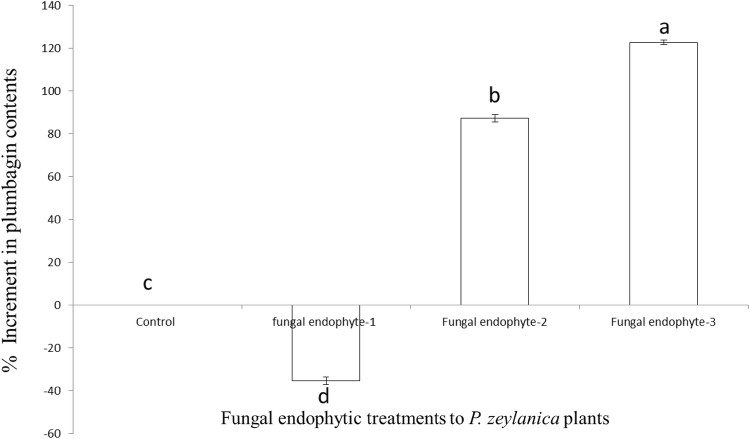
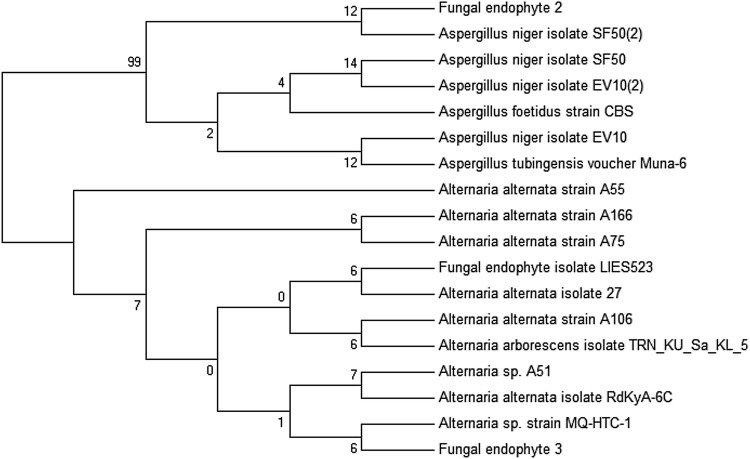
Total 3 fungal endophytes were recorded from the roots of P. zeylanica collected from Khadki, Pune. The fungal endophytes were identified at morphological and molecular level. After 1 year of the treatment with fungal endophytes, significant enhancement of plumbagin was recorded in the roots of the P. zeylanica. Plumbagin contents in each were quantified against the standard plumbagin by employing LCMS-MS technique. Among the three fungal endophytes, the maximum enhancement of plumbagin content (122.67%) was reported with the treatment of Alternaria sp. (Isolate-3) in the roots of the P. zeylanica compared to control.
Among the three fungal endophytes, the maximum enhancement of plumbagin content (122.67%) was reported with Alternaria sp. (Isolate 3) in the roots of the pot-grown plants of P. zeylanica at in vivo level.
白花丹素是一种具有抗癌潜力的重要药用生物分子。在已报道能产生白花丹素的植物中,泽番椒名列前茅。白花丹素的产量非常低,生长缓慢,泽番椒中报道的最高产量为干重的0.5%。为了满足全球对白花丹素日益增长的需求,泽番椒被用于商业开发,这可能对该植物种群的种质构成严重威胁。因此,需要利用生物技术方法提高泽番椒中白花丹素的含量。在用于提高泽番椒中白花丹素含量的各种方法中,利用真菌内生菌来提高白花丹素含量是一种广泛接受的方法。因为真菌内生菌有合成各种次生代谢产物的潜力,并且也被报道会影响植物中次生代谢产物的合成。在本研究中,尝试评估泽番椒真菌内生菌在体内水平上对提高白花丹素含量的影响。
从浦那卡迪采集的泽番椒根部分离出3种真菌内生菌。通过形态学和分子水平对真菌内生菌进行了鉴定。用真菌内生菌处理1年后,泽番椒根中的白花丹素显著增加。采用液相色谱-质谱联用技术,以标准白花丹素为对照,对每种真菌内生菌处理后的白花丹素含量进行了定量分析。在这三种真菌内生菌中,与对照相比,用链格孢属(菌株-3)处理的泽番椒根中白花丹素含量增加最多(122.67%)。
在这三种真菌内生菌中,在体内水平上,盆栽泽番椒根中,链格孢属(菌株3)处理后白花丹素含量增加最多(122.67%)。