1 Department of Radiation Oncology, Duke University Medical Center, Durham, NC, USA.
2 Department of Radiation Oncology, Georgetown University Hospital, Rockville, MD, USA.
Technol Cancer Res Treat. 2019 Jan 1;18:1533033819873922. doi: 10.1177/1533033819873922.
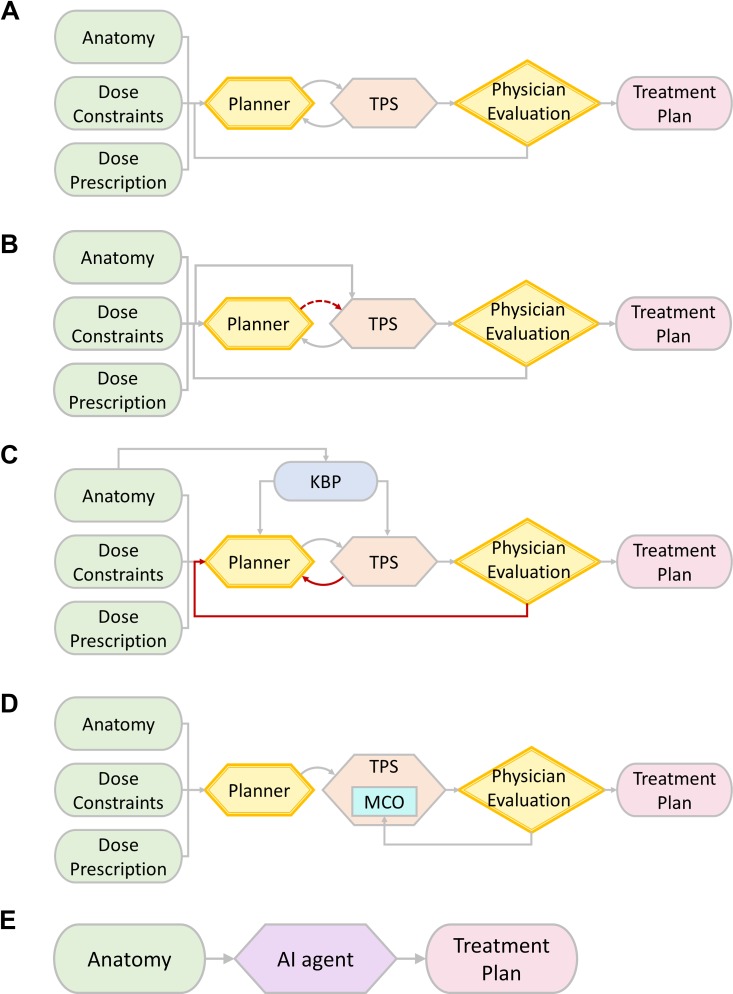
Treatment planning is an essential step of the radiotherapy workflow. It has become more sophisticated over the past couple of decades with the help of computer science, enabling planners to design highly complex radiotherapy plans to minimize the normal tissue damage while persevering sufficient tumor control. As a result, treatment planning has become more labor intensive, requiring hours or even days of planner effort to optimize an individual patient case in a trial-and-error fashion. More recently, artificial intelligence has been utilized to automate and improve various aspects of medical science. For radiotherapy treatment planning, many algorithms have been developed to better support planners. These algorithms focus on automating the planning process and/or optimizing dosimetric trade-offs, and they have already made great impact on improving treatment planning efficiency and plan quality consistency. In this review, the smart planning tools in current clinical use are summarized in 3 main categories: automated rule implementation and reasoning, modeling of prior knowledge in clinical practice, and multicriteria optimization. Novel artificial intelligence-based treatment planning applications, such as deep learning-based algorithms and emerging research directions, are also reviewed. Finally, the challenges of artificial intelligence-based treatment planning are discussed for future works.
治疗计划是放射治疗工作流程的一个重要步骤。在计算机科学的帮助下,在过去的几十年中,它变得更加复杂,使规划师能够设计高度复杂的放射治疗计划,最大限度地减少正常组织损伤,同时保持足够的肿瘤控制。因此,治疗计划变得更加耗费人力,需要规划师花费数小时甚至数天的时间,以试错的方式为每个患者优化治疗方案。最近,人工智能已被用于自动化和改进医学的各个方面。对于放射治疗计划,已经开发了许多算法来更好地支持规划师。这些算法专注于自动化规划过程和/或优化剂量学权衡,它们已经对提高治疗计划效率和计划质量的一致性产生了重大影响。在这篇综述中,总结了当前临床应用的智能规划工具,主要分为 3 类:自动化规则的实现和推理、临床实践中先验知识的建模以及多标准优化。还回顾了基于人工智能的新的治疗计划应用,如基于深度学习的算法和新兴的研究方向。最后,讨论了基于人工智能的治疗计划所面临的挑战,为未来的工作提供了参考。