Elizabeth Dickson, PhD, RN, is Assistant Professor, College of Nursing, University of New Mexico, Albuquerque. Maya Magarati, PhD, is Assistant Professor, Department of Sociology, University of Washington, Seattle. Blake Boursaw, MS, is Instructor, College of Nursing, University of New Mexico, Albuquerque. John Oetzel, PhD, is Professor, Waikato Management School, University of Waikato, Hamilton, New Zealand. Carlos Devia, MA, is Community Research Partner and Doctoral Candidate, School of Public Health and Health Policy, City University of New York, New York. Kasim Ortiz, MS, is Research Assistant, Department of Sociology, University of New Mexico, Albuquerque. Nina Wallerstein, DrPH, is Professor, College of PopulationHealth, University of New Mexico, Albuquerque.
Nurs Res. 2020 Jan/Feb;69(1):51-61. doi: 10.1097/NNR.0000000000000399.
As federal research funding focuses more on academic/community collaborations to address health inequities, it is important to understand characteristics of these partnerships and how they work to achieve health equity outcomes.
This study built on previous National Institutes of Health-funded research to (a) describe partnership characteristics and processes of federally funded, community-based participatory research (CBPR) or community-engaged research projects; (b) explore characteristics of these projects by stage of funding; and (c) build on previous understanding of partnership promising practices.
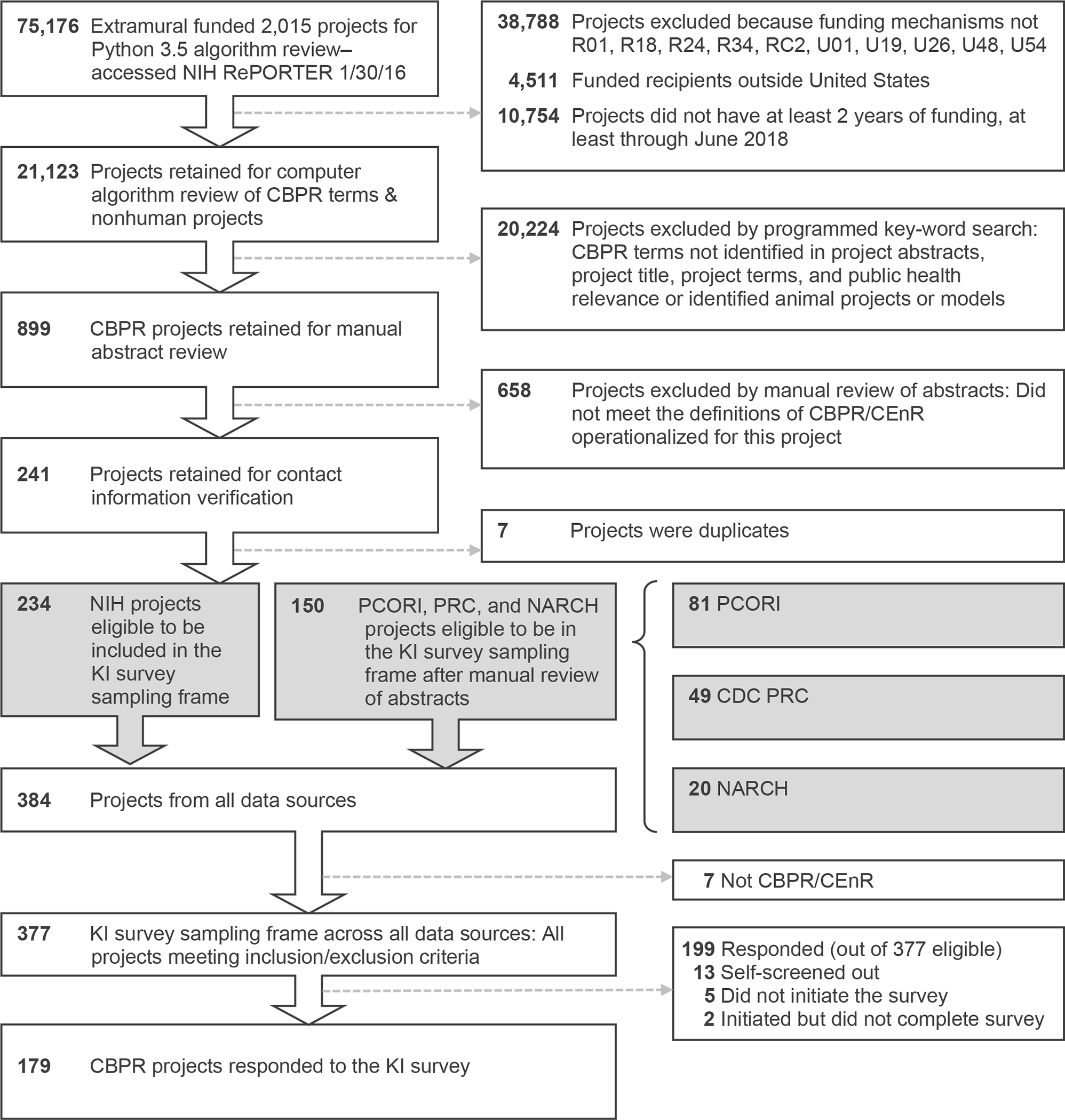
Between fall 2016 and spring 2017, we completed a cross-sectional analysis and principal component analysis of online survey data from key informants of federally funded CBPR and community-engaged research projects. Respondents for 179 projects (53% response rate) described project characteristics (e.g., type of partner, stage of partnership, and population) and the use of promising practices (e.g., stewardship, advisory board roles, training topics) by stage of partnership.
Projects involved community, healthcare, and government partners, with 49% of respondents reporting their project was in the early stage of funding. More projects focused on Black/African American populations, whereas principal investigators were mostly White. The more established a partnership (e.g., with multiple projects), the more likely it employed the promising practices of stewardship (i.e., community safeguards for approval), community advisory boards, and training on values and power.
Community engagement is a developmental process with differences between early-stage and established CBPR partnerships. Engaging in active reflection and adopting promising partnering practices are important for CBPR partnerships working to improve health equity. The data provided in this study provide key indicators for reflection.
随着联邦研究资金更多地投向解决健康不平等问题的学术/社区合作,了解这些伙伴关系的特点以及它们如何实现健康公平成果就变得尤为重要。
本研究基于先前由美国国立卫生研究院资助的研究,(a)描述联邦资助的基于社区的参与式研究(CBPR)或社区参与式研究项目的伙伴关系特征和过程;(b)按资助阶段探讨这些项目的特征;(c)在先前对伙伴关系有希望的做法的理解基础上进一步研究。
在 2016 年秋季至 2017 年春季期间,我们对在线调查数据进行了横断面分析和主成分分析,这些数据来自联邦资助的 CBPR 和社区参与式研究项目的主要知情人。179 个项目的受访者(53%的回应率)描述了项目特征(例如,合作伙伴类型、伙伴关系阶段和人群)以及按伙伴关系阶段使用有希望的实践(例如,管理、顾问委员会角色、培训主题)的情况。
项目涉及社区、医疗保健和政府合作伙伴,49%的受访者报告他们的项目处于资金的早期阶段。更多的项目侧重于黑人和非洲裔美国人,而主要研究者大多是白人。伙伴关系越成熟(例如,有多个项目),就越有可能采用管理(即,社区批准保障措施)、社区咨询委员会以及关于价值观和权力的培训等有希望的合作实践。
社区参与是一个发展过程,早期和成熟的 CBPR 伙伴关系之间存在差异。积极反思并采用有希望的合作实践对于致力于改善健康公平的 CBPR 伙伴关系非常重要。本研究提供的数据为反思提供了关键指标。