Pirmoghani Amin, Salehi Iraj, Moradkhani Shirin, Karimi Seyed Asaad, Salehi Sakineh
Neurophysiology Research Center, Hamadan University of Medical Sciences, Hamadan, Iran.
Student Research Committee, Hamadan University of Medical Sciences, Hamadan, Iran.
IBRO Rep. 2019 Oct 22;7:90-96. doi: 10.1016/j.ibror.2019.10.004. eCollection 2019 Dec.
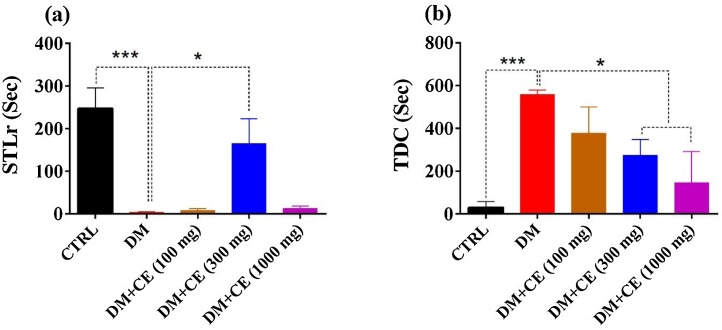
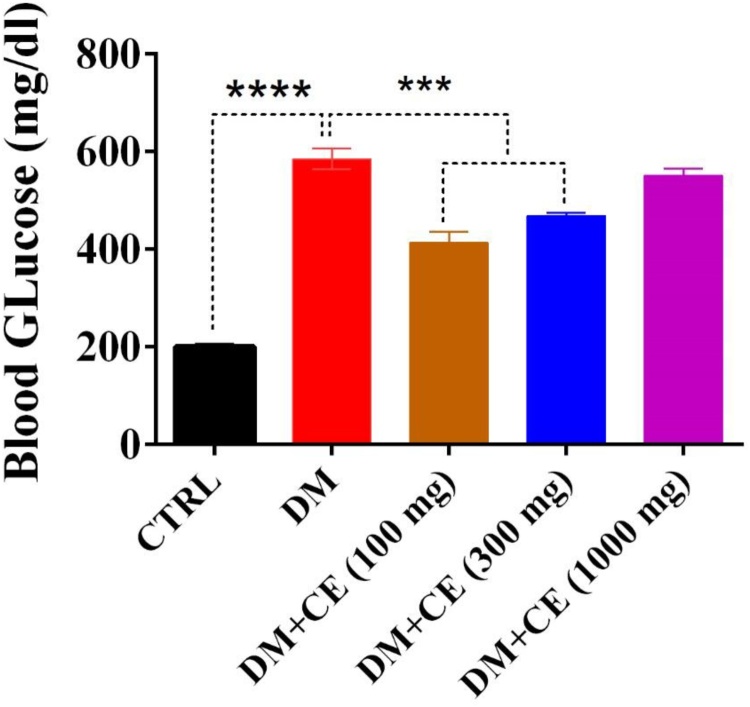
This study was undertaken to investigate the Crataegus extract (CE) eff ;ects on diabetes-induced memory deficit in passive avoidance learning (PAL), blood glucose, and lipid profile panel. Male Wistar rats were divided into five groups: (CTRL); (DM); and with three doses of CE (100, 300 and 1000 mg/kg) (DM + CE). Streptozotocin (STZ)-induced diabetic rats (50 mg/kg, ip) were orally administrated with CE once a day for 2 weeks. After 2 weeks, PAL task was used to evaluate the passive avoidance learning and memory. At the end of experiment, the level of plasma glucose, triglycerides (TG), cholesterol, low-density lipoprotein (LDL), and high-density lipoprotein (HDL) were determined. Our results showed that the step-through latency (STLr) in diabetic animals was less than the control group (P = 0.0009). Crataegus (300 mg) increased STLr in diabetic animals (P = 0.0418). Diabetic animals spent more time in the dark compartment (TDC) (P = 0.0009). Crataegus (300 and 1000 mg) decreased TDC in diabetic animals (P = 0.0175). Crataegus (100 and 300 mg) decreased blood glucose in diabetic animals (P < 0.001). TG and Cholesterol concentration increased in diabetic animals in comparison with control (P < 0.05). CE (100 and 300 mg) reduced the cholesterol concentration in diabetic animals (P < 0.001). There was no significant difference in the case of LDL among the experimental groups (P > 0.05). CE (1000 mg) increased HDL in diabetic animals (P < 0.05). Our findings demonstrated that CE had the hypolipidemic and hypoglycemic effects and lead to memory improvement in STZ-induced diabetes.
本研究旨在探讨山楂提取物(CE)对糖尿病诱导的被动回避学习(PAL)记忆缺陷、血糖和血脂谱的影响。雄性Wistar大鼠分为五组:(对照组);(糖尿病组);以及给予三种剂量CE(100、300和1000mg/kg)的组(糖尿病+CE组)。用链脲佐菌素(STZ)诱导糖尿病大鼠(50mg/kg,腹腔注射),每天口服CE一次,持续2周。2周后,用PAL任务评估被动回避学习和记忆。实验结束时,测定血浆葡萄糖、甘油三酯(TG)、胆固醇、低密度脂蛋白(LDL)和高密度脂蛋白(HDL)水平。我们的结果表明,糖尿病动物的穿通潜伏期(STLr)短于对照组(P = 0.0009)。山楂(300mg)增加了糖尿病动物的STLr(P = 0.0418)。糖尿病动物在暗室中停留的时间更长(TDC)(P = 0.0009)。山楂(300和1000mg)减少了糖尿病动物的TDC(P = 0.0175)。山楂(100和300mg)降低了糖尿病动物的血糖(P < 0.001)。与对照组相比,糖尿病动物的TG和胆固醇浓度升高(P < 0.05)。CE(100和300mg)降低了糖尿病动物的胆固醇浓度(P < 0.001)。各实验组之间的LDL无显著差异(P > 0.05)。CE(1000mg)增加了糖尿病动物的HDL(P < 0.05)。我们的研究结果表明,CE具有降血脂和降血糖作用,并能改善STZ诱导的糖尿病大鼠的记忆。