Department of Health Research Methods, Evidence, and Impact, McMaster University, Hamilton, ON, Canada.
Division of Orthopaedic Surgery, Centre for Evidence-Based Orthopaedics, McMaster University, Hamilton, ON, Canada.
Knee Surg Sports Traumatol Arthrosc. 2020 Sep;28(9):3031-3039. doi: 10.1007/s00167-019-05763-1. Epub 2020 Jan 3.
There are a number of developments in intra-articular therapies that have been determined to be differentiating factors within the classes of treatments. This study evaluated the efficacy and safety of intra-articular treatments of primary knee osteoarthritis in the short term (3 months follow-up), using a network meta-analysis design, while taking within-class differentiating factors into consideration.
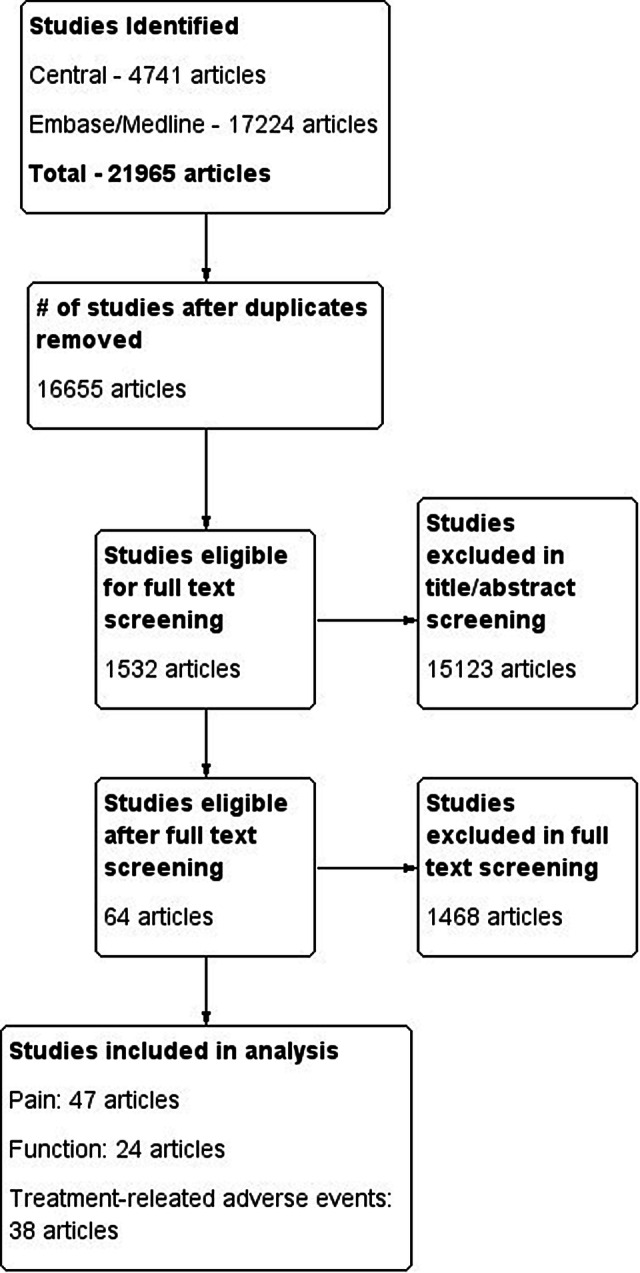
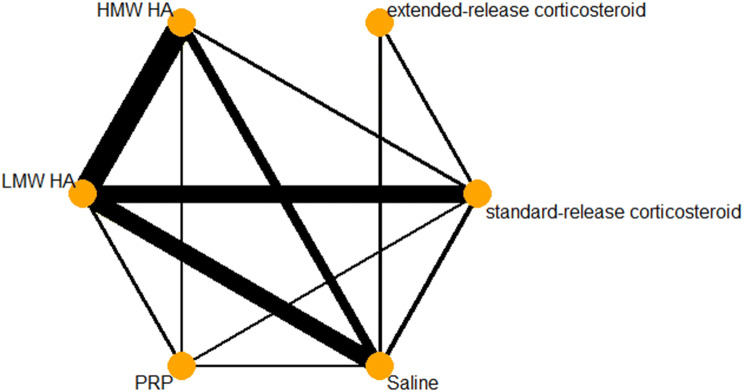
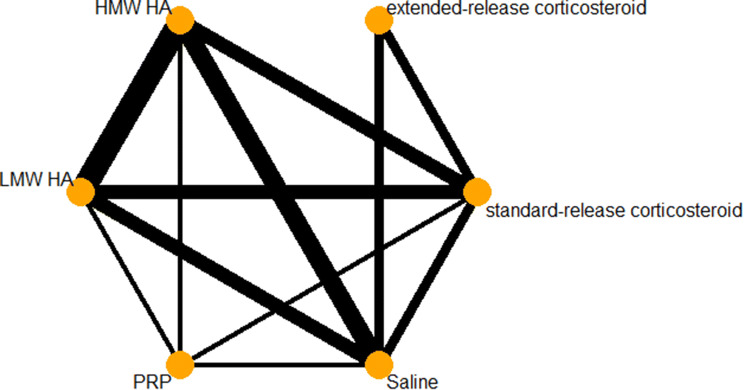
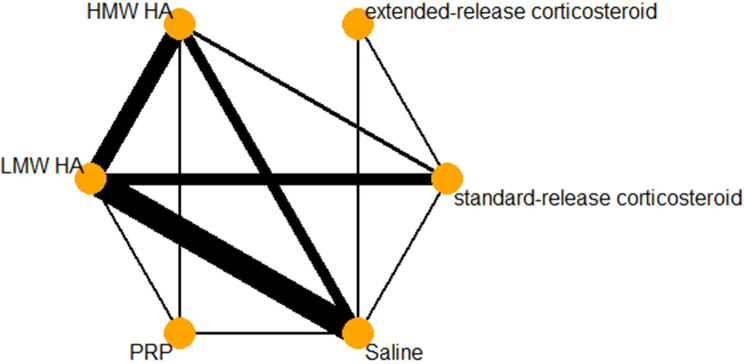
A literature search of MEDLINE (through OVID), EMBASE (through OVID), Cochrane Central Register of Controlled Trials for all trials comparing intra-articular therapies was conducted on November 12, 2018. The treatments assessed were high molecular weight and low molecular weight hyaluronic acid injections, extended-release corticosteroids, standard-release corticosteroids, platelet-rich plasma, and saline. A frequentist network meta-analysis was conducted for each outcome.
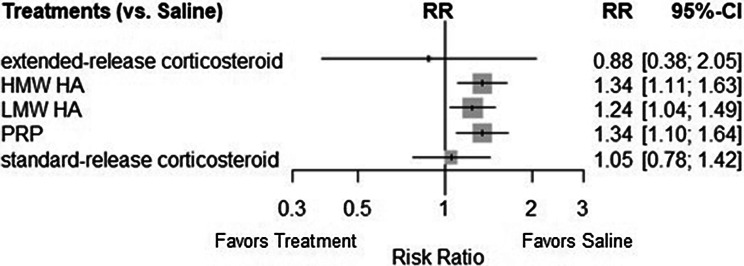
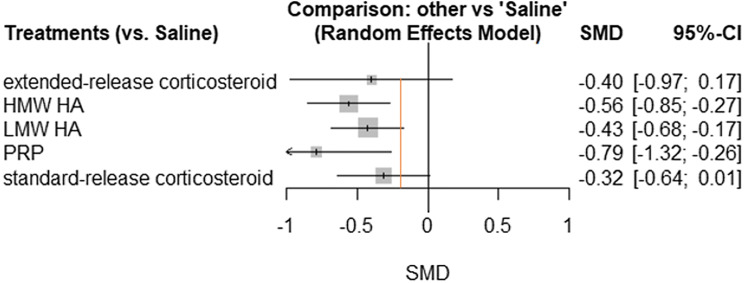
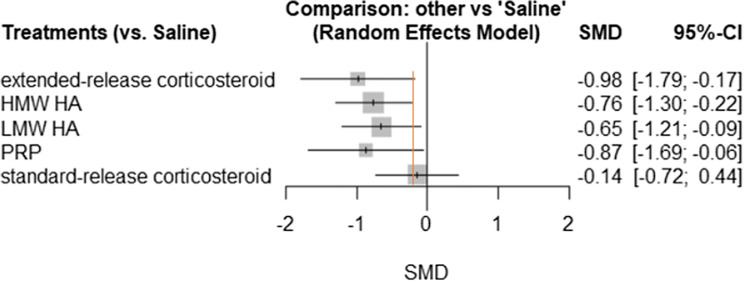
Sixty-four articles (9710 patients) met the inclusion criteria. High molecular weight hyaluronic acid (- 0.53, 95% CI - 0.81 to - 0.25) and PRP (- 0.79, 95% CI - 1.32 to - 0.26) were the only treatments with a confidence interval that lay completely above the MID threshold; however, PRP results varied within sensitivity analyses. For the function analysis, high molecular weight hyaluronic acid (SMD - 0.76, 95% CI - 1.30 to - 0.22) was the only treatment with a confidence interval entirely above the MID. Extended-release corticosteroid demonstrated a possible benefit in functional improvement (SMD - 0.98, 95% CI - 1.79 to - 0.17) compared to that of standard-release corticosteroid (SMD - 0.14, 95% CI - 0.72 to 0.44).
High molecular weight HA was the only treatment to surpass the MID for both pain and function outcomes. Extended-release corticosteroids may provide additional clinical benefit over standard-release corticosteroids. Platelet-rich plasma demonstrated possibly beneficial results; however, wide confidence intervals and sensitivity analyses made the conclusions of efficacy uncertain.
Level 1. Systematic review of level 1 evidence.
关节内治疗有许多进展,已被确定为治疗类别中的区分因素。本研究通过网络荟萃分析设计,在考虑到类内区分因素的情况下,评估了短期(3 个月随访)原发性膝骨关节炎的关节内治疗的疗效和安全性。
于 2018 年 11 月 12 日,通过 OVID 对 MEDLINE(医学文献在线数据检索)、EMBASE(通过 OVID)、Cochrane 对照试验中心注册库进行了一次针对比较关节内治疗的所有试验的文献检索。评估的治疗方法包括高分子量和低分子量透明质酸注射、长效皮质类固醇、标准释放皮质类固醇、富血小板血浆和生理盐水。对每个结果进行了频率主义网络荟萃分析。
64 篇文章(9710 名患者)符合纳入标准。高分子量透明质酸(-0.53,95%置信区间-0.81 至-0.25)和 PRP(-0.79,95%置信区间-1.32 至-0.26)是唯一置信区间完全高于 MID 阈值的治疗方法;然而,PRP 结果在敏感性分析中有所不同。对于功能分析,高分子量透明质酸(SMD-0.76,95%置信区间-1.30 至-0.22)是唯一置信区间完全高于 MID 的治疗方法。与标准释放皮质类固醇(SMD-0.14,95%置信区间-0.72 至 0.44)相比,长效皮质类固醇显示出在功能改善方面可能有益(SMD-0.98,95%置信区间-1.79 至-0.17)。
高分子量 HA 是唯一在疼痛和功能结果方面均超过 MID 的治疗方法。长效皮质类固醇可能比标准释放皮质类固醇提供额外的临床益处。富血小板血浆显示出可能有益的结果;然而,置信区间较宽且敏感性分析使疗效的结论不确定。
1 级。对 1 级证据的系统评价。