Department of Neuroinformatics, Institute of Cognitive Science, Osnabrück University, Osnabrück, Germany.
Data Science and AI Group, Faculty of Information Technology, Monash University, Clayton, Victoria, Australia.
PLoS One. 2020 Feb 5;15(2):e0228025. doi: 10.1371/journal.pone.0228025. eCollection 2020.
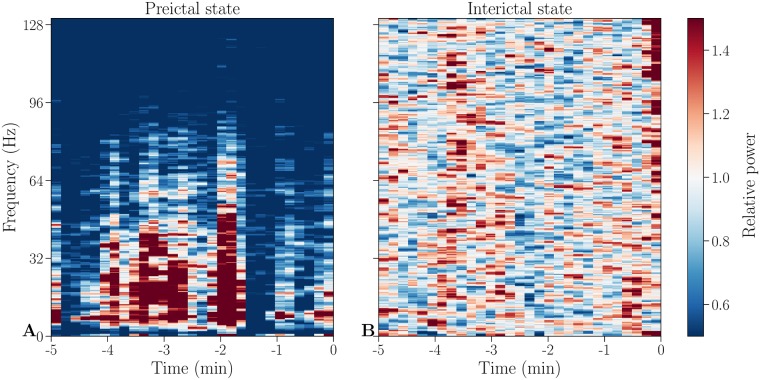
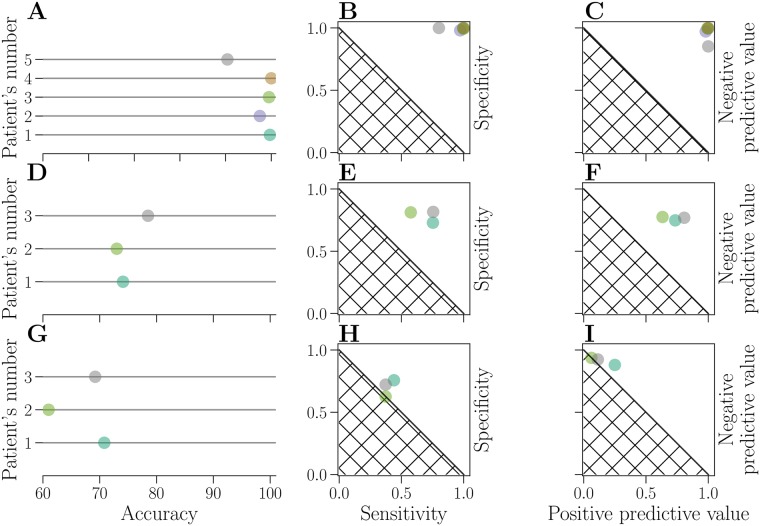
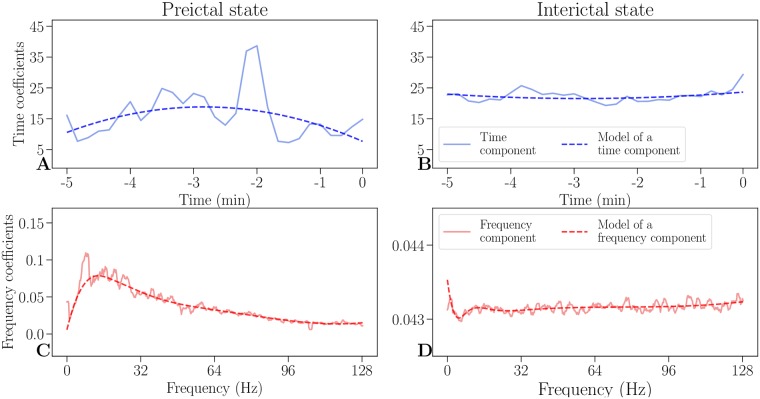
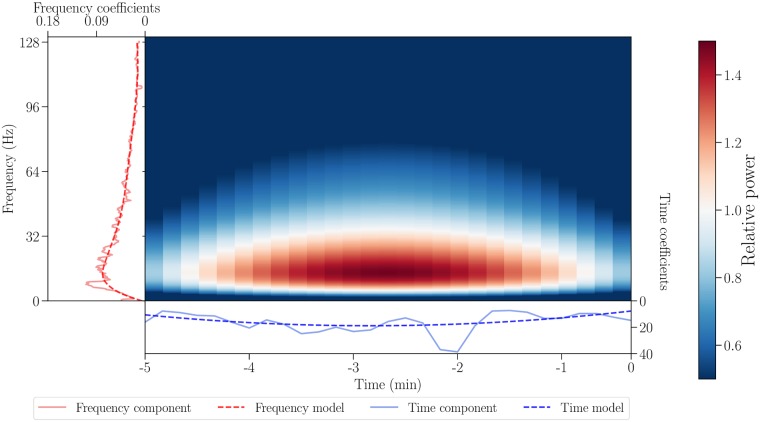
This paper presents a procedure for the patient-specific prediction of epileptic seizures. To this end, a combination of nonnegative matrix factorization (NMF) and smooth basis functions with robust regression is applied to power spectra of intracranial electroencephalographic (iEEG) signals. The resulting time and frequency components capture the dominant information from power spectra, while removing outliers and noise. This makes it possible to detect structure in preictal states, which is used for classification. Linear support vector machines (SVM) with L1 regularization are used to select and weigh the contributions from different number of not equally informative channels among patients. Due to class imbalance in data, synthetic minority over-sampling technique (SMOTE) is applied. The resulting method yields a computationally and conceptually simple, interpretable model of EEG signals of preictal and interictal states, which shows a good performance for the task of seizure prediction on two datasets (the EPILEPSIAE and on the public Epilepsyecosystem dataset).
本文提出了一种针对癫痫发作的患者特异性预测的方法。为此,将非负矩阵分解 (NMF) 和稳健回归的平滑基函数相结合,应用于颅内脑电图 (iEEG) 信号的功率谱。得到的时间和频率分量从功率谱中捕获主要信息,同时去除异常值和噪声。这使得能够检测到发作前状态中的结构,从而进行分类。使用具有 L1 正则化的线性支持向量机 (SVM) 来选择和加权来自不同数量的患者中信息不等的通道的贡献。由于数据中的类别不平衡,应用了合成少数过采样技术 (SMOTE)。所得到的方法产生了一种计算上和概念上简单的、可解释的 EEG 信号发作前和发作间期状态模型,在两个数据集 (EPILEPSIAE 和公共 Epilepsyecosystem 数据集) 的癫痫预测任务中表现出良好的性能。