Department of Psychiatry and Behavioral Sciences, Tokyo Metropolitan Institute of Medical Science, 2-1-6 Kamikitazawa, Setagaya-ku, Tokyo 156-8506, Japan.
Department of Neuropsychiatry, Graduate School of Medicine, University of Tokyo, 7-3-1 Hongo, Bunkyo-ku, Tokyo 113-8655, Japan.
Int J Environ Res Public Health. 2020 Jan 31;17(3):884. doi: 10.3390/ijerph17030884.
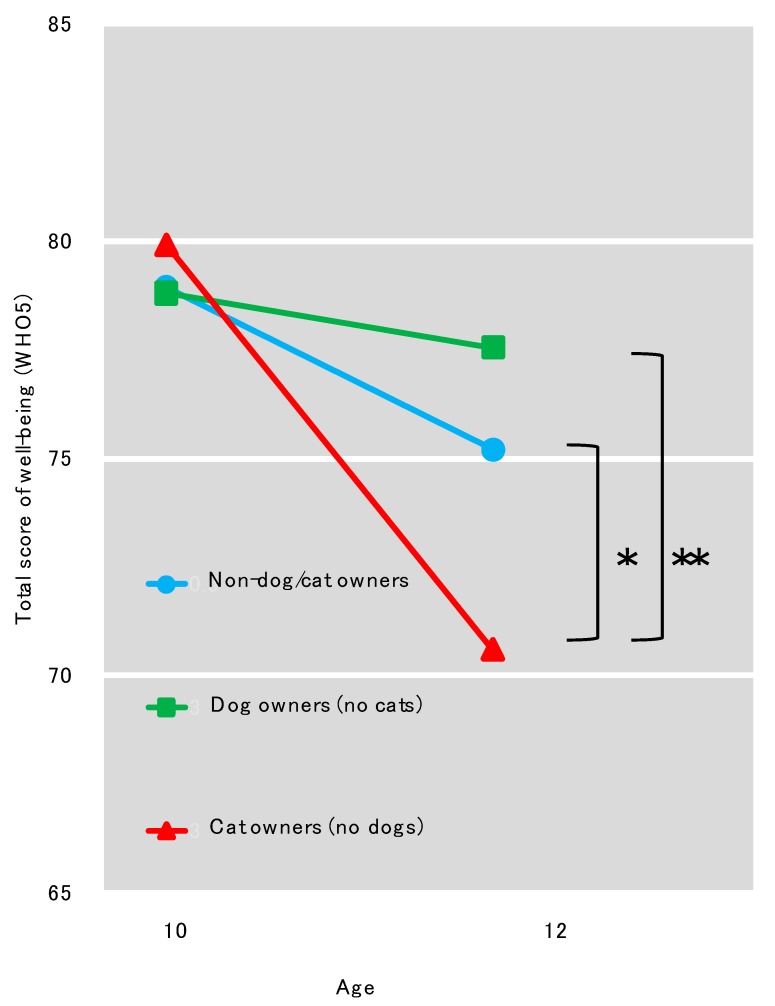
A potential association between pet ownership and mental well-being is suggested, but there is a shortage of high-quality longitudinal studies that consider probable differences among different species. We aimed to examine whether ownership of the most popular pets (dogs and cats) would predict mental well-being. The Tokyo Teen Cohort (TTC), a prospective population-based birth cohort study, had dog and cat ownership data at age 10 and mental well-being score at ages 10 and 12 from 2584 adolescents. Linear regression analysis with adjusting for covariates showed that dog ownership had a positive effect on mental well-being compared to no dog ownership, however, cat ownership had a negative effect compared to no cat ownership. Two-factor mixed-design analysis of variance showed that dog ownership predicted maintained mental well-being, while cat ownership predicted progressing decline of mental well-being. Thus, dog and cat ownership may have different effects on adolescents' mental well-being, implying that the underlying mechanisms that are activated by these types of ownership may differ.
宠物拥有与心理健康之间可能存在关联,但缺乏考虑不同物种之间可能存在差异的高质量纵向研究。我们旨在研究最受欢迎的宠物(狗和猫)的拥有是否可以预测心理健康。东京青少年队列(TTC)是一项基于人群的前瞻性出生队列研究,在 2584 名青少年中,10 岁时收集了宠物(狗和猫)拥有数据,10 岁和 12 岁时收集了心理健康评分。调整协变量后的线性回归分析表明,与没有狗的家庭相比,养狗对心理健康有积极影响,而与没有猫的家庭相比,养猫对心理健康有负面影响。双因素混合设计方差分析显示,养狗可以预测维持心理健康,而养猫则预示着心理健康的逐渐下降。因此,宠物狗和猫的拥有可能对青少年的心理健康有不同的影响,这表明这些类型的拥有所激活的潜在机制可能不同。