Departamento de Química en Ciencias Farmacéuticas, Facultad de Farmacia, Universidad Complutense de Madrid, Instituto de Investigación Sanitaria del Hospital 12 de Octubre i + 12, Plaza Ramón y Cajal s/n, 28040 Madrid, Spain.
J Mater Chem B. 2020 Mar 4;8(9):1781-1800. doi: 10.1039/c9tb02710f.
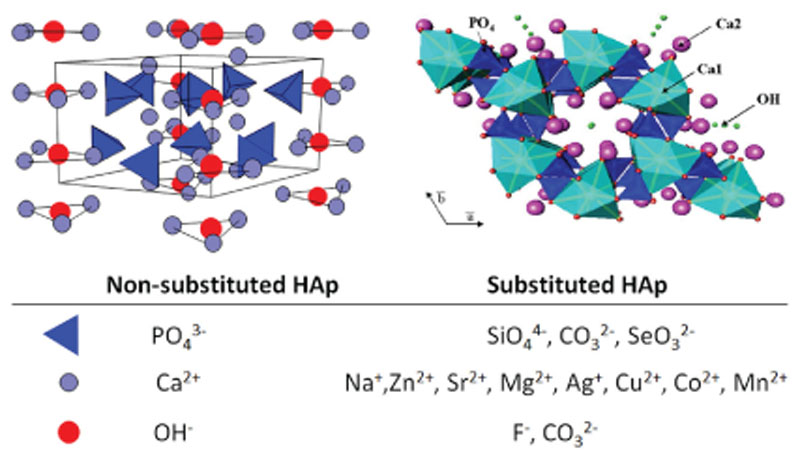
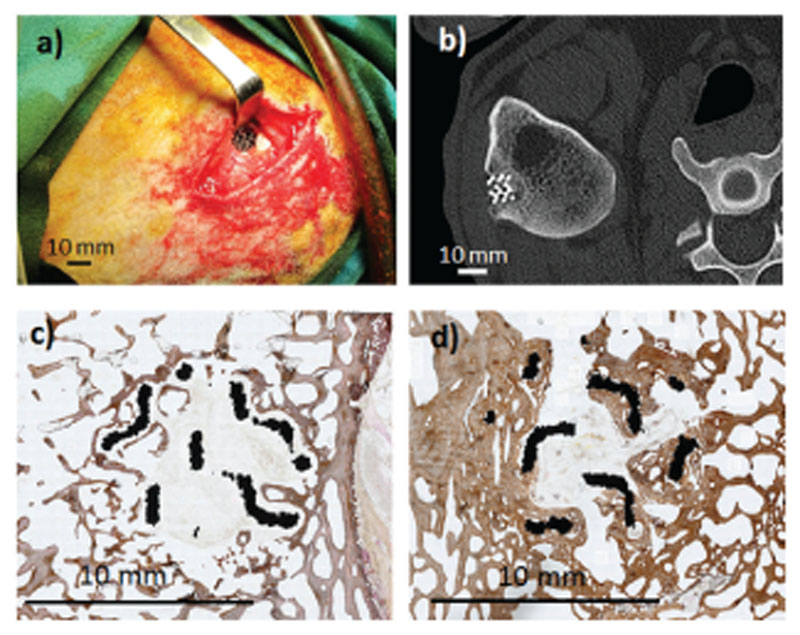
Surface modification of orthopedic and dental implants has been demonstrated to be an effective strategy to accelerate bone healing at early implantation times. Among the different alternatives, coating implants with a layer of hydroxyapatite (HAp) is one of the most used techniques, due to its excellent biocompatibility and osteoconductive behavior. The composition and crystalline structure of HAp allow for numerous ionic substitutions that provide added value, such as antibiotic properties or osteoinduction. In this article, we will review and critically analyze the most important advances in the field of substituted hydroxyapatite coatings. In recent years substituted HAp coatings have been deposited not only on orthopedic prostheses and dental implants, but also on macroporous scaffolds, thus expanding their applications towards bone regeneration therapies. Besides, the capability of substituted HAps to immobilize proteins and growth factors by non-covalent interactions has opened new possibilities for preparing hybrid coatings that foster bone healing processes. Finally, the most important in vivo outcomes will be discussed to understand the prospects of substituted HAp coatings from a clinical point of view.
表面改性的骨科和牙科植入物已被证明是一种有效的策略,以加速骨愈合在早期植入时间。在不同的替代方案中,涂层植入物的一层羟基磷灰石(HAp)是最常用的技术之一,由于其优异的生物相容性和骨诱导。HAp 的组成和晶体结构允许许多离子取代,提供附加值,如抗生素性能或成骨诱导。在本文中,我们将回顾和批判性分析在取代的羟基磷灰石涂层领域最重要的进展。近年来,取代的 HAp 涂层不仅沉积在骨科假体和牙科植入物上,而且还沉积在大孔支架上,从而将其应用扩展到骨再生治疗领域。此外,取代的 HAps 通过非共价相互作用固定蛋白质和生长因子的能力为制备促进骨愈合过程的混合涂层开辟了新的可能性。最后,将讨论最重要的体内结果,从临床角度了解取代的 HAp 涂层的前景。