Hawley Aubree L, Gbur Edward, Tacinelli Angela M, Walker Sam, Murphy Allie, Burgess Regan, Baum Jamie I
Department of Food Science, Center for Human Nutrition, University of Arkansas, Fayetteville, AR, USA.
Agricultural Statistics Laboratory, University of Arkansas, Fayetteville, AR, USA.
Curr Dev Nutr. 2020 Jan 22;4(2):nzaa009. doi: 10.1093/cdn/nzaa009. eCollection 2020 Feb.
Diets higher in protein have been reported to improve age-related changes in body composition via increased energy expenditure, shifts in substrate oxidation (SO), and decreased appetite. However, how protein source (e.g., animal compared with plant protein) affects energy expenditure, appetite, and food intake as we age is unknown.
The objective of this study was to evaluate the effect of protein source as part of a high-protein breakfast on appetite, food intake, energy expenditure, and fat oxidation in young men (YM) compared with older men (OM).
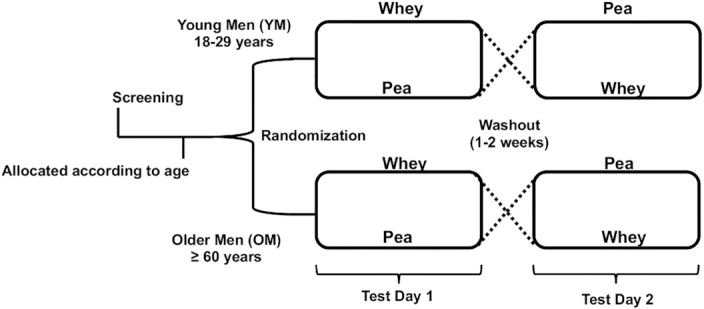
This study used a randomized, single-blinded crossover design, with a 1-wk washout period between testing days. Fifteen YM (mean ± SD age: 25.2 ± 2.8 y) and 15 OM (67.7 ± 4.5 y), healthy adults, participated in the study. Participants arrived fasted and consumed an isocaloric, volume-matched, high-protein (40-g) test beverage made with either an animal [whey protein isolate (WPI)] or plant [pea protein isolate (PPI)] protein isolate source. Markers of appetite and energy expenditure were determined at baseline and over 4 h postprandial.
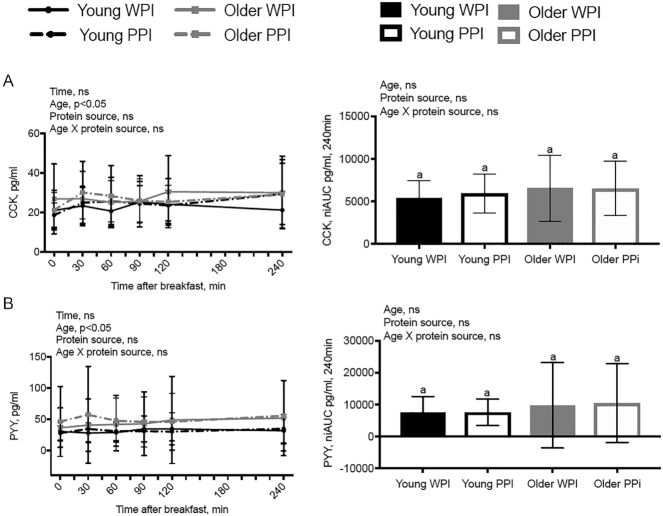
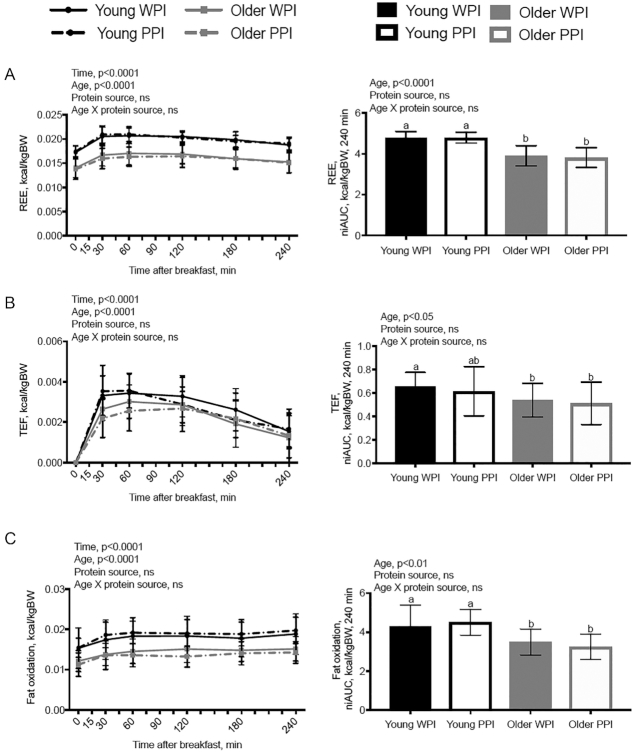
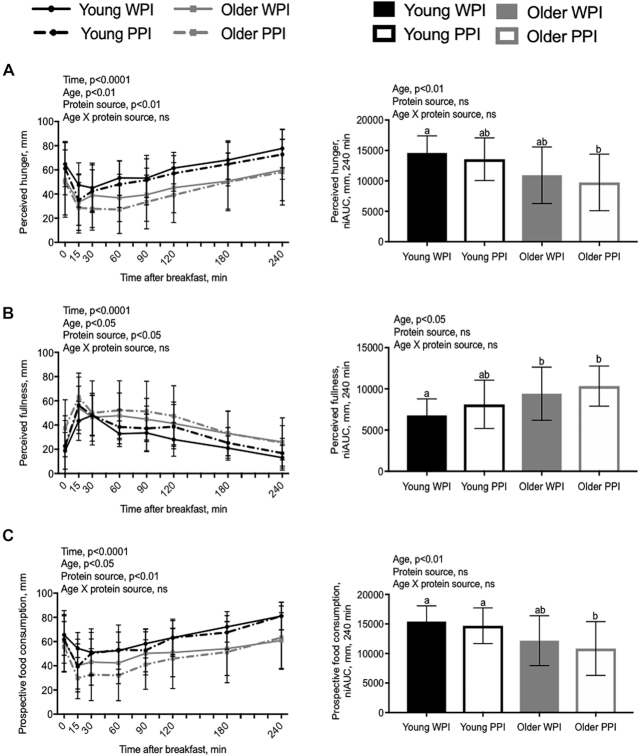
There was a significant effect of time, age, and protein source on appetite ( < 0.05). There was no effect of protein source on plasma markers of appetite, food intake, energy expenditure, and SO. After controlling for body weight, OM had decreased energy expenditure ( < 0.05) and lower fat oxidation ( < 0.001) compared with YM.
This study indicates that a high-protein breakfast containing WPI or PPI exerts comparable effects on appetite, energy expenditure, and 24-h energy intake in both young and older healthy adult men.This trial was registered at clinicaltrials.gov as NCT03399812.
据报道,高蛋白饮食可通过增加能量消耗、改变底物氧化(SO)和降低食欲来改善与年龄相关的身体成分变化。然而,随着年龄增长,蛋白质来源(如动物蛋白与植物蛋白相比)如何影响能量消耗、食欲和食物摄入量尚不清楚。
本研究的目的是评估与老年男性(OM)相比,高蛋白早餐中蛋白质来源对年轻男性(YM)食欲、食物摄入量、能量消耗和脂肪氧化的影响。
本研究采用随机、单盲交叉设计,测试日之间有1周的洗脱期。15名YM(平均±标准差年龄:25.2±2.8岁)和15名OM(67.7±4.5岁)健康成年人参与了研究。参与者空腹到达,食用一种等热量、体积匹配的高蛋白(40克)测试饮料,该饮料由动物[乳清蛋白分离物(WPI)]或植物[豌豆蛋白分离物(PPI)]蛋白分离物制成。在基线和餐后4小时内测定食欲和能量消耗指标。
时间、年龄和蛋白质来源对食欲有显著影响(P<0.05)。蛋白质来源对食欲、食物摄入量、能量消耗和SO的血浆标志物没有影响。在控制体重后,与YM相比,OM的能量消耗降低(P<0.05),脂肪氧化较低(P<0.001)。
本研究表明,含有WPI或PPI的高蛋白早餐对年轻和老年健康成年男性的食欲、能量消耗和24小时能量摄入具有相似的影响。该试验在clinicaltrials.gov上注册,注册号为NCT03399812。