Hemamy Mostafa, Heidari-Beni Motahar, Askari Gholamreza, Karahmadi Mojgan, Maracy Mohammadreza
Department of Community Nutrition, School of Nutrition and Food Sciences, Isfahan University of Medical Sciences, Isfahan, Iran.
Child Growth and Development Research Center, Research Institute for Primordial Prevention of Non-Communicable Disease, Isfahan University of Medical Sciences, Isfahan, Iran.
Int J Prev Med. 2020 Jan 24;11:4. doi: 10.4103/ijpvm.IJPVM_546_17. eCollection 2020.
Attention-deficit hyperactivity disorder (ADHD) is a neurodevelopmental disorder characterized by the three main symptom domains including inattention, hyperactivity, and impulsivity. Recent findings suggested that nutrients might play an important role in the pathology of ADHD. The present study aimed to examine the effects of Vitamin D and magnesium supplementation on behavior problems in children with ADHD.
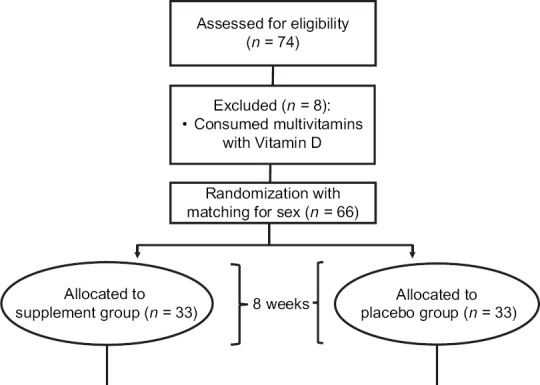
This double-blind, randomized controlled clinical trial study was conducted on 66 children with ADHD in Clinic of Noor and Ali Asghar Hospital in Isfahan, Iran, in 2016. Children were randomly allocated to receive both Vitamin D (50,000 IU/week) and magnesium (6 mg/kg/day) supplements ( = 33) or placebos ( = 33) for 8 weeks. Conners' Parent Rating Scale was used to evaluate children's behavior at baseline and at the end of the study.
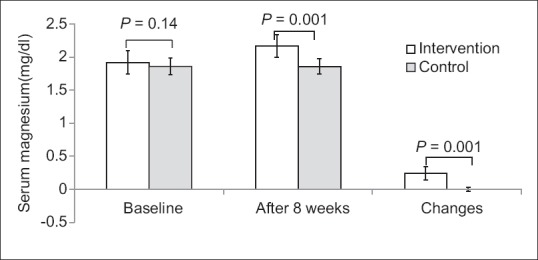
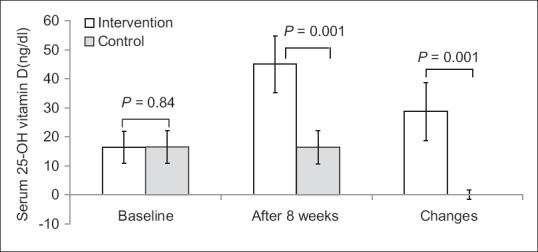
After 8 weeks of Vitamin D consumption as well as magnesium, the serum levels of 25-hydroxy-Vitamin D3 and magnesium increased significantly in the intervention group compared with placebo group. Supplementation with Vitamin D and magnesium caused a significant decrease in conduct problems, social problems, and anxiety/shy scores; but it had no significant effect on psychosomatic problems score.
Vitamin D and magnesium supplementation in children with ADHD was effective on conduct problems, social problems, and anxiety/shy scores compared with placebo intake, but it did not affect psychosomatic problem scores, significantly.
注意力缺陷多动障碍(ADHD)是一种神经发育障碍,其特征在于三个主要症状领域,包括注意力不集中、多动和冲动。最近的研究结果表明,营养物质可能在ADHD的病理过程中发挥重要作用。本研究旨在探讨补充维生素D和镁对ADHD儿童行为问题的影响。
2016年,在伊朗伊斯法罕的努尔和阿里·阿斯加尔医院诊所对66名ADHD儿童进行了这项双盲、随机对照临床试验研究。儿童被随机分配接受维生素D(50,000 IU/周)和镁(6 mg/kg/天)补充剂(n = 33)或安慰剂(n = 33),为期8周。使用康纳斯父母评定量表在基线和研究结束时评估儿童的行为。
与安慰剂组相比,干预组在服用维生素D和镁8周后,血清25-羟基维生素D3和镁水平显著升高。补充维生素D和镁导致品行问题、社交问题和焦虑/害羞得分显著降低;但对身心问题得分没有显著影响。
与服用安慰剂相比,补充维生素D和镁对ADHD儿童的品行问题、社交问题和焦虑/害羞得分有效,但对身心问题得分没有显著影响。