Akrami Atefeh, Makiabadi Elham, Askarpour Moein, Zamani Katayoun, Hadi Amir, Mokari-Yamchi Amin, Babajafari Siavash, Faghih Shiva, Hojhabrimanesh Abdollah
Nutrition Research Center, School of Nutrition and Food Sciences, Shiraz University of Medical Sciences, Shiraz 71348-14336, Iran.
Department of Community Nutrition, School of Nutrition and Food Sciences, Shiraz University of Medical Sciences, Shiraz 71348-14336, Iran.
Clin Nutr Res. 2020 Jan 29;9(1):63-72. doi: 10.7762/cnr.2020.9.1.63. eCollection 2020 Jan.
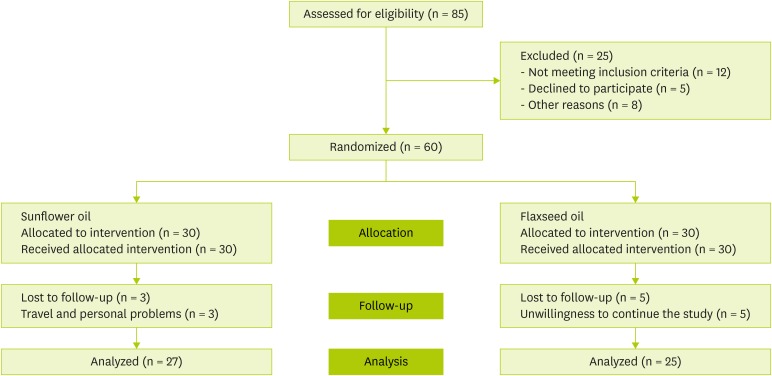
Metabolic syndrome (MetS) is a chronic disease with inflammatory and hypercoagulable states. The current study aimed to compare the effects of flaxseed oil and sunflower oil consumption on the coagulation score and selected oxidative and inflammatory parameters in patients with MetS. In this randomized controlled clinical trial, 60 patients with MetS were allocated into 2 groups. One group received 25 mL/day flaxseed oil and the other group received 25 mL/day sunflower oil for 7 weeks. Maintenance diet including 15% protein, 55% carbohydrate, and 30% fat from daily total energy intake was designed for each participant. Serum levels of total antioxidant capacity (TAC) and interleukin 6 (IL-6), as well as coagulation score were measured before and after the intervention. Three 24-hour food records were taken during the study. Fifty-two of participants (27 in sunflower oil and 25 in flaxseed oil groups) completed the study. The baseline characteristics and dietary intakes were similar between patients. After 7 weeks, no significant difference was observed between the 2 groups regarding the serum TAC level and coagulation score (p > 0.05). However, serum IL-6 levels significantly decreased in the flaxseed oil group compared to the sunflower oil group (p = 0.017). No side effect was observed during the study due to the use of sunflower and flaxseed oils. We observed that consumption of flaxseed oil improved serum IL-6 levels but had no effect on oxidative stress and coagulation score in patients with MetS. Further studies are needed to confirm the veracity of our results.
Iranian Registry of Clinical Trials Identifier: IRCT2015012020737N1.
代谢综合征(MetS)是一种具有炎症和高凝状态的慢性疾病。本研究旨在比较食用亚麻籽油和葵花籽油对代谢综合征患者凝血评分以及所选氧化和炎症参数的影响。在这项随机对照临床试验中,60名代谢综合征患者被分为两组。一组每天服用25毫升亚麻籽油,另一组每天服用25毫升葵花籽油,持续7周。为每位参与者设计了维持饮食,其每日总能量摄入中蛋白质占15%、碳水化合物占55%、脂肪占30%。在干预前后测量血清总抗氧化能力(TAC)、白细胞介素6(IL - 6)水平以及凝血评分。研究期间进行了三次24小时饮食记录。52名参与者(葵花籽油组27名,亚麻籽油组25名)完成了研究。患者之间的基线特征和饮食摄入量相似。7周后,两组在血清TAC水平和凝血评分方面未观察到显著差异(p > 0.05)。然而,与葵花籽油组相比,亚麻籽油组的血清IL - 6水平显著降低(p = 0.017)。在研究期间,由于使用葵花籽油和亚麻籽油未观察到副作用。我们观察到,食用亚麻籽油可改善代谢综合征患者的血清IL - 6水平,但对氧化应激和凝血评分无影响。需要进一步研究来证实我们结果的真实性。
伊朗临床试验注册中心标识符:IRCT2015012020737N1。