Department of Clinical Medicine and Therapeutics, University of Nairobi, Nairobi, Kenya.
Healthy Heart Africa, Nairobi, Kenya.
BMC Public Health. 2020 Mar 3;20(1):281. doi: 10.1186/s12889-020-8363-z.
Hypertension is the leading risk factor for mortality globally. African countries, including Kenya, have a high and rising prevalence of hypertension. Prehypertension is associated with an increased risk of progression to overt hypertension and a higher risk of cardiovascular disease and mortality. Despite this, little is documented on the prevalence and distribution of prehypertension in sub-Saharan Africa. This study sought to estimate the overall burden of prehypertension in Kenyan adults enrolled in a large hypertension control programme, Healthy Heart Africa. The distribution and determinants of prehypertension in the sample were explored as secondary objectives.
This was a post hoc analysis of cross-sectional data obtained from population-level blood pressure (BP) screening of adults aged ≥18 years in the community and ambulatory care facilities in 17/47 sub-national administrative units in Kenya. All participants with a complete record for systolic and diastolic BP were included. Descriptive analyses were performed for sociodemographic characteristics. Pearson's chi-square test was used to assess differences in categorical variables. Multivariate logistic regression analysis was performed to identify factors independently associated with prehypertension.
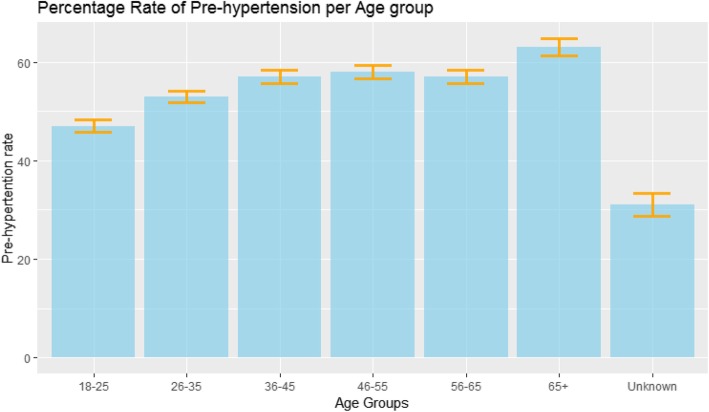
Of 5,985,185 participant records that were included in the analysis, 34% were men (mean age: 45 [SD 2.9] years). The majority (63%) lived in rural Kenya. The prevalence of prehypertension was 54.5% and that of hypertension was 20.8%. Characteristics that were independently associated with prehypertension (adjusted odds ratio [95% CI]) included male sex (1.23 [±0.0023], p < 0.001 for all age groups > 25 years) and rural residence (1.60 [±0.023], p < 0.001).
Approximately one in every two Kenyan adults has prehypertension. This calls for urgent development and roll-out of a national BP screening and control programme. It also provides a strong basis for the formulation of multisectoral national policies that will ensure implementation of evidence-based, low-cost public health interventions geared towards primary prevention of hypertension, especially in population groups that are traditionally considered at low risk, such as young adults and rural residents.
高血压是全球死亡的主要危险因素。包括肯尼亚在内的非洲国家高血压的患病率居高不下且呈上升趋势。高血压前期与高血压进展风险增加和心血管疾病及死亡率升高相关。尽管如此,撒哈拉以南非洲高血压前期的患病率和分布情况记录甚少。本研究旨在评估参与大型高血压控制项目“非洲健康心脏”的肯尼亚成年人中高血压前期的总体负担。作为次要目标,还探讨了该样本中高血压前期的分布和决定因素。
这是对肯尼亚社区和流动医疗设施中 17/47 个次国家级行政区 18 岁以上成年人进行人群水平血压(BP)筛查后获得的横断面数据的事后分析。所有记录完整收缩压和舒张压的参与者均被纳入分析。对社会人口统计学特征进行描述性分析。使用 Pearson's chi-square 检验评估分类变量的差异。采用多元逻辑回归分析确定与高血压前期独立相关的因素。
纳入分析的 5985185 名参与者记录中,34%为男性(平均年龄:45 [2.9] 岁)。大多数(63%)居住在肯尼亚农村。高血压前期的患病率为 54.5%,高血压的患病率为 20.8%。与高血压前期独立相关的特征(调整后比值比[95%CI])包括男性(所有年龄组>25 岁者 1.23 [±0.0023],p<0.001)和农村居住(1.60 [±0.023],p<0.001)。
肯尼亚约有二分之一的成年人患有高血压前期。这呼吁紧急制定和推行全国 BP 筛查和控制计划。这也为制定多部门国家政策提供了强有力的依据,这些政策将确保实施基于证据、低成本的公共卫生干预措施,特别是针对那些传统上被认为风险较低的人群,如年轻成年人和农村居民,以实现高血压的一级预防。