Lee Donguk, Han Woojae
Laboratory of Hearing and Technology, Research Institute of Audiology and Speech Pathology, Hallym University, Chuncheon; Division of Speech Pathology and Audiology, College of Natural Sciences, Hallym University, Chuncheon; Department of Audiology and Speech Pathology, The University of Tennessee Health Science Center, Knoxville, TN, USA, Republic of Korea.
Laboratory of Hearing and Technology, Research Institute of Audiology and Speech Pathology, Hallym University, Chuncheon; Division of Speech Pathology and Audiology, College of Natural Sciences, Hallym University, Chuncheon, Republic of Korea.
Noise Health. 2019 Mar-Apr;21(99):47-54. doi: 10.4103/nah.NAH_39_18.
Many public health professionals have expressed concern that regular participation in recreational settings with high noise levels might induce hearing loss. This study measures the noise levels in a baseball stadium and analyzes baseball fans' attitude of effect of recreational noise exposure on their hearing.
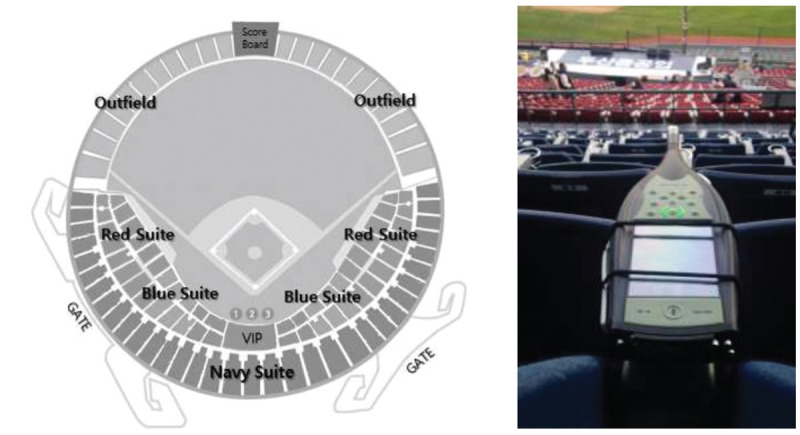
In the baseball stadium, noise levels from the beginning to the end of four games were measured in four seating sections, the red, blue, navy, and outfield sections using a sound level meter. For the survey sample, 344 randomly selected participants who visited the stadium and/or were baseball fans completed a 16-question survey on their noise exposure during the game and on the potential risk of hearing loss.
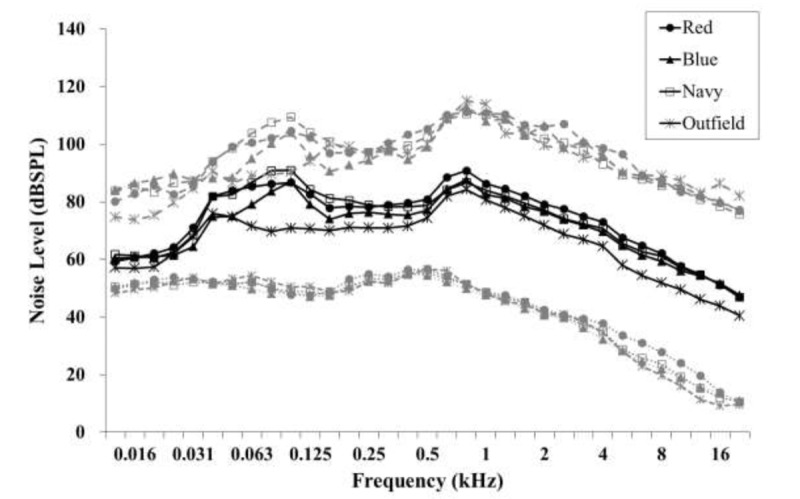
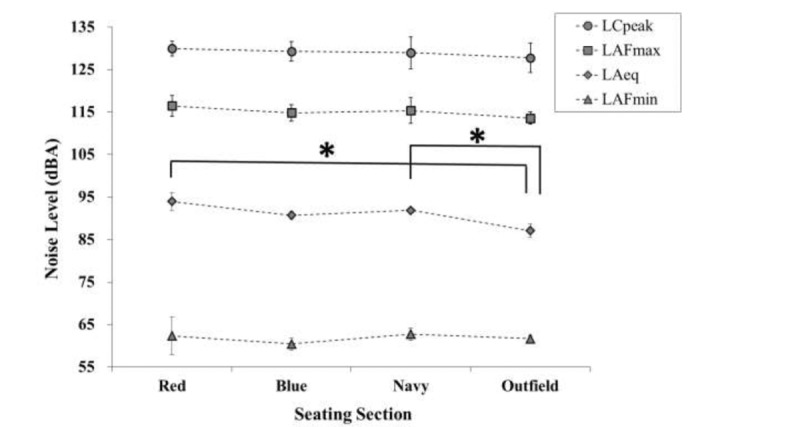
The LAeq average of the 16 measures produced 91.7 dBA, showing a significantly high noise level in the red and navy sections. As a function of frequency by LZeq analysis, the noise levels of low frequencies between 0.05 and 1 kHz were significantly higher than other frequencies except for the outfield section, but the levels abruptly decreased above 1 kHz. Despite the very high noise levels, 70% of the respondents preferred sitting in either the red or the navy section to be closer to the cheerleaders and to obtain a good view. Most respondents reported that they did not consider wearing earplugs, and one-third experienced hearing muffled speech after the game. Notably, they agreed that an information announcement regarding loud noise and hearing protection was needed at the stadium.
We conclude that the noise levels in baseball stadiums are high enough to cause hearing damage and/or tinnitus later when applying a rule of 85 dB LAeq for 8 hours with a 3-dB exchange rate. We expect these results to improve public education regarding safe noise exposure during popular sports activities.
许多公共卫生专业人员担心,经常置身于噪音水平高的娱乐场所可能会导致听力损失。本研究测量了棒球场的噪音水平,并分析了棒球迷对娱乐性噪音暴露对其听力影响的态度。
在棒球场中,使用声级计在四个座位区(红色、蓝色、海军蓝色和外场区域)测量了四场比赛从开始到结束的噪音水平。对于调查样本,344名随机选择的参观过该体育场和/或为棒球迷的参与者完成了一项包含16个问题的调查,内容涉及他们在比赛期间的噪音暴露情况以及听力损失的潜在风险。
16次测量的等效连续A声级(LAeq)平均值为91.7分贝,表明红色和海军蓝色区域的噪音水平显著较高。通过等效连续Z声级(LZeq)分析,除了外场区域,0.05至1千赫兹之间的低频噪音水平显著高于其他频率,但在1千赫兹以上水平急剧下降。尽管噪音水平非常高,但70%的受访者更喜欢坐在红色或海军蓝色区域,以便更靠近啦啦队并获得良好视野。大多数受访者表示他们没有考虑佩戴耳塞,三分之一的人在比赛后经历了听力模糊的情况。值得注意的是,他们一致认为体育场需要发布有关高分贝噪音和听力保护的信息公告。
我们得出结论,按照85分贝等效连续A声级暴露8小时且以3分贝为交换率的规则,棒球场的噪音水平高到足以在以后导致听力损伤和/或耳鸣。我们期望这些结果能改善公众对热门体育活动期间安全噪音暴露的教育。