Lu Dave W, Lall Michelle D, Mitzman Jennifer, Heron Sheryl, Pierce Ava, Hartman Nicholas D, McCarthy Danielle M, Jauregui Joshua, Strout Tania D
Tufts University School of Medicine - Maine Medical Center, Department of Emergency Medicine, Portland, Maine.
University of Washington School of Medicine, Department of Emergency Medicine, Seattle, Washington.
West J Emerg Med. 2020 Feb 21;21(2):252-260. doi: 10.5811/westjem.2019.11.44592.
Gender-based discrimination and sexual harassment of female physicians are well documented. The #MeToo movement has brought renewed attention to these problems. This study examined academic emergency physicians' experiences with workplace gender discrimination and sexual harassment.
We conducted a cross-sectional survey of a convenience sample of emergency medicine (EM) faculty across six programs. Survey items included the following: the Overt Gender Discrimination at Work (OGDW) Scale; the frequency and source of experienced and observed discrimination; and whether subjects had encountered unwanted sexual behaviors by a work superior or colleague in their careers. For the latter question, we asked subjects to characterize the behaviors and whether those experiences had a negative effect on their self-confidence and career advancement. We made group comparisons using t-tests or chi-square analyses, and evaluated relationships between gender and physicians' experiences using correlation analyses.
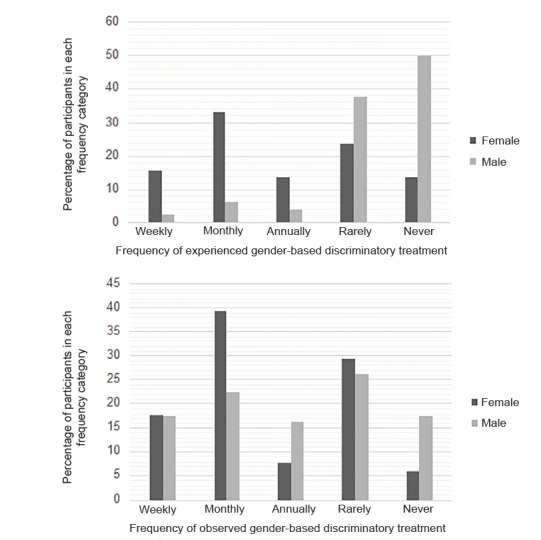
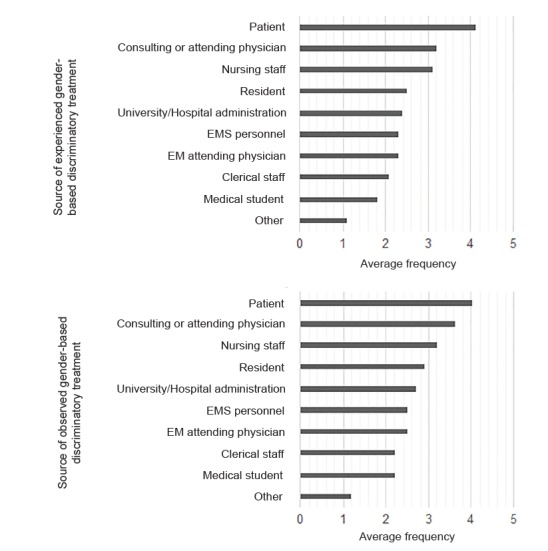
A total of 141 out of 352 (40.1%) subjects completed at least a portion of the survey. Women reported higher mean OGDW scores than men (15.4 vs 10.2; 95% confidence interval [CI], 3.6-6.8). Female faculty were also more likely to report having experienced gender-based discriminatory treatment than male faculty (62.7% vs 12.5%; 95% CI, 35.1%-65.4%), although male and female faculty were equally likely to report having observed gender-based discriminatory treatment of another physician (64.7% vs 56.3%; 95% CI, 8.6%-25.5%). The three most frequent sources of experienced or observed gender-based discriminatory treatment were patients, consulting or admitting physicians, and nursing staff. The majority of women reported having encountered unwanted sexual behaviors in their careers, with a significantly greater proportion of women reporting them compared to men (52.9% vs 26.2%, 95% CI, 9.9%-43.4%). The majority of unwanted behaviors were sexist remarks and sexual advances. Of those respondents who encountered these unwanted behaviors, 22.9% and 12.5% reported at least somewhat negative effects on their self-confidence and career advancement.
Female EM faculty perceived more gender-based discrimination in their workplaces than their male counterparts. The majority of female and approximately a quarter of male EM faculty encountered unwanted sexual behaviors in their careers.
女性医生遭受基于性别的歧视和性骚扰的情况有充分记录。#MeToo运动再次引发了对这些问题的关注。本研究调查了学术急诊医生在工作场所遭遇性别歧视和性骚扰的经历。
我们对六个项目中的急诊医学(EM)教员便利样本进行了横断面调查。调查项目包括:工作场所公开性别歧视(OGDW)量表;经历和观察到的歧视的频率及来源;以及受试者在职业生涯中是否遭遇过上级或同事的不当性行为。对于后一个问题,我们要求受试者描述这些行为,以及这些经历是否对他们的自信和职业发展产生负面影响。我们使用t检验或卡方分析进行组间比较,并使用相关分析评估性别与医生经历之间的关系。
352名受试者中有141名(40.1%)至少完成了部分调查。女性报告的OGDW平均得分高于男性(15.4对10.2;95%置信区间[CI],3.6 - 6.8)。女性教员也比男性教员更有可能报告经历过基于性别的歧视性待遇(62.7%对12.5%;95%CI,35.1% - 65.4%),尽管男性和女性教员报告观察到对另一位医生的基于性别的歧视性待遇的可能性相同(64.7%对56.3%;95%CI,8.6% - 25.5%)。经历或观察到的基于性别的歧视性待遇的三个最常见来源是患者、会诊或收治医生以及护理人员。大多数女性报告在职业生涯中遭遇过不当性行为,报告遭遇此类行为的女性比例显著高于男性(52.9%对26.2%,95%CI,9.9% - 43.4%)。大多数不当行为是性别歧视言论和性侵犯。在遇到这些不当行为的受访者中,22.9%和12.5%报告这些行为至少对他们的自信和职业发展产生了一定的负面影响。
女性急诊医学教员比男性教员在工作场所感受到更多基于性别的歧视。大多数女性和大约四分之一的男性急诊医学教员在职业生涯中遭遇过不当性行为。