Aramoana Jaclyn, Koea Jonathan
North Shore Hospital, Takapuna, Auckland, New Zealand.
JCO Glob Oncol. 2020 Mar;6:83-91. doi: 10.1200/JGO.18.00156.
This investigation was undertaken to define the barriers to Indigenous peoples participating in biobanking and genomic research.
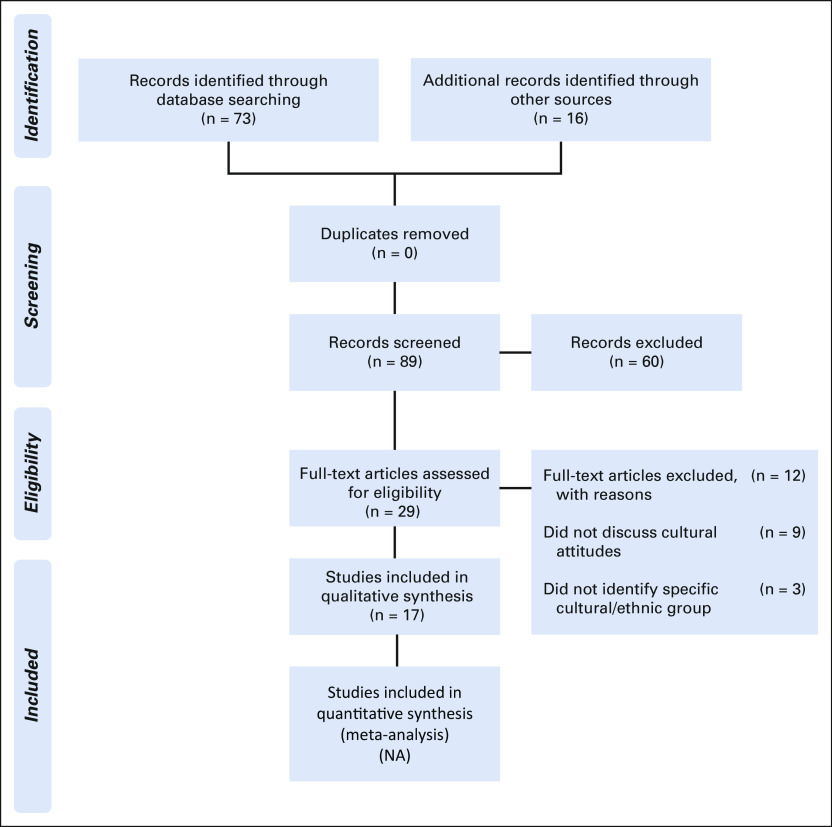
A literature review was conducted to identify studies reporting on the experience of Indigenous peoples with biobanking, tissue banking, and genomic research. Studies pertaining to organ transplantation or blood donation for transfusion were excluded. The databases searched were MEDLINE, EMBASE, PubMed, Web of Science, and Google Scholar, with all literature available until the search date of June 1, 2018, included. The reference lists of all included papers, as well as related review articles, were manually searched to identify additional relevant studies. An inductive approach was used to identify common themes.
Seventeen publications discussed the experiences of New Zealand Māori (n = 2), Aboriginal and Torres Strait Islanders (n = 3), Native Hawaiian (n = 4), Native Alaskan (n = 2), American First Nation (n = 2), or multiple ethnicities (n = 4). Across all Indigenous peoples, four themes emerged: land, ancestors, culture, and bodily substances are powerfully interconnected and can act on each other; tissue and blood can provide important information (both Western and traditional) about a person; the ownership of specimens-custodians, trustees, or guardians; and the beneficence of the researchers and research team.
Indigenous communities, like Western populations, are concerned with issues pertaining to handling, treatment, and ownership of tissue as well as knowledge gained from specimen analysis. Unlike many Western populations, Indigenous communities have retained a strong sense of cultural connection to ancestors and traditional lands and view biologic specimens as inseparable from these things.
开展此项调查以明确原住民参与生物样本库和基因组研究的障碍。
进行文献综述,以识别报告原住民在生物样本库、组织库和基因组研究方面经历的研究。排除与器官移植或输血用血捐献相关的研究。检索的数据库有MEDLINE、EMBASE、PubMed、科学网和谷歌学术,纳入截至2018年6月1日检索日期的所有可用文献。对所有纳入论文的参考文献列表以及相关综述文章进行人工检索,以识别其他相关研究。采用归纳法确定共同主题。
17篇出版物讨论了新西兰毛利人(n = 2)、澳大利亚原住民和托雷斯海峡岛民(n = 3)、夏威夷原住民(n = 4)、阿拉斯加原住民(n = 2)、美国原住民(n = 2)或多个种族(n = 4)的经历。在所有原住民群体中,出现了四个主题:土地、祖先、文化和身体物质紧密相连且相互影响;组织和血液可以提供有关一个人的重要信息(包括西方和传统信息);样本的所有权——保管人、受托人或监护人;以及研究人员和研究团队的善举。
与西方人群一样,原住民社区关注与组织的处理、治疗和所有权以及从样本分析中获得的知识相关的问题。与许多西方人群不同的是,原住民社区与祖先和传统土地保持着强烈的文化联系,并将生物样本视为与这些事物不可分割。