Bultink C C, O'Brien T E, Vollmer R, Muthusubramanian N, Beekman M W, Rol M A, Fu X, Tarasinski B, Ostroukh V, Varbanov B, Bruno A, DiCarlo L
QuTech, Delft University of Technology P.O. Box 5046, 2600 GA Delft, Netherlands.
Kavli Institute of Nanoscience, Delft University of Technology P.O. Box 5046, 2600 GA Delft, Netherlands.
Sci Adv. 2020 Mar 20;6(12):eaay3050. doi: 10.1126/sciadv.aay3050. eCollection 2020 Mar.
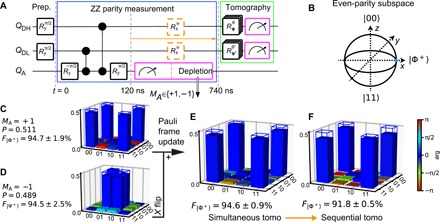
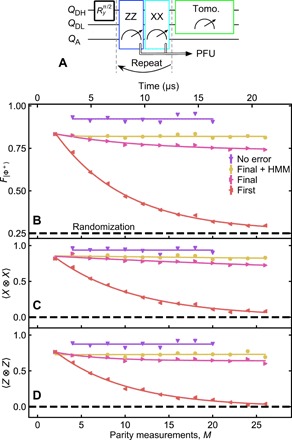
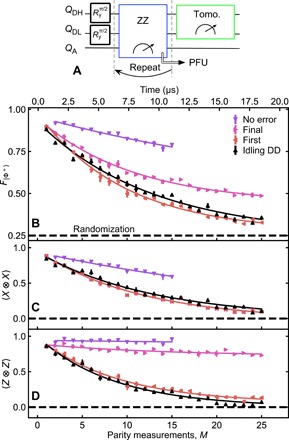
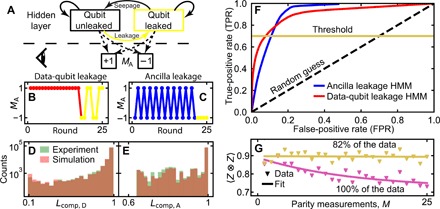
Protecting quantum information from errors is essential for large-scale quantum computation. Quantum error correction (QEC) encodes information in entangled states of many qubits and performs parity measurements to identify errors without destroying the encoded information. However, traditional QEC cannot handle leakage from the qubit computational space. Leakage affects leading experimental platforms, based on trapped ions and superconducting circuits, which use effective qubits within many-level physical systems. We investigate how two-transmon entangled states evolve under repeated parity measurements and demonstrate the use of hidden Markov models to detect leakage using only the record of parity measurement outcomes required for QEC. We show the stabilization of Bell states over up to 26 parity measurements by mitigating leakage using postselection and correcting qubit errors using Pauli-frame transformations. Our leakage identification method is computationally efficient and thus compatible with real-time leakage tracking and correction in larger quantum processors.
保护量子信息免受错误影响对于大规模量子计算至关重要。量子纠错(QEC)将信息编码在多个量子比特的纠缠态中,并执行奇偶校验测量以识别错误而不破坏编码信息。然而,传统的量子纠错无法处理量子比特计算空间的泄漏。泄漏影响了基于俘获离子和超导电路的主流实验平台,这些平台在多能级物理系统中使用有效量子比特。我们研究了双跨导量子比特纠缠态在重复奇偶校验测量下如何演化,并展示了使用隐马尔可夫模型仅通过量子纠错所需的奇偶校验测量结果记录来检测泄漏。我们通过后选择减轻泄漏并使用泡利框架变换校正量子比特错误,展示了贝尔态在多达26次奇偶校验测量中的稳定性。我们的泄漏识别方法计算效率高,因此与更大规模量子处理器中的实时泄漏跟踪和校正兼容。