Wen Jun, Herron Sterling A, Yang Xue, Liu Bin-Bin, Zuo Yun-Juan, Harris A J, Kalburgi Yash, Johnson Gabriel, Zimmer Elizabeth A
Department of Botany, National Museum of Natural History, Smithsonian Institution, Washington, DC, United States.
Donald Danforth Plant Science Center, St. Louis, MO, United States.
Front Plant Sci. 2020 Mar 17;11:263. doi: 10.3389/fpls.2020.00263. eCollection 2020.
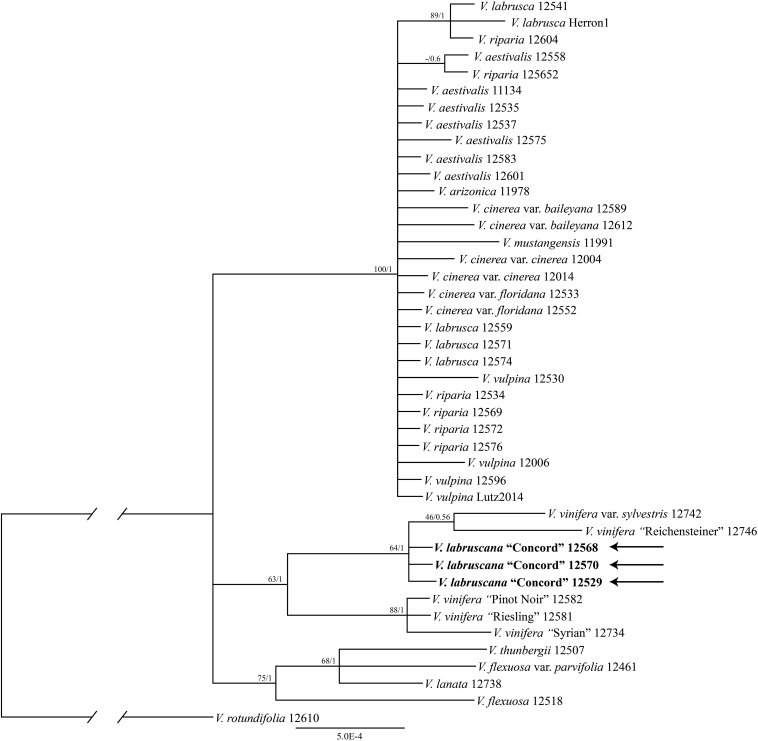
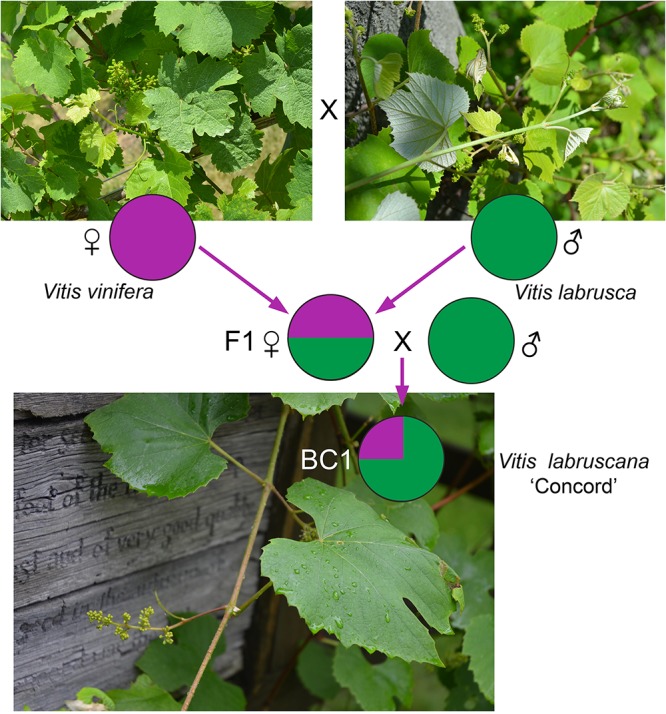
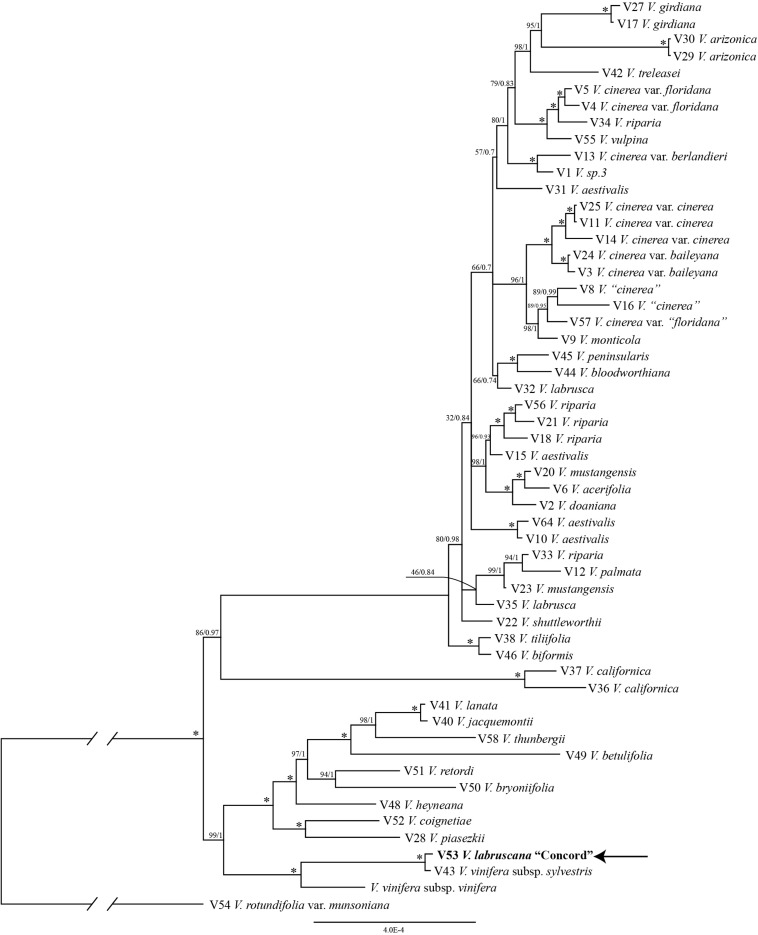
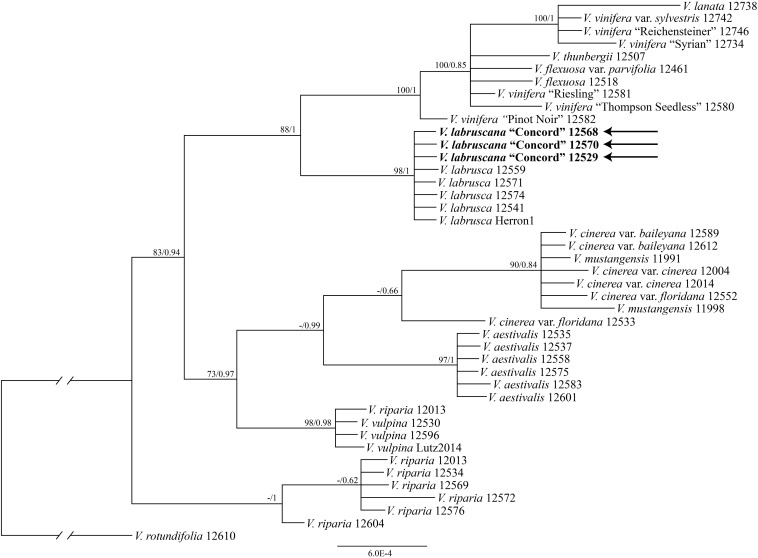
Despite the commercial importance of the Concord grape, its origin has remained unresolved for over 150 years without a comprehensive phylogenetic analysis. In this study we aimed to reconstruct the evolutionary history of the Concord grape using sequence data from four nuclear markers (, , , and ), six plastid markers (, , , , , and ), and the plastid genome. We sampled extensively the species native to northeastern North America as well as representative species from Europe and Asia, including the commercially important (wine grape), a native European species with hermaphroditic flowers, and its wild progenitor, . subsp. . We also sequenced the plastid genome of one accession of the Concord grape and compared the plastid genome data to the recently published data set of plastomes. Phylogenetic analyses of the plastid and nuclear data using maximum likelihood and Bayesian inference support the hybrid origin of the Concord grape. The results clearly pinpoint the wine grape, . , as the maternal donor and the fox grape, , which is common in northeastern North America, as the paternal donor. Moreover, we infer that the breeding history of the Concord grape must have involved the backcrossing of the F1 hybrid with the paternal parent . . This backcrossing also explains the higher morphological similarity of the Concord grape to . than to . . This study provides concrete genetic evidence for the hybrid origin of a widespread cultivar and is, therefore, promising for similar future studies focused on resolving ambiguous origins of major crops or to create successful hybrid fruit crops.
尽管康科德葡萄具有商业重要性,但其起源在超过150年的时间里一直未得到解决,而没有进行全面的系统发育分析。在本研究中,我们旨在利用来自四个核标记(、、、和)、六个质体标记(、、、、、和)以及质体基因组的序列数据,重建康科德葡萄的进化历史。我们广泛采样了北美东北部的本土物种以及来自欧洲和亚洲的代表性物种,包括具有商业重要性的(酿酒葡萄),一种具有两性花的欧洲本土物种,及其野生祖先,亚种。我们还对一份康科德葡萄的质体基因组进行了测序,并将质体基因组数据与最近发表的个质体基因组数据集进行了比较。使用最大似然法和贝叶斯推断对质体和核数据进行的系统发育分析支持了康科德葡萄的杂交起源。结果清楚地确定酿酒葡萄,作为母本供体,而在北美东北部很常见的狐葡萄,作为父本供体。此外,我们推断康科德葡萄的育种历史一定涉及F1杂种与父本的回交。这种回交也解释了康科德葡萄与在形态上比与更相似的原因。本研究为一种广泛种植的品种的杂交起源提供了具体的遗传证据,因此,对于未来类似的专注于解决主要作物模糊起源或创造成功杂交水果作物的研究具有前景。