Wathoni Nasrul, Rusdin Agus, Motoyama Keiichi, Joni I Made, Lesmana Ronny, Muchtaridi Muchtaridi
Department of Pharmaceutics and Pharmaceutical Technology, Faculty of Pharmacy, Universitas Padjadjaran, Sumedang 45363, Indonesia.
Department of Pharmacy, Faculty of Sports and Health, Universitas Negeri Gorontalo, Gorontalo 96128, Indonesia.
Nanotechnol Sci Appl. 2020 Apr 1;13:23-36. doi: 10.2147/NSA.S243017. eCollection 2020.
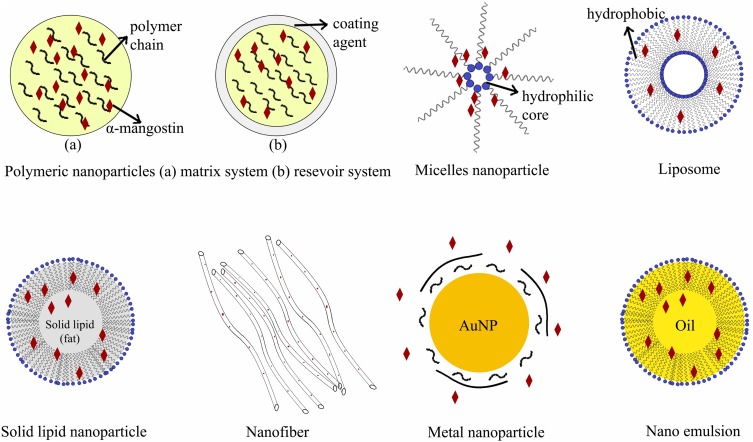
α-Mangostin, a xanthone derivative from the pericarp of L., has numerous bioactivities and pharmacological properties. However, α-mangostin has low aqueous solubility and poor target selectivity in the human body. Recently, nanoparticle drug delivery systems have become an excellent technique to improve the physicochemical properties and effectiveness of drugs. Therefore, many efforts have been made to overcome the limitations of α-mangostin through nanoparticle formulations. Our review aimed to summarise and discuss the nanoparticle drug delivery systems for α-mangostin from published papers recorded in Scopus, PubMed and Google Scholar. We examined various types of nanoparticles for α-mangostin to enhance water solubility, provide controlled release and create targeted delivery systems. These forms include polymeric nanoparticles, nanomicelles, liposomes, solid lipid nanoparticles, nanofibers and nanoemulsions. Notably, nanomicelle modification increased α-mangostin solubility increased more than 10,000 fold. Additionally, polymeric nanoparticles provided targeted delivery and significantly enhanced the biodistribution of α-mangostin into specific organs. In conclusion, the nanoparticle drug delivery system could be a promising technique to increase the solubility, selectivity and efficacy of α-mangostin as a new drug candidate in clinical therapy.
α-山竹黄酮是一种从山竹果皮中提取的氧杂蒽酮衍生物,具有多种生物活性和药理特性。然而,α-山竹黄酮在水中的溶解度较低,在人体内的靶向选择性较差。近年来,纳米颗粒药物递送系统已成为改善药物理化性质和有效性的一种优秀技术。因此,人们已经做出了许多努力,通过纳米颗粒制剂来克服α-山竹黄酮的局限性。我们的综述旨在总结和讨论Scopus、PubMed和谷歌学术记录的已发表论文中关于α-山竹黄酮的纳米颗粒药物递送系统。我们研究了用于α-山竹黄酮的各种类型的纳米颗粒,以提高其水溶性、实现控释并创建靶向递送系统。这些形式包括聚合物纳米颗粒、纳米胶束、脂质体、固体脂质纳米颗粒、纳米纤维和纳米乳液。值得注意的是,纳米胶束修饰使α-山竹黄酮的溶解度增加了10000多倍。此外,聚合物纳米颗粒提供了靶向递送,并显著增强了α-山竹黄酮在特定器官中的生物分布。总之,纳米颗粒药物递送系统可能是一种很有前景的技术,可提高α-山竹黄酮作为临床治疗新药候选物的溶解度、选择性和疗效。