Haghighi Amir Hossein, Khorasani Mohammad Taghi, Faghih Zahra, Farjadian Fatemeh
Department of Biomedical Engineering, Science and Research Branch, Islamic Azad University, Tehran, Iran.
Biomaterials Department, Iran Polymer and Petrochemical Institute, Tehran, Iran.
Heliyon. 2020 Apr 4;6(4):e03677. doi: 10.1016/j.heliyon.2020.e03677. eCollection 2020 Apr.
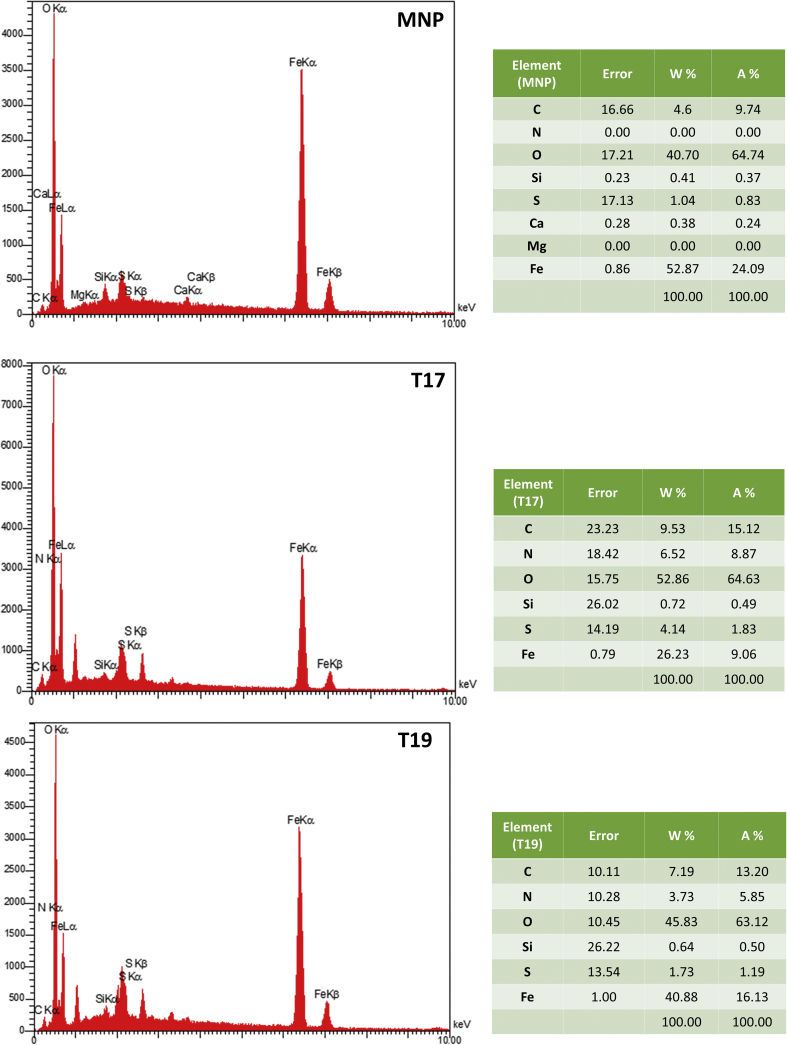
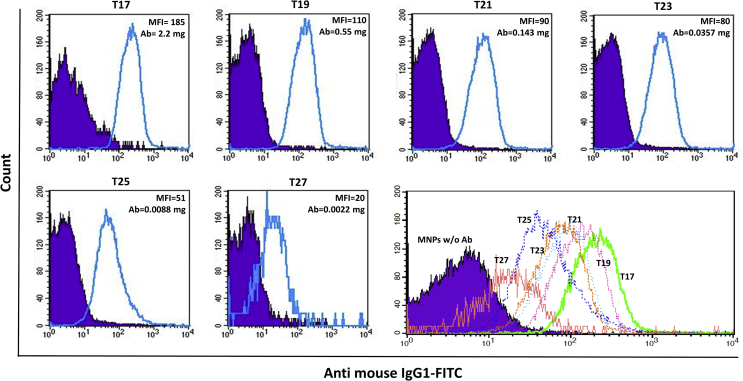
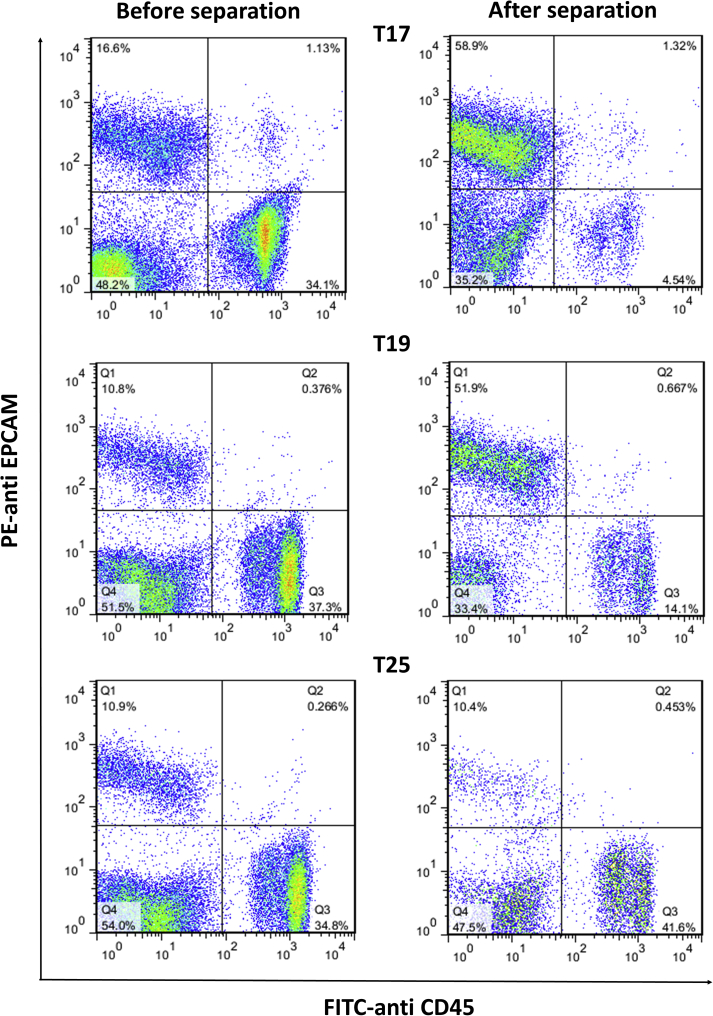
Antibody-conjugated magnetic nanoparticles (Ab-MNPs) have received considerable attention in bioseparation and clinical diagnostics assays due to their unique ability to detect and isolate a variety of biomolecules and cells. Because antibodies can be expensive, a key challenge for bioconjugation is to determine the optimal amount of antibodies with reasonable antigen-capturing activity. We designed an approach to determine the minimum amounts of antibodies for efficient coating. Different quantities of Herceptin (anti-human epidermal growth factor receptor 2: HER2) antibody were applied and immobilized on the surface of MNPs. Antibody binding was then checked by using an anti-human antibody conjugated with fluorochrome and flow cytometry. When the ratio of MNPs to antibodies increased from 0.79 to 795.45, mean fluorescence intensity (MFI) of conjugated MNPs decreased markedly from 185.56 to 20.07, indicating lower surface antibody coverage. We then investigated the relation between antibody content and isolation efficiency. Three Ab-MNP samples with different MFI were used to isolate SK-BR-3, a HER2-positive breast cancer cell line, from mixtures of whole blood or mononuclear cells. After isolation in a magnetic field, separation efficiency was evaluated by fluorescence microscopy and flow cytometry-based techniques. Our results collectively showed that the amount of anti-HER2 antibodies for conjugation with MNPs could be decreased by as much as one-fifteenth without compromising isolation efficiency, which in turn can reduce the cost of immunoassay biosensors.
抗体偶联磁性纳米颗粒(Ab-MNPs)因其具有检测和分离多种生物分子及细胞的独特能力,在生物分离和临床诊断分析中受到了广泛关注。由于抗体可能成本高昂,生物偶联的一个关键挑战是确定具有合理抗原捕获活性的抗体最佳用量。我们设计了一种方法来确定有效包被所需的最低抗体量。将不同量的赫赛汀(抗人表皮生长因子受体2:HER2)抗体应用并固定在磁性纳米颗粒表面。然后使用与荧光染料偶联的抗人抗体和流式细胞术检查抗体结合情况。当磁性纳米颗粒与抗体的比例从0.79增加到795.45时,偶联磁性纳米颗粒的平均荧光强度(MFI)从185.56显著降低至20.07,表明表面抗体覆盖率降低。接着,我们研究了抗体含量与分离效率之间的关系。使用三个具有不同MFI的Ab-MNP样品从全血或单核细胞混合物中分离HER2阳性乳腺癌细胞系SK-BR-3。在磁场中进行分离后,通过荧光显微镜和基于流式细胞术的技术评估分离效率。我们的结果共同表明,与磁性纳米颗粒偶联的抗HER2抗体用量可降低多达十五分之一而不影响分离效率,这进而可以降低免疫分析生物传感器的成本。