Ciufolini Ignazio, Paolozzi Antonio
1Dipartimento di Ingegneria dell'Innovazione, University of Salento, Lecce, and Centro Fermi, Rome, Italy.
2Scuola di Ingegneria Aerospaziale, Sapienza, University of Rome, Rome, Italy.
Eur Phys J Plus. 2020;135(4):355. doi: 10.1140/epjp/s13360-020-00383-y. Epub 2020 Apr 15.
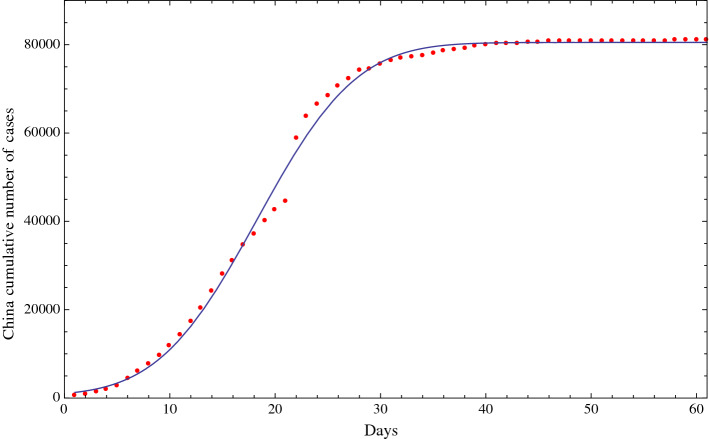
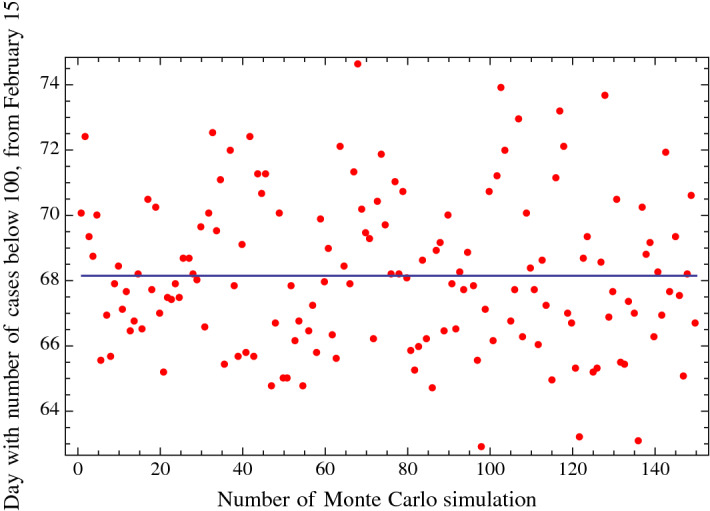
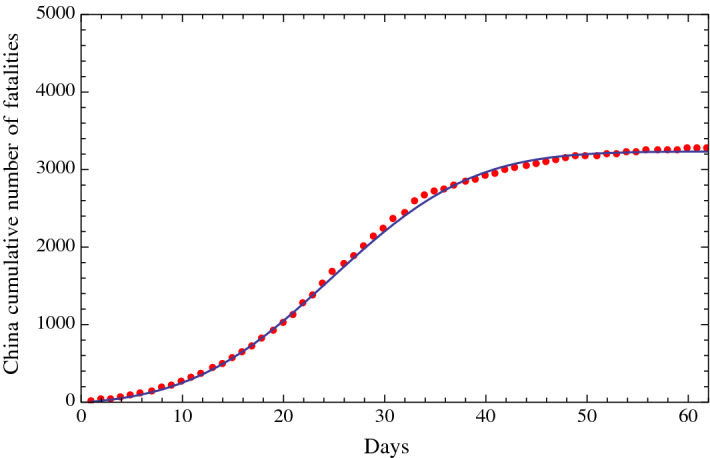
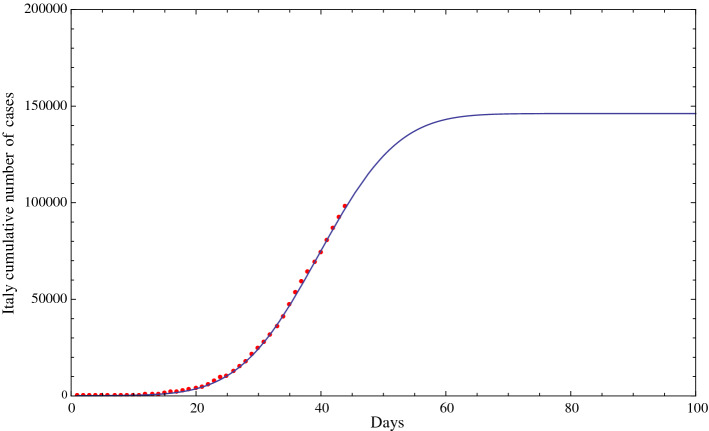
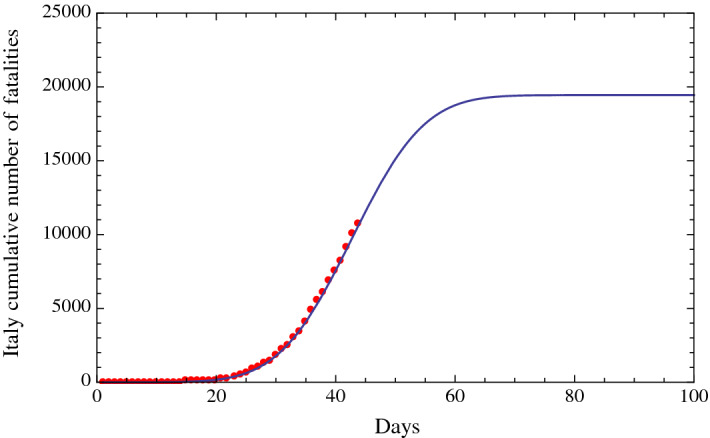
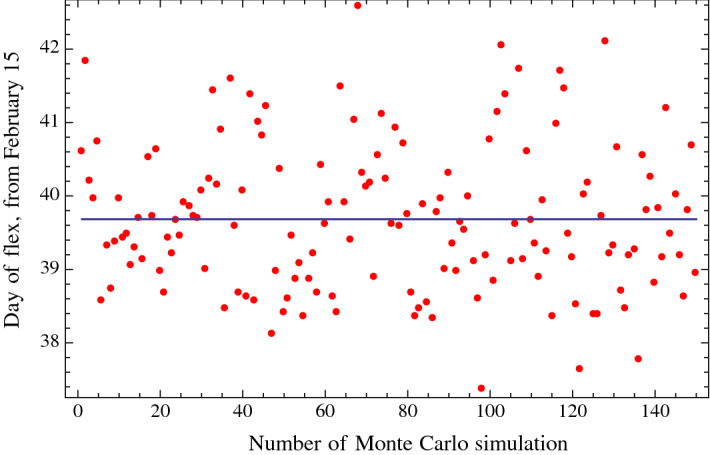
In this paper are presented mathematical predictions on the evolution in time of the number of positive cases in Italy of the COVID-19 pandemic based on official data and on the use of a function of the type of a Gauss error function, with four parameters, as a cumulative distribution function. We have analyzed the available data for China and Italy. The evolution in time of the number of cumulative diagnosed positive cases of COVID-19 in China very well approximates a distribution of the type of the error function, that is, the integral of a normal, Gaussian distribution. We have then used such a function to study the potential evolution in time of the number of positive cases in Italy by performing a number of fits of the official data so far available. We then found a statistical prediction for the day in which the peak of the number of daily positive cases in Italy occurs, corresponding to the flex of the fit, that is, to the change in sign of its second derivative (i.e., the change from acceleration to deceleration), as well as of the day in which a substantial attenuation of such number of daily cases is reached. We have also analyzed the predictions of the cumulative number of fatalities in both China and Italy, obtaining consistent results. We have then performed 150 Monte Carlo simulations to have a more robust prediction of the day of the above-mentioned peak and of the day of the substantial decrease in the number of daily positive cases and fatalities. Although official data have been used, those predictions are obtained with a heuristic approach since they are based on a statistical approach and do not take into account either a number of relevant issues (such as number of daily nasopharyngeal swabs, medical, social distancing, virological and epidemiological) or models of contamination diffusion.
本文基于官方数据,并使用具有四个参数的高斯误差函数类型的函数作为累积分布函数,对意大利新冠疫情阳性病例数随时间的演变进行了数学预测。我们分析了中国和意大利的现有数据。中国新冠确诊阳性病例累计数随时间的演变非常近似于误差函数类型的分布,即正态高斯分布的积分。然后,我们使用这样一个函数,通过对目前可用的官方数据进行多次拟合,来研究意大利阳性病例数随时间的潜在演变。然后,我们找到了意大利每日新增阳性病例数峰值出现日期的统计预测,该日期对应于拟合曲线的拐点,即其二阶导数符号的变化(即从加速到减速的变化),以及每日新增病例数大幅下降的日期。我们还分析了中国和意大利的累计死亡人数预测,得到了一致的结果。然后,我们进行了150次蒙特卡洛模拟,以对上述峰值日期以及每日新增阳性病例数和死亡人数大幅下降的日期进行更可靠的预测。虽然使用了官方数据,但这些预测是通过启发式方法获得的,因为它们基于统计方法,没有考虑到许多相关问题(如每日鼻咽拭子数量、医疗、社交距离、病毒学和流行病学)或污染传播模型。