Paediatric Department, Hospital Papa Giovanni XXIII, Bergamo, Italy.
Paediatric Cardiology, Hospital Papa Giovanni XXIII, Bergamo, Italy.
Lancet. 2020 Jun 6;395(10239):1771-1778. doi: 10.1016/S0140-6736(20)31103-X. Epub 2020 May 13.
The Bergamo province, which is extensively affected by the severe acute respiratory syndrome coronavirus 2 (SARS-CoV-2) epidemic, is a natural observatory of virus manifestations in the general population. In the past month we recorded an outbreak of Kawasaki disease; we aimed to evaluate incidence and features of patients with Kawasaki-like disease diagnosed during the SARS-CoV-2 epidemic.
All patients diagnosed with a Kawasaki-like disease at our centre in the past 5 years were divided according to symptomatic presentation before (group 1) or after (group 2) the beginning of the SARS-CoV-2 epidemic. Kawasaki- like presentations were managed as Kawasaki disease according to the American Heart Association indications. Kawasaki disease shock syndrome (KDSS) was defined by presence of circulatory dysfunction, and macrophage activation syndrome (MAS) by the Paediatric Rheumatology International Trials Organisation criteria. Current or previous infection was sought by reverse-transcriptase quantitative PCR in nasopharyngeal and oropharyngeal swabs, and by serological qualitative test detecting SARS-CoV-2 IgM and IgG, respectively.
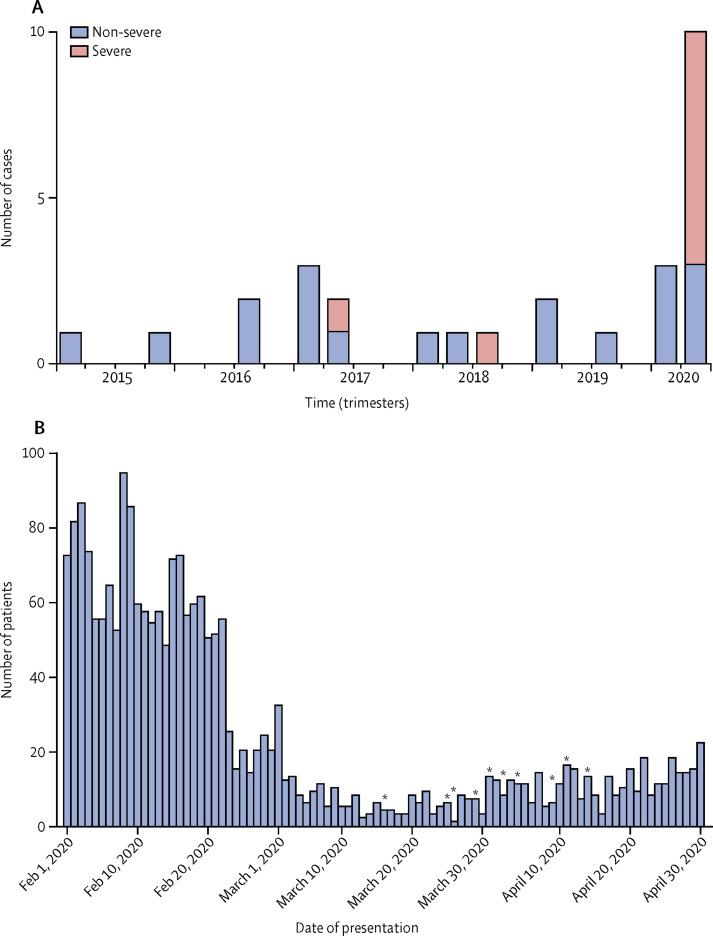
Group 1 comprised 19 patients (seven boys, 12 girls; aged 3·0 years [SD 2·5]) diagnosed between Jan 1, 2015, and Feb 17, 2020. Group 2 included ten patients (seven boys, three girls; aged 7·5 years [SD 3·5]) diagnosed between Feb 18 and April 20, 2020; eight of ten were positive for IgG or IgM, or both. The two groups differed in disease incidence (group 1 vs group 2, 0·3 vs ten per month), mean age (3·0 vs 7·5 years), cardiac involvement (two of 19 vs six of ten), KDSS (zero of 19 vs five of ten), MAS (zero of 19 vs five of ten), and need for adjunctive steroid treatment (three of 19 vs eight of ten; all p<0·01).
In the past month we found a 30-fold increased incidence of Kawasaki-like disease. Children diagnosed after the SARS-CoV-2 epidemic began showed evidence of immune response to the virus, were older, had a higher rate of cardiac involvement, and features of MAS. The SARS-CoV-2 epidemic was associated with high incidence of a severe form of Kawasaki disease. A similar outbreak of Kawasaki-like disease is expected in countries involved in the SARS-CoV-2 epidemic.
None.
贝加莫省深受严重急性呼吸综合征冠状病毒 2(SARS-CoV-2)流行的影响,是观察普通人群中病毒表现的天然观测站。在过去的一个月中,我们记录了川崎病的暴发;我们旨在评估在 SARS-CoV-2 流行期间诊断出的类似川崎病患者的发病率和特征。
在过去 5 年中,我们中心根据症状表现将所有诊断为类似川崎病的患者分为 SARS-CoV-2 流行前(第 1 组)或后(第 2 组)。根据美国心脏协会的指示,将类似川崎病的表现作为川崎病进行管理。川崎病休克综合征(KDSS)的定义为存在循环功能障碍,巨噬细胞活化综合征(MAS)的定义为儿科风湿病国际试验组织标准。通过鼻咽和口咽拭子的逆转录酶定量 PCR 以及血清学定性检测 SARS-CoV-2 IgM 和 IgG 分别检测当前或先前的感染。
第 1 组包括 19 名患者(7 名男性,12 名女性;年龄 3·0 岁[SD 2·5]),诊断时间为 2015 年 1 月 1 日至 2020 年 2 月 17 日。第 2 组包括 10 名患者(7 名男性,3 名女性;年龄 7·5 岁[SD 3·5]),诊断时间为 2020 年 2 月 18 日至 4 月 20 日;其中 10 名中有 8 名的 IgG 或 IgM 呈阳性,或两者均呈阳性。两组在疾病发病率(第 1 组与第 2 组,0·3 与 10 每月)、平均年龄(3·0 与 7·5 岁)、心脏受累(19 名中的 2 名与 10 名中的 6 名)、KDSS(19 名中的 0 名与 10 名中的 5 名)、MAS(19 名中的 0 名与 10 名中的 5 名)和需要辅助皮质激素治疗(19 名中的 3 名与 10 名中的 8 名;所有 p<0·01)方面存在差异。
在过去的一个月中,我们发现类似川崎病的发病率增加了 30 倍。在 SARS-CoV-2 流行开始后被诊断出的儿童表现出对病毒的免疫反应,年龄较大,心脏受累发生率较高,且有 MAS 的特征。SARS-CoV-2 流行与川崎病严重形式的高发病率有关。预计在涉及 SARS-CoV-2 的国家中也会出现类似川崎病的暴发。
无。