Instituto de Tecnologia Química e Biológica António Xavier (ITQB-NOVA), Universidade Nova de Lisboa, Av. da República (EAN), 2780-157, Oeiras, Portugal.
Magnetic Resonance Center (CERM), Department of Chemistry and Consorzio Interuniversitario Risonanze Magnetiche Metallo Proteine (C.I.R.M.M.P.), University of Florence, Via L. Sacconi 6, 50019, Sesto Fiorentino, Italy.
Biomol NMR Assign. 2020 Oct;14(2):211-215. doi: 10.1007/s12104-020-09947-6. Epub 2020 May 15.
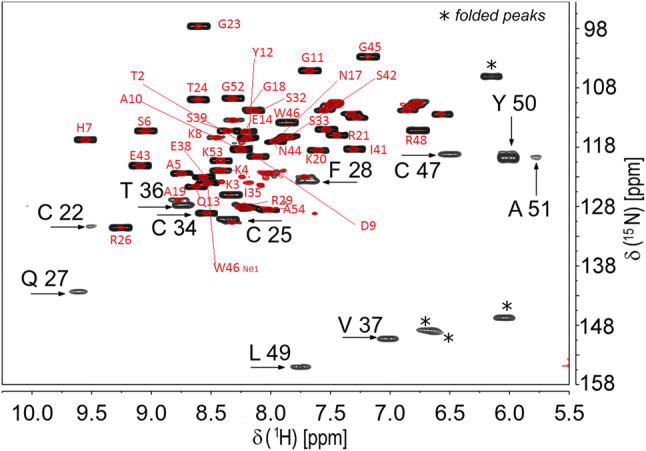
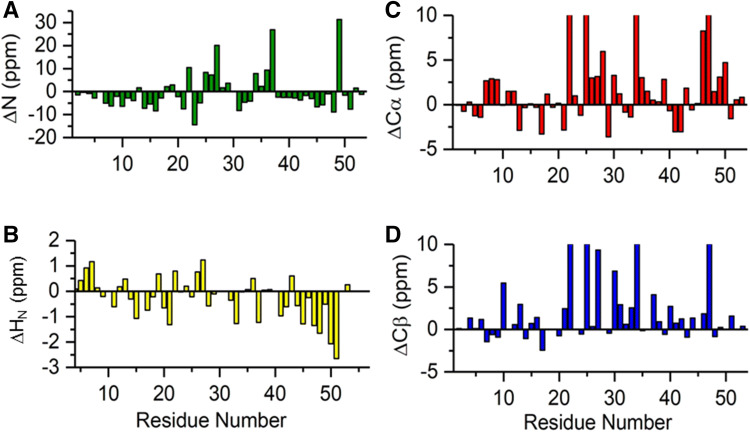
High potential iron-sulfur proteins (HiPIPs) are a class of small proteins (50-100 aa residues), containing a 4Fe-4S iron-sulfur cluster. The 4Fe-4S cluster shuttles between the oxidation states [FeS], with a positive redox potential in the range (500-50 mV) throughout the different known HiPIPs. Both oxidation states are paramagnetic at room temperature. HiPIPs are electron transfer proteins, isolated from photosynthetic bacteria and usually provide electrons to the photosynthetic reaction-center. PioC, the HIPIP isolated from Rhodopseudomonas palustris TIE-1, is the smallest among all known HiPIPs. Despite their small dimensions, an extensive NMR assignment is only available for two of them, because paramagnetism prevents the straightforward assignment of all resonances. We report here the complete NMR assignment of H, C and N signals for the reduced [FeS] state of the protein. A set of double and triple resonance experiments performed with standardized parameters/datasets provided the assignment of about 72% of the residues. The almost complete resonance assignment (99.5% of backbone and ca. 90% of side chain resonances) was achieved by combining the above information with those obtained using a second set of NMR experiments, in which acquisition and processing parameters, as well as pulse sequences design, were optimized to account for the peculiar features of this paramagnetic protein.
高潜能铁硫蛋白(HiPIPs)是一类小分子蛋白质(50-100 个氨基酸残基),含有一个 4Fe-4S 铁硫簇。4Fe-4S 簇在 [FeS]的氧化态之间穿梭,在不同已知的 HiPIPs 中具有 500-50 mV 的正氧化还原电位。两种氧化态在室温下都是顺磁性的。HiPIPs 是电子转移蛋白,从光合细菌中分离出来,通常为光合反应中心提供电子。从 Rhodopseudomonas palustris TIE-1 中分离出来的 PioC 是所有已知 HiPIPs 中最小的一种。尽管它们的尺寸很小,但只有两种 HiPIPs 有广泛的 NMR 分配,因为顺磁性阻止了所有共振的直接分配。我们在此报告该蛋白还原 [FeS]状态的 H、C 和 N 信号的完整 NMR 分配。使用标准化参数/数据集进行的一组双共振和三共振实验提供了约 72%残基的分配。通过将上述信息与使用第二组 NMR 实验获得的信息相结合,实现了几乎完整的共振分配(99.5%的骨架和大约 90%的侧链共振),在第二组实验中,采集和处理参数以及脉冲序列设计都进行了优化,以适应这种顺磁性蛋白质的特殊性质。