Magnetic Resonance Center (CERM) and Department of Chemistry, University of Florence, Via L. Sacconi 6, 50019, Sesto Fiorentino, Italy.
Consorzio Interuniversitario Risonanze Magnetiche Di Metallo Proteine (CIRMMP), Via L. Sacconi 6, 50019, Sesto Fiorentino, Italy.
J Biomol NMR. 2020 Sep;74(8-9):431-442. doi: 10.1007/s10858-020-00334-w. Epub 2020 Jul 24.
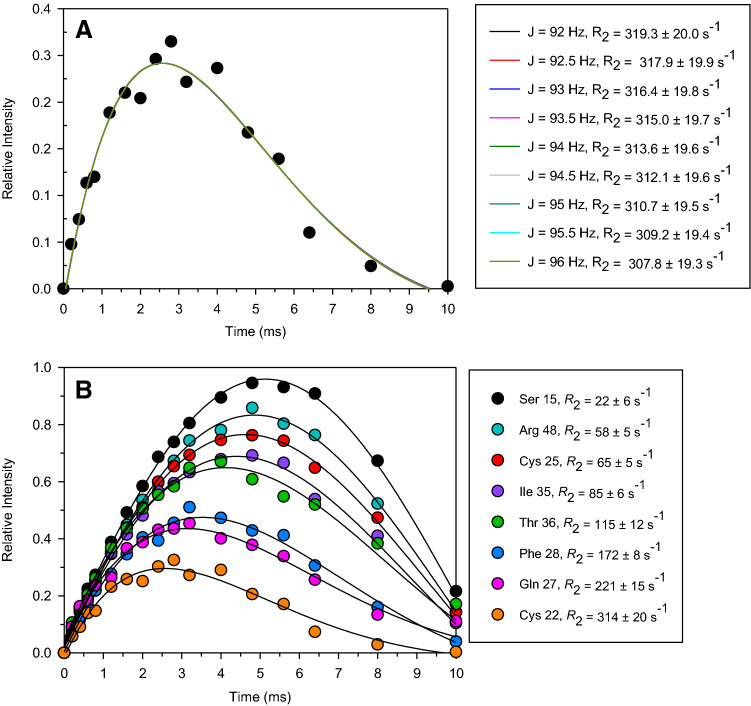
The enhancement of nuclear relaxation rates due to the interaction with a paramagnetic center (known as Paramagnetic Relaxation Enhancement) is a powerful source of structural and dynamics information, widely used in structural biology. However, many signals affected by the hyperfine interaction relax faster than the evolution periods of common NMR experiments and therefore they are broadened beyond detection. This gives rise to a so-called blind sphere around the paramagnetic center, which is a major limitation in the use of PREs. Reducing the blind sphere is extremely important in paramagnetic metalloproteins. The identification, characterization, and proper structural restraining of the first coordination sphere of the metal ion(s) and its immediate neighboring regions is key to understand their biological function. The novel HSQC scheme we propose here, that we termed R-weighted, HSQC-AP, achieves this aim by detecting signals that escaped detection in a conventional HSQC experiment and provides fully reliable R values in the range of H R rates ca. 50-400 s. Independently on the type of paramagnetic center and on the size of the molecule, this experiment decreases the radius of the blind sphere and increases the number of detectable PREs. Here, we report the validation of this approach for the case of PioC, a small protein containing a high potential 4Fe-4S cluster in the reduced [FeS] form. The blind sphere was contracted to a minimal extent, enabling the measurement of R rates for the cluster coordinating residues.
由于与顺磁中心相互作用而导致的核弛豫率增强(称为顺磁弛豫增强)是结构和动力学信息的强大来源,广泛用于结构生物学。然而,许多受超精细相互作用影响的信号比常见 NMR 实验的演化周期快,因此它们被展宽到无法检测的程度。这导致在顺磁中心周围出现所谓的“盲区”,这是 PRE 应用的主要限制之一。在顺磁金属蛋白中,减小盲区极为重要。鉴定、表征和适当限制金属离子(及其紧邻区域)的第一配位球,是理解其生物学功能的关键。我们在这里提出的新的 HSQC 方案,我们称之为 R 加权 HSQC-AP,通过检测在常规 HSQC 实验中无法检测到的信号来实现这一目标,并在 H R 率约为 50-400 s 的范围内提供完全可靠的 R 值。无论顺磁中心的类型和分子的大小如何,该实验都会减小盲区的半径并增加可检测 PRE 的数量。在这里,我们报告了该方法在 PioC 情况下的验证,PioC 是一种含有还原 [FeS] 形式的高潜在 4Fe-4S 簇的小蛋白。盲区被缩小到最小程度,使簇配位残基的 R 率得以测量。