Department of Urology, Gachon University College of Medicine, Incheon, Korea.
Department of Medical Education, Gachon University College of Medicine, Incheon, Korea.
Korean J Med Educ. 2020 Jun;32(2):131-142. doi: 10.3946/kjme.2020.161. Epub 2020 May 28.
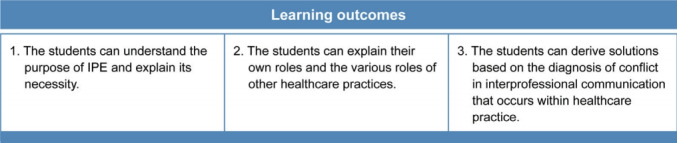
This study is to develop an interprofessional education (IPE) program for medical, nursing, and pharmacy students and to analyze the effectiveness.
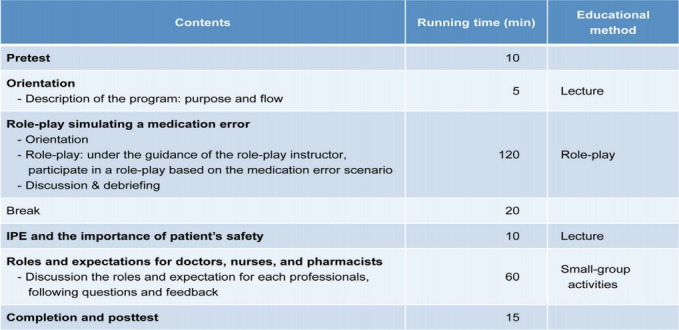
Subjects consisted of 116 students (41 medical, 46 nursing, and 29 pharmacy students) enrolled in their final year. Subjects were randomly assigned to either the intervention group or the control group, with 58 in each group. A pretest-posttest control group design was used. The program was operated for a single day, and consisted of small-group activities and role-play. We utilized the following tools: Perceptions towards Interprofessional Education (PIPE), Self-Efficacy for Interprofessional Experiential Learning (SEIEL), and Perception towards Interprofessional Competency (PIC). We used t-test and analysis of covariance for analysis.
The PIPE tool revealed that the scores of the intervention group were significantly higher than those of the control group (p=0.000). The result was the same when the scores were categorized into the groups medical students (p=0.001), nursing students (p=0.000), and pharmacy students (p=0.005). The SEIEL study also indicated the intervention group scored significantly higher than the control group (p=0.000). However, pharmacy students did not reveal significant (p=0.983). The intervention group scored significantly higher than the control group in the PIC. A concluding survey of the intervention group indicated that most students were satisfied with the IPE program.
We hope this study will provide useful information for designing and improving IPE programs in other universities.
本研究旨在为医学生、护理学生和药学学生开发一项跨专业教育(IPE)计划,并分析其效果。
研究对象为 116 名即将毕业的学生(41 名医学生、46 名护理学生和 29 名药学学生)。将学生随机分为干预组和对照组,每组 58 人。采用前后测对照设计。该计划持续一天,包括小组活动和角色扮演。我们使用了以下工具:对跨专业教育的认知(PIPE)、跨专业体验学习自我效能感(SEIEL)和对跨专业能力的认知(PIC)。我们使用 t 检验和协方差分析进行分析。
PIPE 工具显示,干预组的得分明显高于对照组(p=0.000)。将分数分为医学生(p=0.001)、护理学生(p=0.000)和药学学生(p=0.005)组后,结果也是如此。SEIEL 研究也表明,干预组的得分明显高于对照组(p=0.000)。然而,药学学生的得分没有显著差异(p=0.983)。PIC 也显示干预组的得分明显高于对照组。对干预组的总结调查表明,大多数学生对 IPE 计划感到满意。
我们希望本研究能为其他大学设计和改进 IPE 计划提供有用的信息。