Department of Oral and Maxillofacial Surgery, Kobe University Graduate School of Medicine, 7-5-1, Kusunoki-cho, Chuo-ku, Kobe, 650-0017, Japan.
BMC Cancer. 2020 Jun 17;20(1):568. doi: 10.1186/s12885-020-07063-1.
Prognostic biomarkers provide essential information about a patient's overall outcome. However, existing biomarkers are limited in terms of either sample collection, such as requiring tissue specimens, or the process, such as prolonged time for analysis. In view of the need for convenient and non-invasive prognostic biomarkers for oral cancer, we aimed to investigate the prognostic values of neutrophil-to-lymphocyte ratio, lymphocyte-to-monocyte ratio, and platelet-to-lymphocyte ratio in patient survival. We also aimed to explore the associations of these ratios with the clinicopathologic characteristics of Japanese oral squamous cell carcinoma patients.
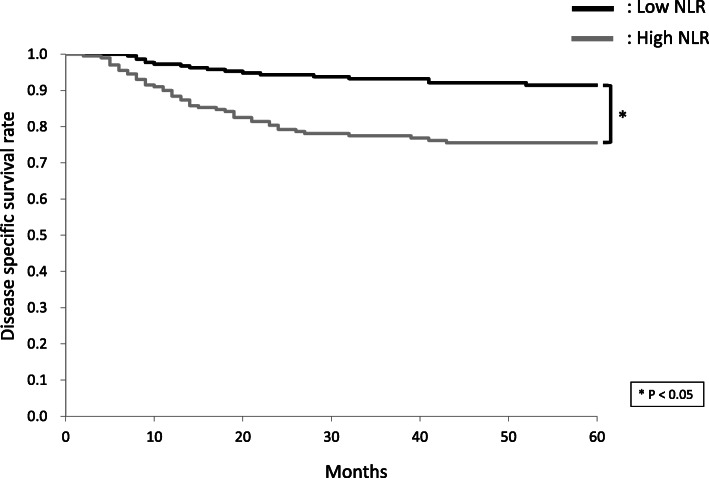
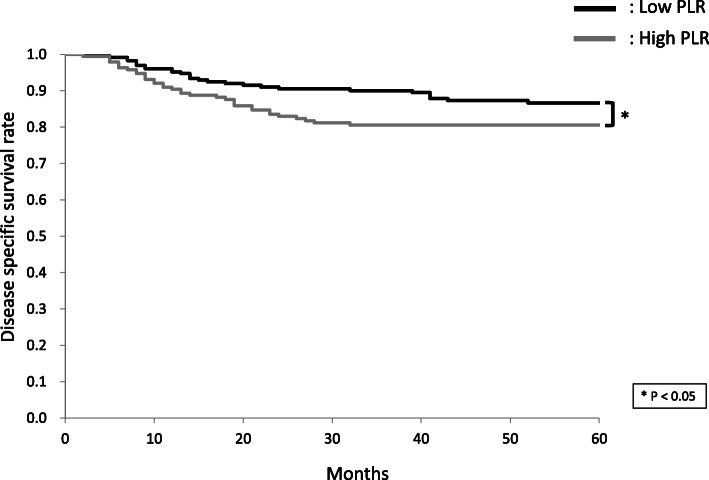
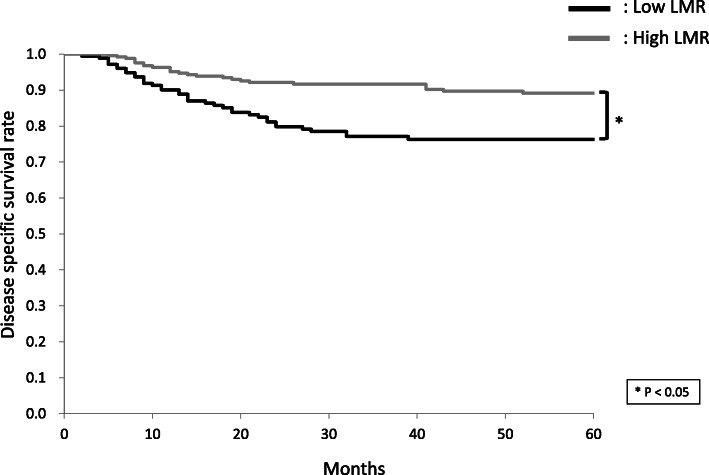
This study was a non-randomized retrospective cohort study in a tertiary referral center. We included 433 patients (246 men, 187 women) who underwent radical surgery for oral cancers between January 2001 and December 2013. We evaluated various risk factors for poor prognosis including neutrophil-to-lymphocyte ratio, lymphocyte-to-monocyte ratio, and platelet-to-lymphocyte ratio with univariate and multivariate analyses. The disease-specific survival and overall survival rates of patients were compared among the factors and biomarkers.
In multivariable Cox proportional hazards analysis, high neutrophil-to-lymphocyte ratio (hazard ratio 2.87, 95% confidence interval 1.59-5.19, P < 0.001), moderately or poorly differentiated histology (hazard ratio 2.37, 95% confidence interval 1.32-4.25, P < 0.001), and extranodal extension (hazard ratio 1.95, 95% confidence interval 1.13-3.35, P = 0.016) were independent predictors of disease-specific survival. High neutrophil-to-lymphocyte ratio (hazard ratio 2.30, 95% confidence interval 1.42-3.72, P < 0.001), moderately or poorly differentiated (hazard ratio 1.72, 95% confidence interval 1.07-2.76, P = 0.025), and extranodal extension (hazard ratio 1.79, 95% confidence interval 1.13-2.84, P = 0.013) were independent predictors of overall survival.
Neutrophil-to-lymphocyte ratio might be a potential independent prognostic factor in Japanese oral squamous cell carcinoma patients.
预后生物标志物为患者的整体预后提供了重要信息。然而,现有的生物标志物在样本采集方面存在局限性,例如需要组织标本,或者在分析过程方面存在耗时过长的问题。鉴于需要方便且非侵入性的口腔癌预后生物标志物,我们旨在探讨中性粒细胞与淋巴细胞比值、淋巴细胞与单核细胞比值和血小板与淋巴细胞比值对患者生存的预后价值。我们还旨在探索这些比值与日本口腔鳞状细胞癌患者临床病理特征的关系。
这是一项在三级转诊中心进行的非随机回顾性队列研究。我们纳入了 2001 年 1 月至 2013 年 12 月期间因口腔癌接受根治性手术的 433 名患者(246 名男性,187 名女性)。我们使用单变量和多变量分析评估了包括中性粒细胞与淋巴细胞比值、淋巴细胞与单核细胞比值和血小板与淋巴细胞比值在内的各种预后不良风险因素。比较了患者的疾病特异性生存率和总生存率。
在多变量 Cox 比例风险分析中,高中性粒细胞与淋巴细胞比值(风险比 2.87,95%置信区间 1.59-5.19,P<0.001)、中或低分化组织学(风险比 2.37,95%置信区间 1.32-4.25,P<0.001)和淋巴结外扩散(风险比 1.95,95%置信区间 1.13-3.35,P=0.016)是疾病特异性生存率的独立预测因素。高中性粒细胞与淋巴细胞比值(风险比 2.30,95%置信区间 1.42-3.72,P<0.001)、中或低分化(风险比 1.72,95%置信区间 1.07-2.76,P=0.025)和淋巴结外扩散(风险比 1.79,95%置信区间 1.13-2.84,P=0.013)是总生存率的独立预测因素。
中性粒细胞与淋巴细胞比值可能是日本口腔鳞状细胞癌患者潜在的独立预后因素。