Boretti Alberto
Mechanical Engineering Department, College of Engineering, Prince Mohammad Bin Fahd University, Al Khobar, Saudi Arabia.
Health Serv Res Manag Epidemiol. 2020 Jun 17;7:2333392820932324. doi: 10.1177/2333392820932324. eCollection 2020 Jan-Dec.
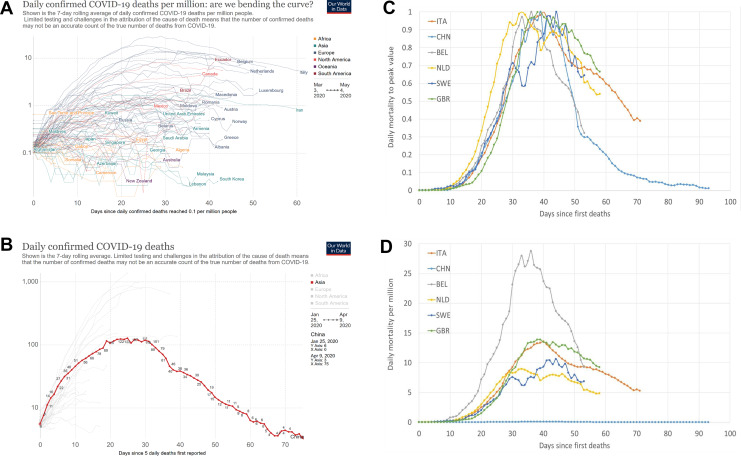
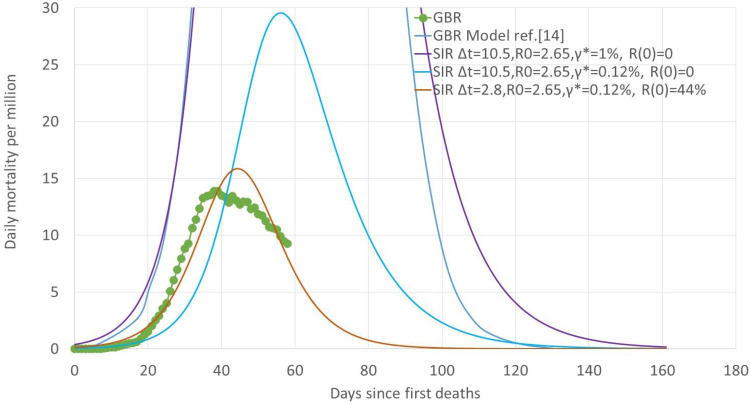
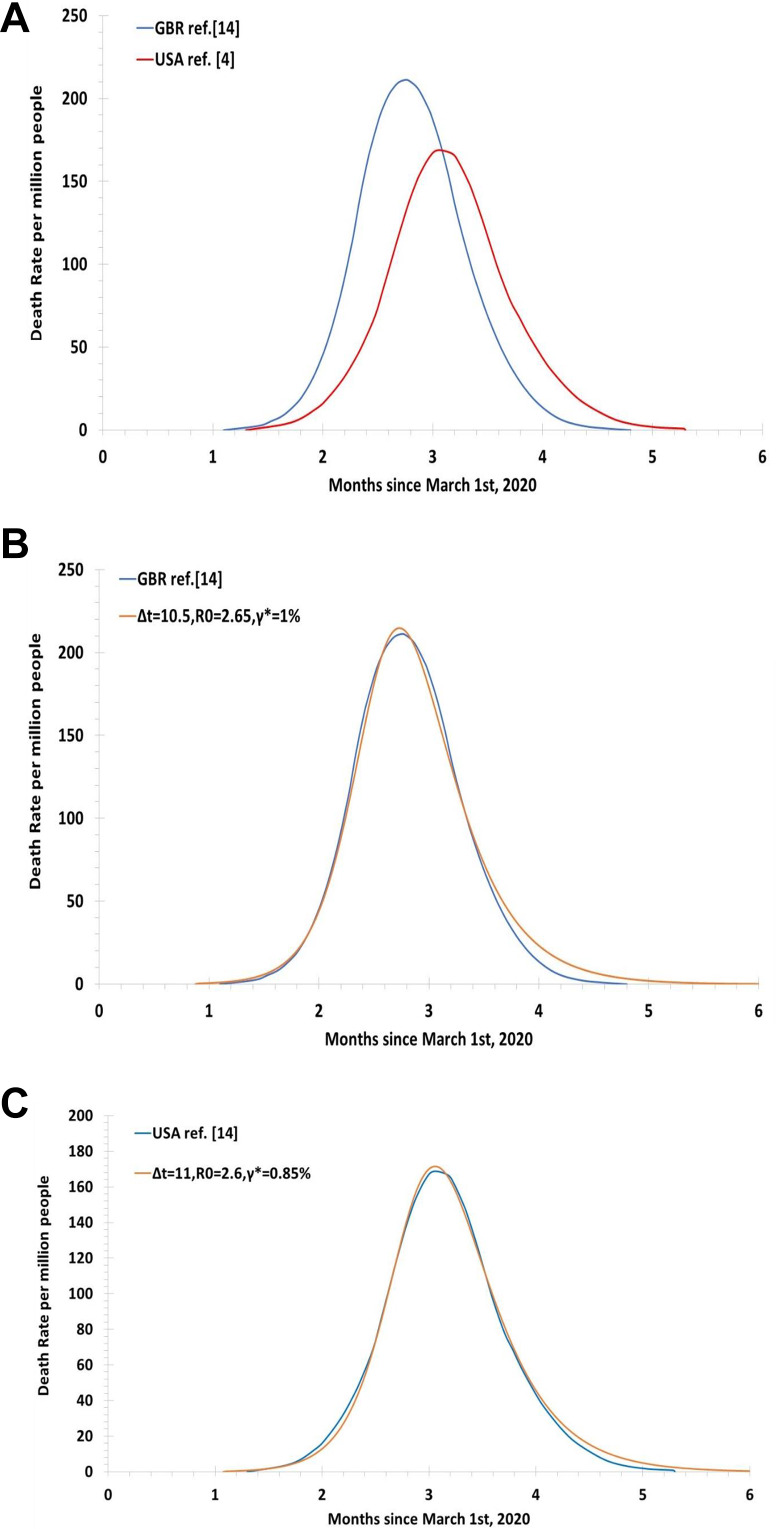
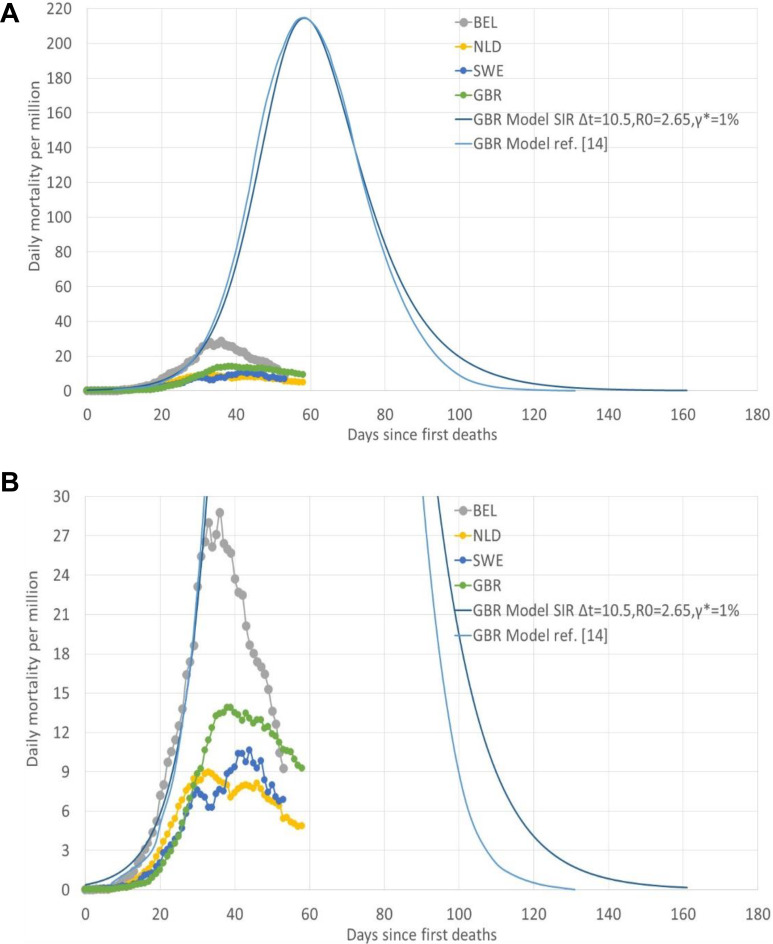
Here, we review modeling predictions for Covid-19 mortality based on recent data. The Imperial College model trusted by the British Government predicted peak mortalities above 170 deaths per million in the United States, and above 215 deaths per million in Great Britain, after more than 2 months from the outbreak, and a length for the outbreak well above 4 months. These predictions drove the world to adopt harsh distancing measures and forget the concept of herd immunity. China had peak mortalities of less than 0.1 deaths per million after 40 days since first deaths, and an 80-day-long outbreak. Italy, Belgium, the Netherlands, Sweden, or Great Britain flattened the curve at 13.6, 28.6, 9.0, 10.6, and 13.9 deaths per million after 40, 39, 33, 44, and 39 days from first deaths, or 31, 29, 24, 38, and 29 days since the daily confirmed deaths reached 0.1 per million people, respectively. The declining curve is much slower for Italy, the Netherlands, or Great Britain than Belgium or Sweden. Opposite to Great Britain, Italy, or Belgium that enforced a complete lockdown, the Netherlands only adopted an "intelligent" lockdown, and Sweden did not adopt any lockdown. However, they achieved better results. Coupled to new evidence for minimal impact of Covid-19 on the healthy population, with the most part not infected even if challenged, or only mild or asymptomatic if infected, there are many good reasons to question the validity of the specific epidemiological model simulations and the policies they produced. Fewer restrictions on the healthy while better protecting the vulnerable would have been a much better option, permitting more sustainable protection of countries otherwise at risk of second waves as soon as the strict measures are lifted.
在此,我们基于近期数据回顾了针对新冠病毒死亡情况的模型预测。英国政府所信赖的帝国理工学院模型预测,在美国,疫情爆发两个多月后,每百万人口的死亡峰值将超过170人;在英国,这一数字将超过每百万人口215人,且疫情持续时间远超过4个月。这些预测促使全球采取了严厉的社交 distancing 措施,并摒弃了群体免疫的概念。中国自首例死亡病例出现40天后,每百万人口的死亡峰值不到0.1人,疫情持续了80天。意大利、比利时、荷兰、瑞典和英国在自首例死亡病例起40天、39天、33天、44天和39天后,或自每日确诊死亡人数达到每百万人口0.1人起31天、29天、24天、38天和29天后,每百万人口的死亡人数分别降至13.6人、28.6人、9.0人、10.6人和13.9人,曲线趋于平缓。意大利、荷兰和英国的曲线下降速度比比利时或瑞典慢得多。与实施全面封锁的英国、意大利或比利时不同,荷兰仅采取了“智能”封锁措施,瑞典则未采取任何封锁措施。然而,它们却取得了更好的效果。再加上有新证据表明新冠病毒对健康人群影响极小,大多数人即使接触病毒也不会感染,或者感染后仅出现轻微症状或无症状,因此有充分理由质疑特定流行病学模型模拟及其所产生政策的有效性。对健康人群限制更少,同时更好地保护弱势群体,本应是一个更好的选择,这样一旦严格措施解除,就能更可持续地保护那些否则可能面临第二波疫情风险的国家。