Ye JiaJia, Zheng Qikai, Zou Liye, Yu Qian, Veronese Nicola, Grabovac Igor, Stefanac Sinisa, Tzeng Huey-Ming, Yu Jane Jie
Department of Rehabilitation Assessment, Rehabilitation Hospital Affiliated to Fujian University of Traditional Chinese Medicine, Fuzhou, Fujian 350000, China.
Fujian Key Laboratory of Rehabilitation Technology, 13 Hudong Road, Fuzhou, Fujian 350000, China.
Evid Based Complement Alternat Med. 2020 Jun 14;2020:9869161. doi: 10.1155/2020/9869161. eCollection 2020.
The postural stability is a major factor that helps prevent developing knee osteoarthritis with aging. The aim of this study was to investigate the effects of Baduanjin qigong on postural control and physical function in older adults with knee osteoarthritis.
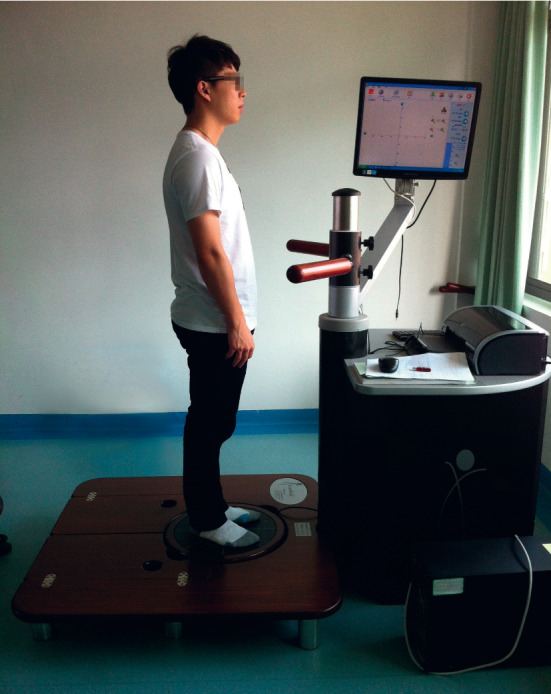
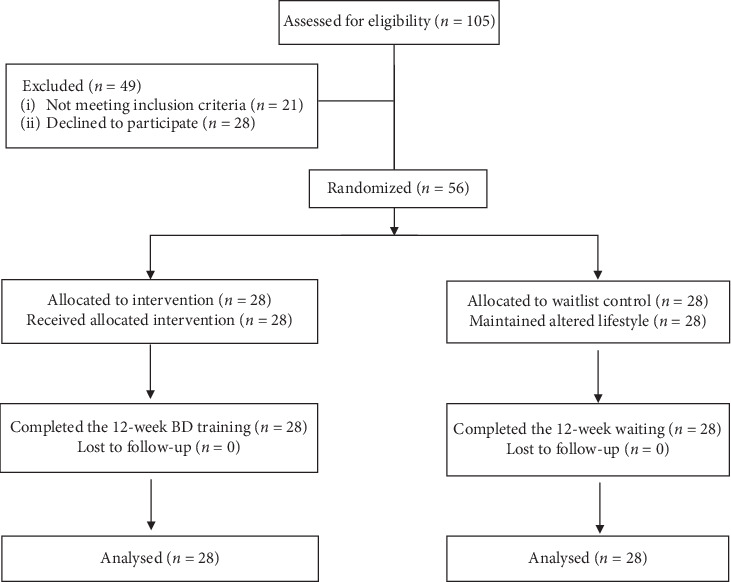
Fifty-six individuals over 60 years of age with knee osteoarthritis were randomly assigned to either an experimental group ( = 28) or a control group ( = 28). Participants in the experimental group received a 12-week Baduanjin training, while those in the control group did not receive any additional physical exercise during the study period. The postural control was quantified by perimeter and ellipse area of center of pressure movement trajectory. The assessments were conducted three times (baseline, week 8, and week 12).
The perimeter and ellipse area with both open- and closed-eyes conditions and Western Ontario and McMaster Universities Osteoarthritis Index (WOMAC) function were significantly improved at week eight in the experimental group ( < 0.005). The ellipse area with open-eyes condition, WOMAC index, and stiffness and physical function domains were significantly decreased after the 12 weeks of Baduanjin training compared to the control group ( < 0.005). Only the perimeter area with both open- and closed-eyes conditions was not statistically significant at week 12 in the intervention group ( > 0.005).
Baduanjin is an effective and adjuvant therapy for older adults with knee osteoarthritis. Regular Baduanjin training can improve postural control and WOMAC function of old individuals with knee osteoarthritis. More advanced techniques and biopsychological measurements are required for further understanding of Baduanjin exercise in this population. The trial was registered in Chinese Clinical Trial Registry (ChiCTR-IOR-16010042).
姿势稳定性是有助于预防随着年龄增长而患膝骨关节炎的一个主要因素。本研究的目的是调查八段锦气功对老年膝骨关节炎患者姿势控制和身体功能的影响。
56名60岁以上的膝骨关节炎患者被随机分为实验组(n = 28)或对照组(n = 28)。实验组参与者接受为期12周的八段锦训练,而对照组参与者在研究期间不接受任何额外的体育锻炼。通过压力中心运动轨迹的周长和椭圆面积对姿势控制进行量化。评估进行了三次(基线、第8周和第12周)。
实验组在第8周时,睁眼和闭眼条件下的周长和椭圆面积以及西安大略和麦克马斯特大学骨关节炎指数(WOMAC)功能均有显著改善(P < 0.005)。与对照组相比,八段锦训练12周后,睁眼条件下的椭圆面积、WOMAC指数以及僵硬和身体功能领域均显著降低(P < 0.005)。干预组在第12周时,只有睁眼和闭眼条件下的周长面积无统计学意义(P > 0.005)。
八段锦是老年膝骨关节炎患者的一种有效辅助治疗方法。定期进行八段锦训练可改善老年膝骨关节炎患者的姿势控制和WOMAC功能。需要更先进的技术和生物心理测量方法来进一步了解该人群的八段锦运动。该试验已在中国临床试验注册中心注册(ChiCTR-IOR-16010042)。