Department of Biomedical Engineering, School of Biomedical Engineering and Imaging Sciences, King's College London, King's Health Partners, St. Thomas' Hospital, London, UK.
Centre for the Developing Brain, School of Biomedical Engineering and Imaging Sciences, King's College London, King's Health Partners, St. Thomas' Hospital, London, UK.
NMR Biomed. 2020 Sep;33(9):e4348. doi: 10.1002/nbm.4348. Epub 2020 Jul 6.
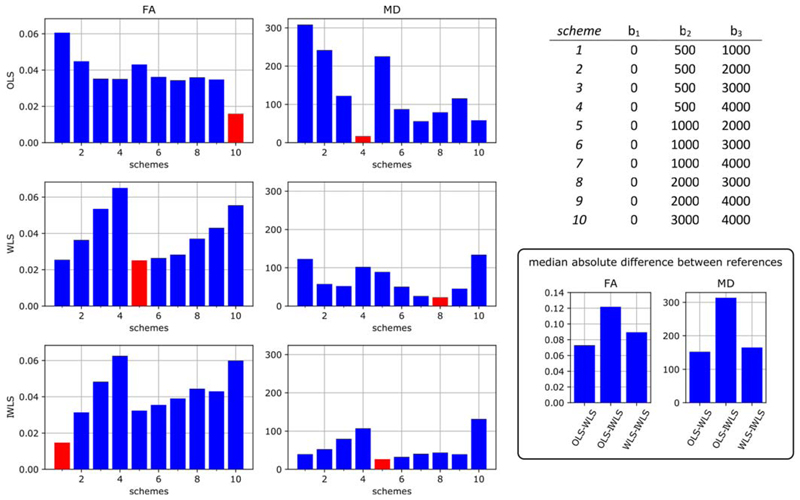
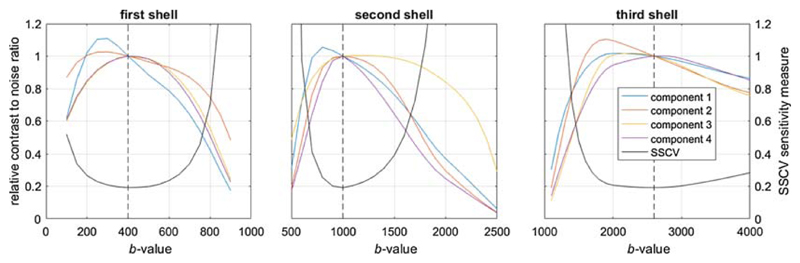
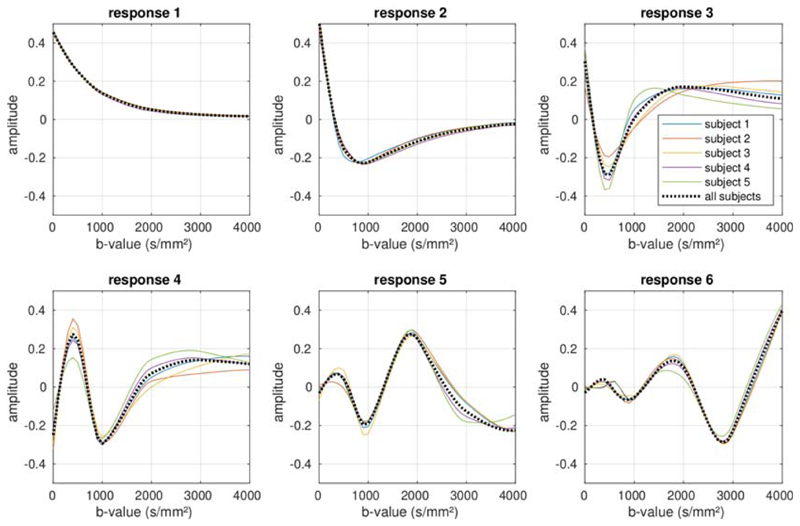
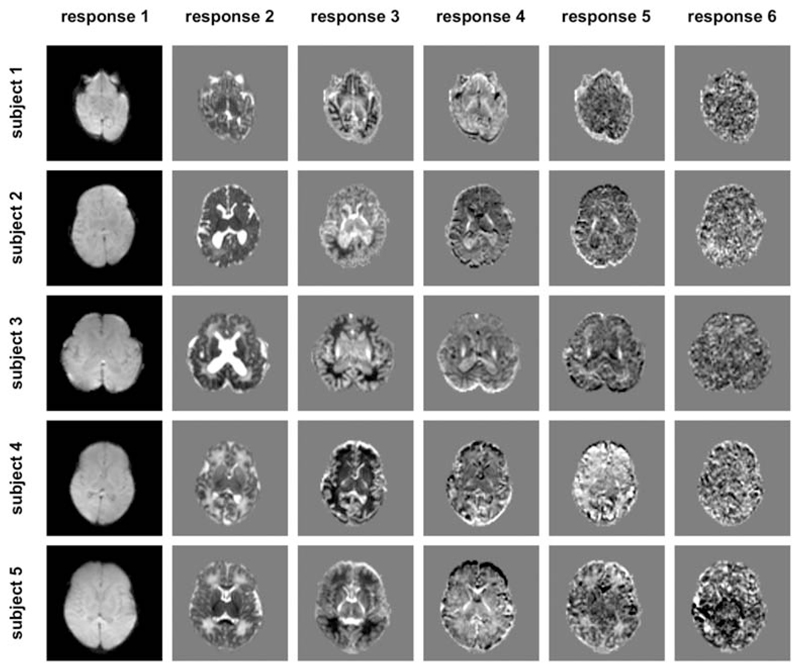
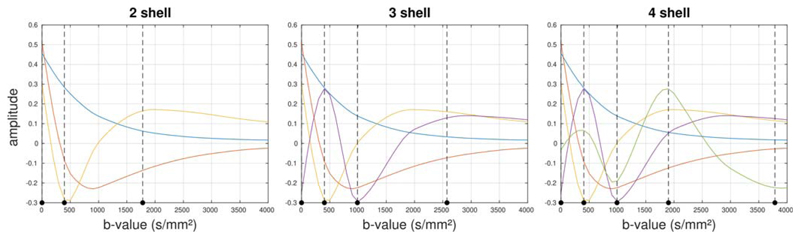
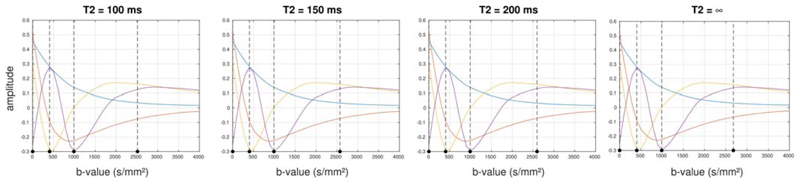
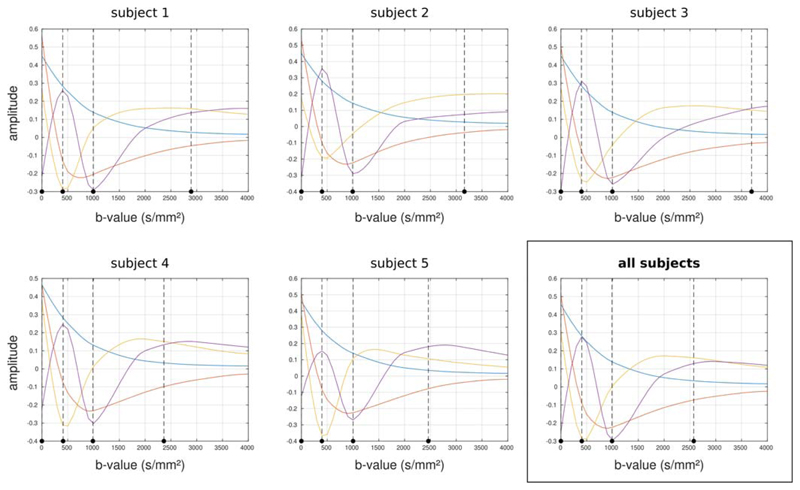
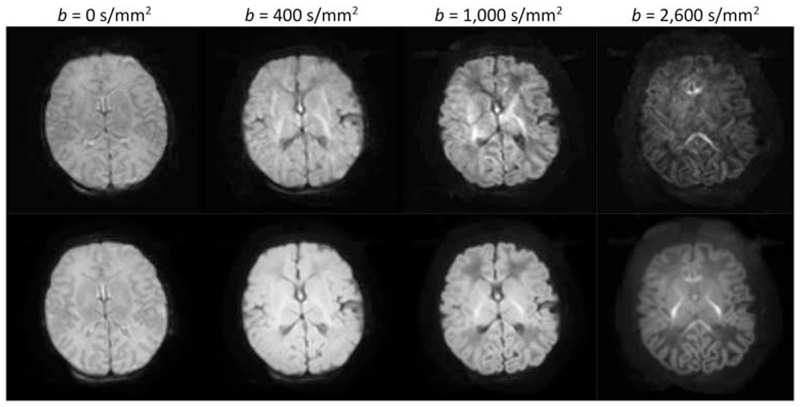
Diffusion MRI has the potential to provide important information about the connectivity and microstructure of the human brain during normal and abnormal development, noninvasively and in vivo. Recent developments in MRI hardware and reconstruction methods now permit the acquisition of large amounts of data within relatively short scan times. This makes it possible to acquire more informative multi-shell data, with diffusion sensitisation applied along many directions over multiple b-value shells. Such schemes are characterised by the number of shells acquired, and the specific b-value and number of directions sampled for each shell. However, there is currently no clear consensus as to how to optimise these parameters. In this work, we propose a means of optimising multi-shell acquisition schemes by estimating the information content of the diffusion MRI signal, and optimising the acquisition parameters for sensitivity to the observed effects, in a manner agnostic to any particular diffusion analysis method that might subsequently be applied to the data. This method was used to design the acquisition scheme for the neonatal diffusion MRI sequence used in the developing Human Connectome Project (dHCP), which aims to acquire high quality data and make it freely available to the research community. The final protocol selected by the algorithm, and currently in use within the dHCP, consists of 20 b=0 images and diffusion-weighted images at b = 400, 1000 and 2600 s/mm with 64, 88 and 128 directions per shell, respectively.
扩散 MRI 有可能在正常和异常发育过程中,非侵入性地、在体内提供关于人脑连通性和微观结构的重要信息。最近 MRI 硬件和重建方法的发展使得在相对较短的扫描时间内采集大量数据成为可能。这使得获取更具信息量的多壳数据成为可能,其中在多个 b 值壳上沿多个方向施加扩散敏化。这些方案的特点是采集的壳数,以及每个壳的特定 b 值和方向数。然而,目前还没有明确的共识来优化这些参数。在这项工作中,我们提出了一种通过估计扩散 MRI 信号的信息量并优化采集参数以提高对观察到的效应的敏感性的方法,这种方法是独立于可能随后应用于数据的任何特定扩散分析方法的。这种方法用于设计用于发育中的人类连接组计划 (dHCP) 的新生儿扩散 MRI 序列的采集方案,该计划旨在获取高质量的数据并免费提供给研究界。算法选择的最终协议,并在 dHCP 中使用,包括 20 张 b=0 图像和扩散加权图像,b 值分别为 400、1000 和 2600 s/mm,每个壳的方向分别为 64、88 和 128 个。