Yang Song-Yi, Choi Yu-Ri, Lee Myung-Jin, Kang Min-Kyung
Department and Research Institute of Dental Biomaterials and Bioengineering, Yonsei University College of Dentistry, Seoul 03722, Korea.
Department of Dental Hygiene, Hallym Polytechnic University, Gangwon-do 24210, Korea.
Plants (Basel). 2020 Jul 3;9(7):838. doi: 10.3390/plants9070838.
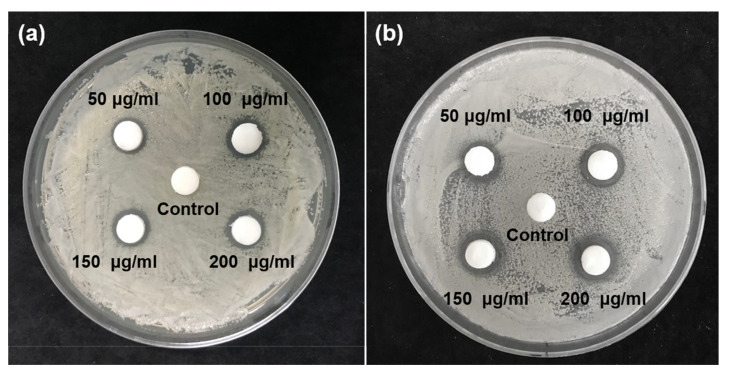
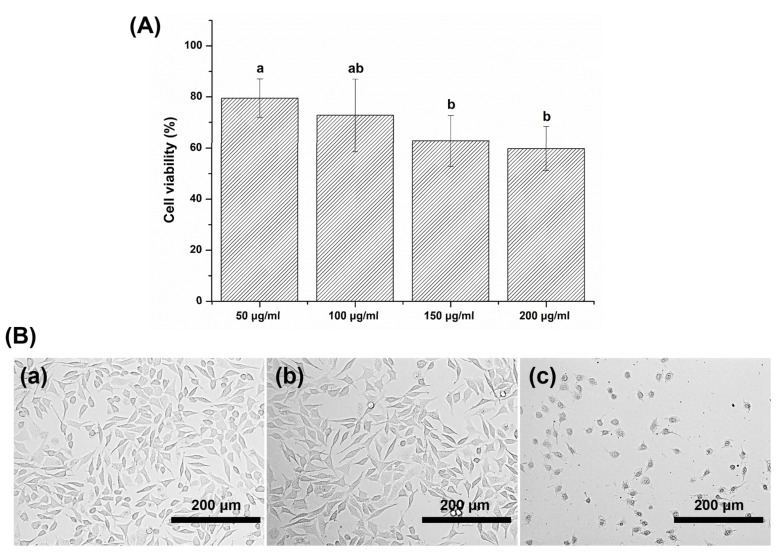
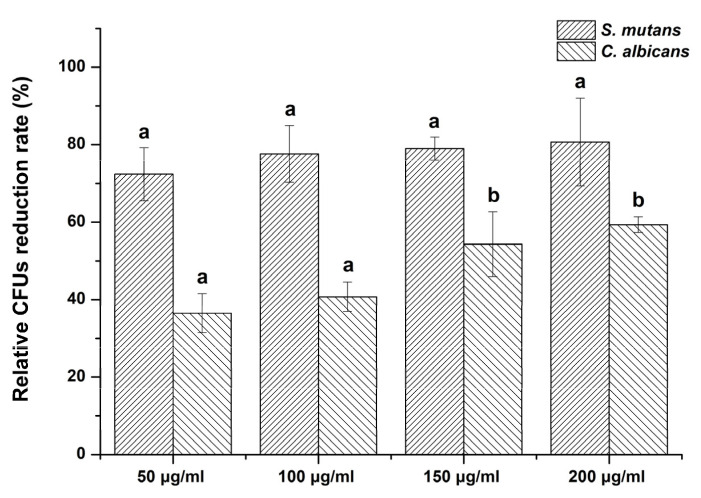
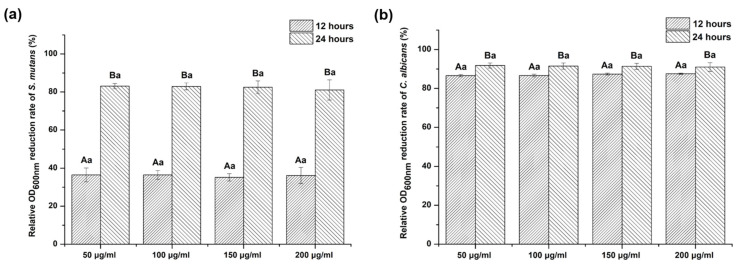
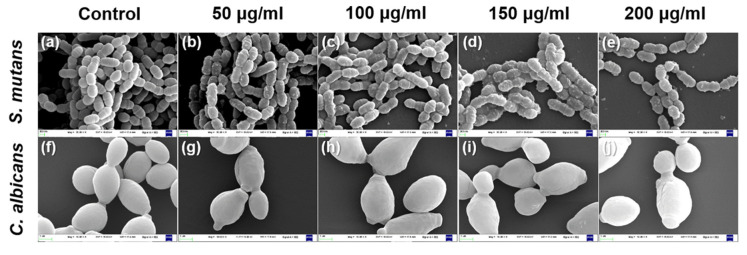
We aimed to evaluate the antimicrobial effects of extract on and and its biocompatibility for dental applications. The antimicrobial activity of the extracts at concentrations of 50, 100, 150, and 200 µg/mL was assessed using agar disk diffusion tests, counting the total number of colony-forming units (CFUs), spectrophotometric growth inhibitory assays, and microbial morphology observations using scanning electron microscopy (SEM; Merin, Carl Zeiss, Oberkochen, Germany). We measured the polyphenol and flavonoid contents of extracts using ultraviolet-visible spectrometry and the cytotoxicity of these extracts using an MTT (3-(4,5-Dimethylthiazol-2-yl)-2,5-diphenyltetrazolium bromide) assay. We identified that extracts had significant antimicrobial effects against and . The optical density of the experimental groups significantly decreased compared with that of the control group. SEM images revealed that the extract affected the morphology and density of and . The extract concentration of flavonoids, but not polyphenols, increased with increasing concentrations of the extract. Furthermore, cell viabilities were more than 70% for extracts with concentrations of 50 and 100 μg/mL. Naturally derived is biocompatible and exhibits an excellent antimicrobial effect against oral pathogens such as and . Thus, extracts can be used for the development of oral products that treat and prevent oral diseases.
我们旨在评估提取物对[具体菌种1]和[具体菌种2]的抗菌作用及其在牙科应用中的生物相容性。使用琼脂平板扩散试验、计算菌落形成单位(CFU)总数、分光光度法生长抑制试验以及使用扫描电子显微镜(SEM;德国奥伯科亨卡尔蔡司公司的Merin)观察微生物形态,评估了浓度为50、100、150和200μg/mL的[提取物名称]提取物的抗菌活性。我们使用紫外可见光谱法测量了[提取物名称]提取物中的多酚和黄酮含量,并使用MTT(3-(4,5-二甲基噻唑-2-基)-2,5-二苯基四氮唑溴盐)试验测量了这些提取物的细胞毒性。我们发现[提取物名称]提取物对[具体菌种1]和[具体菌种2]具有显著的抗菌作用。与对照组相比,实验组的光密度显著降低。SEM图像显示,[提取物名称]提取物影响了[具体菌种1]和[具体菌种2]的形态和密度。随着[提取物名称]提取物浓度的增加,黄酮类化合物而非多酚类化合物的提取物浓度升高。此外,浓度为50和100μg/mL的[提取物名称]提取物的细胞活力超过70%。天然来源的[提取物名称]具有生物相容性,并且对诸如[具体菌种1]和[具体菌种2]等口腔病原体表现出优异的抗菌作用。因此,[提取物名称]提取物可用于开发治疗和预防口腔疾病的口腔产品。