University of Tübingen, Germany.
Lang Speech. 2021 Sep;64(3):594-624. doi: 10.1177/0023830920943625. Epub 2020 Jul 27.
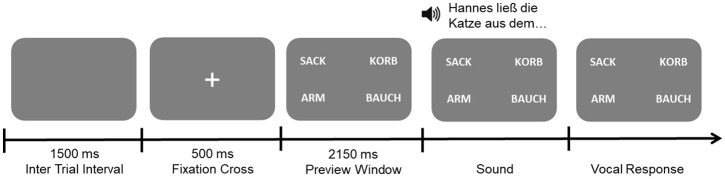
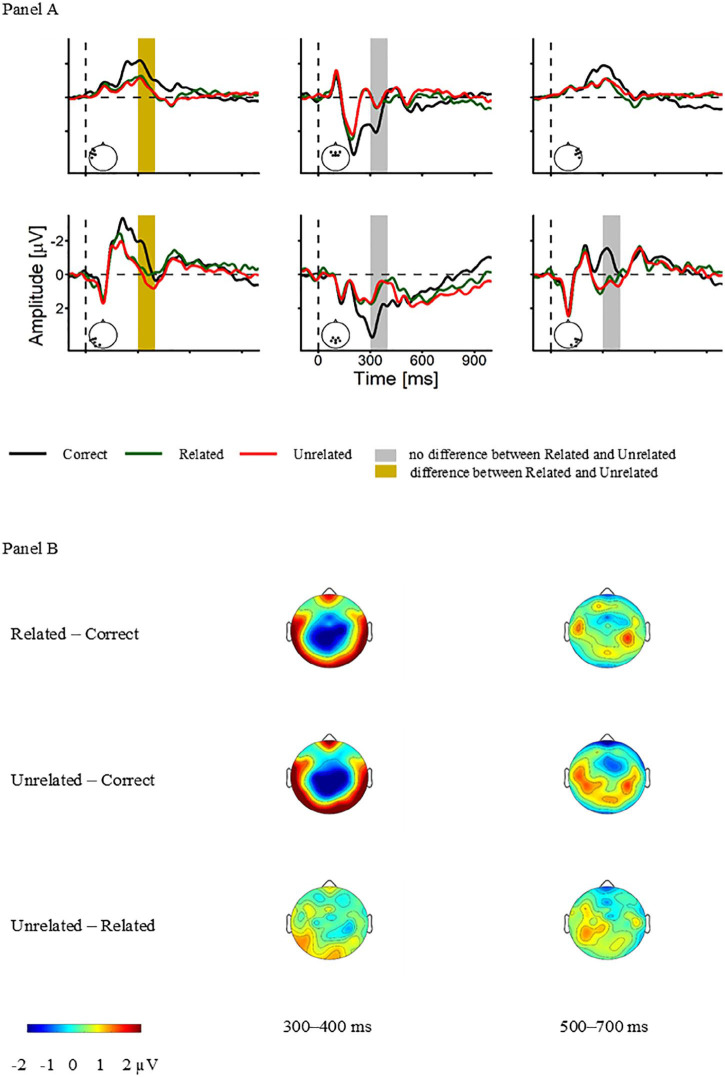
How the language processing system handles formulaic language such as idioms is a matter of debate. We investigated the activation of constituent meanings by means of predictive processing in an eye-tracking experiment and in two ERP experiments (auditory and visual). In the eye-tracking experiment, German-speaking participants listened to idioms in which the final word was excised (). Well before the offset of these idiom fragments, participants fixated on the correct idiom completion () more often than on unrelated distractors (). Moreover, there was an early fixation bias towards semantic associates () of the correct completion, which ended shortly after the offset of the fragment. In the ERP experiments, sentences (spoken or written) either contained complete idioms, or the final word of the idiom was replaced with a semantic associate or with an unrelated word. Across both modalities, ERPs reflected facilitated processing of correct completions across several regions of interest (ROIs) and time windows. Facilitation of semantic associates was only reliably evident in early components for auditory idiom processing. The ERP findings for spoken idioms compliment the eye-tracking data by pointing to early decompositional processing of idioms. It seems that in spoken idiom processing, holistic representations do not solely determine lexical processing.
语言处理系统如何处理习语等惯用语言是一个有争议的问题。我们通过眼动实验和两个 ERP 实验(听觉和视觉)研究了预测加工中成分意义的激活。在眼动实验中,德语参与者听了最后一个单词被删去的成语()。在这些成语片段结束之前,参与者比不相关的干扰项()更频繁地注视正确的成语完成()。此外,对正确完成的语义联想()存在早期的注视偏向,这种偏向在片段结束后不久就结束了。在 ERP 实验中,句子(口头或书面)要么包含完整的成语,要么成语的最后一个单词被一个语义联想词或一个不相关的词所取代。在两种模态中,ERP 反映了在几个感兴趣区域(ROI)和时间窗口中对正确完成的处理的促进。听觉成语处理中只有早期成分可靠地反映了语义联想的促进作用。口语成语的 ERP 发现通过指向成语的早期分解处理,为眼动数据提供了补充。在口语成语处理中,整体表示似乎并不单独决定词汇处理。