He Fei, Lycke Roy, Ganji Mehran, Xie Chong, Luan Lan
Department of Electrical and Computer Engineering, Rice University, 6100 Main Street, Houston, TX 77005, USA; NeuroEngineering Initiative, Rice University, 6500 Main Street, Houston, TX 77005, USA.
Department of Electrical and Computer Engineering, Rice University, 6100 Main Street, Houston, TX 77005, USA; NeuroEngineering Initiative, Rice University, 6500 Main Street, Houston, TX 77005, USA; Department of Biomedical Engineering, University of Texas at Austin, 107 Dean Keeton, Austin, TX 78712, USA.
iScience. 2020 Aug 21;23(8):101387. doi: 10.1016/j.isci.2020.101387. Epub 2020 Jul 20.
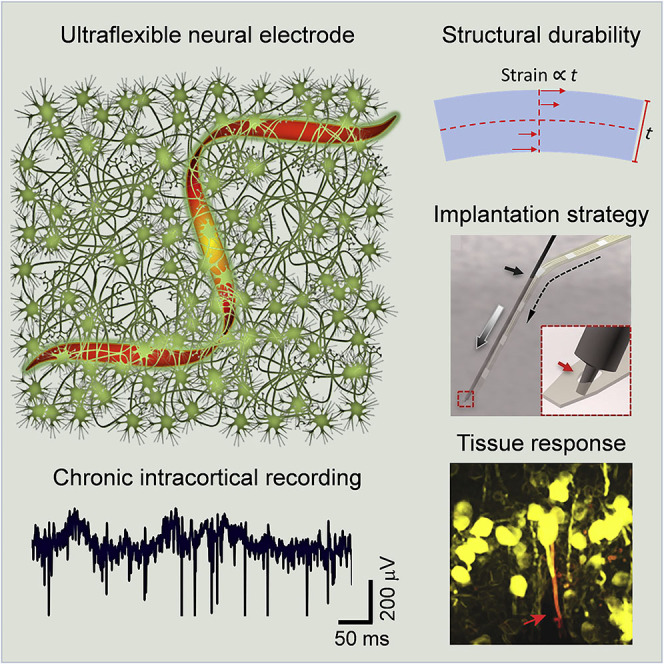
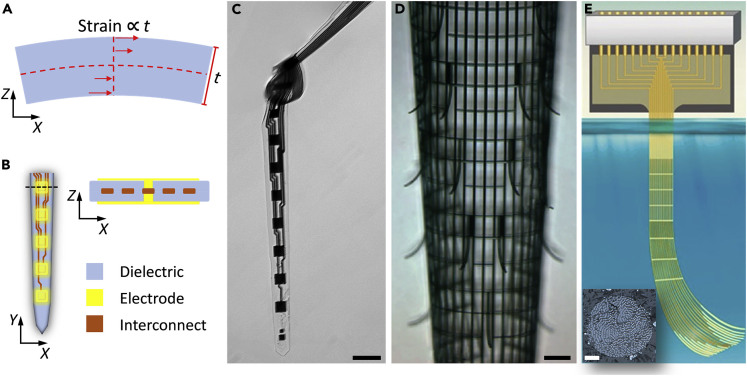
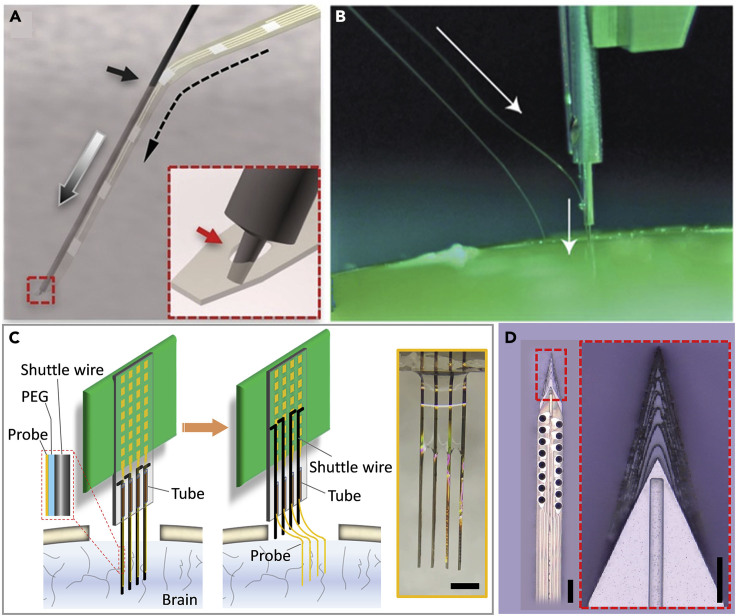
Implanted electrodes provide one of the most important neurotechniques for fundamental and translational neurosciences by permitting time-resolved electrical detection of individual neurons in vivo. However, conventional rigid electrodes typically cannot provide stable, long-lasting recordings. Numerous interwoven biotic and abiotic factors at the tissue-electrode interface lead to short- and long-term instability of the recording performance. Making neural electrodes flexible provides a promising approach to mitigate these challenges on the implants and at the tissue-electrode interface. Here we review the recent progress of ultraflexible neural electrodes and discuss the engineering principles, the material properties, and the implantation strategies to achieve stable tissue-electrode interface and reliable unit recordings in living brains.
植入式电极通过在体内对单个神经元进行时间分辨电检测,为基础神经科学和转化神经科学提供了最重要的神经技术之一。然而,传统的刚性电极通常无法提供稳定、持久的记录。组织-电极界面处众多相互交织的生物和非生物因素导致记录性能的短期和长期不稳定。使神经电极具有柔性为减轻植入物和组织-电极界面上的这些挑战提供了一种有前景的方法。在此,我们综述了超柔性神经电极的最新进展,并讨论了实现活脑稳定组织-电极界面和可靠单元记录的工程原理、材料特性和植入策略。